2026-07-21
Understanding PDLLA Fillers and Safe Application
Learn about PDLLA fillers, their benefits for skin regeneration and volume, potential side effects like granulomas, and safe injection techniques to minimize risks.


Hello,
This is Cheongdam SNU Plastic Surgery Clinic.
Today, we will share information about PDLLA fillers.
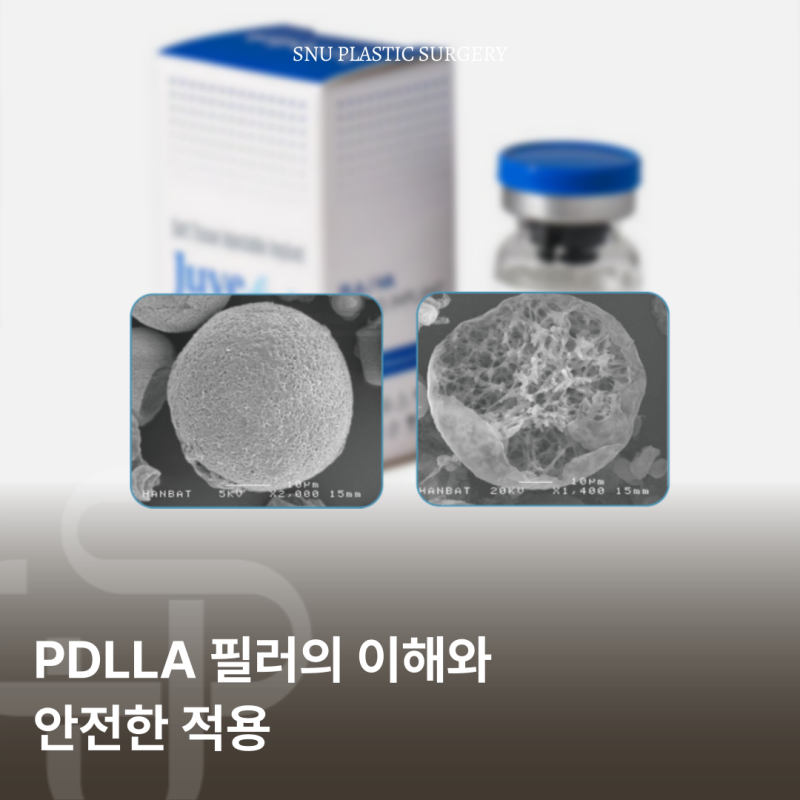
PDLLA fillers are receiving similar attention to past Sculptra (PLLA) or Ellansé (PCL) fillers, but they require a careful approach in terms of their characteristics and application.
Lessons from PDLLA and Past Fillers
PDLLA fillers, such as Juvelook, are manufactured as spherical, microporous particles, improving particle size and uniformity compared to PLLA.
They have the advantage of controlled degradation speed, which induces uniform collagen formation.
However, despite these improvements, non-inflammatory nodules (granuloma) and granulomatous reactions have been reported, requiring caution.
PLLA filler Sculptra was first used for HIV-associated facial atrophy treatment in 2004, then received FDA approval in 2009 and 2023, spreading in the market. However, some cases reported nodule or scar tissue formation.
Ellansé (PCL), despite its volume-enhancing effects, has also shown observations of edema or lymph-compressive edema when used in high doses.
PDLLA Precautions
🌟 Uncertainty of Immune Response
PDLLA lasts approximately 18-24 months in the body and improves skin elasticity through the following process:
After injection, macrophages phagocytose PDLLA particles
▼
Activation of NRF2 and IL-10 pathways
▼
Increased COL1A1, COL3A1, etc., through fibroblast stimulation
▼
Promotion of skin regeneration
Unlike the mechanical stimulation of hyaluronic acid (HA) fillers, this method relies on biological mediation.
🌟 Immune Response and Individual Differences
PDLLA stimulates macrophages and fibroblasts in vivo to regenerate collagen and improve skin elasticity, but due to the uncertainty of immune-mediated responses, results may vary from person to person.
These individual differences make it difficult to predict the treatment's effectiveness.
🌟 Application and Precautions by Area
Suitable Areas
Cheeks with abundant soft tissue (zona malaris)
Upper nasolabial folds
Areas requiring caution
Under-eye area and around the lips, where soft tissue is sparse, carry a risk of asymmetrical collagen accumulation.
Areas with frequent movement, such as the neck and around the mouth, carry a risk of filler displacement or lump formation.
Injection Techniques for Safe Application
The following techniques are recommended for the safe use of PDLLA fillers:
Hyperdilution Technique
Dilution with saline or lidocaine to broaden particle distribution and reduce the risk of nodules.
Gauntlet Technique
Multiple injections in thin layers from various directions to prevent localized over-accumulation.
Gradual Approach
Administering in 2-3 sessions at 4-6 week intervals to gradually induce an immune response.
Notes for Minimizing Risks
Patient Selection
Patients with a history of excessive inflammatory reactions or unrealistic expectations should be excluded from treatment.
Anatomical Approach
Apply restrictively to areas with a consistent thickness, such as the mid-face cheeks and upper nasolabial folds.

Combination Therapy
Combining with VYCROSS·HA fillers or laser treatments can achieve immediate effects and enhanced safety.
Post-procedure Monitoring
Observe filler distribution with ultrasound and monitor progress over several months to check for the occurrence of nodules or granulomas.
If abnormal findings are detected, early steroid or laser treatment is performed.
What can be expected from PDLLA fillers is skin regeneration and moderate volume improvement.
Since there are differences in immune responses among individuals, it is desirable to aim for about 50% gradual improvement.
PDLLA fillers should not be approached as a miraculous solution but as a tool to be used appropriately, based on the lessons learned from similar past fillers.
✔️ Homepage
✔️ KakaoTalk Channel (Click image below to navigate)


Frequently Asked Questions
What effects can be expected from PDLLA fillers?
PDLLA fillers can be expected to provide skin regeneration and moderate volume improvement. They work by stimulating macrophages and fibroblasts in the body to regenerate collagen and improve skin elasticity.
What side effects can occur after PDLLA filler treatment?
After PDLLA filler treatment, non-inflammatory nodules (granuloma) or granulomatous reactions have been reported, requiring caution. Nodule or scar tissue formation has also been reported with past PLLA fillers.
Which areas are suitable for PDLLA filler treatment?
PDLLA fillers are suitable for treatment in areas with abundant soft tissue, such as the cheeks (zona malaris) and the upper nasolabial folds. These areas have a relatively consistent thickness, allowing for safe application.
Which areas should be cautious when performing PDLLA filler treatment?
Areas with sparse soft tissue, such as under the eyes and around the lips, should be treated with caution due to the risk of asymmetrical collagen accumulation. Additionally, areas with frequent movement, such as the neck or around the mouth, carry a risk of filler displacement or lump formation.
What are the safe injection techniques for PDLLA fillers?
For safe injection, the Hyperdilution technique, Gauntlet technique, and a gradual approach involving 2-3 administrations at 4-6 week intervals are recommended. These methods help reduce the risk of side effects.
How should post-procedure care be managed after PDLLA filler treatment?
After the procedure, filler distribution should be observed with ultrasound, and progress should be monitored for several months to check for the occurrence of nodules or granulomas. If abnormal findings are detected, early steroid or laser treatment can be performed.