2026-07-21
Vascular Occlusion Symptoms and Treatment After Filler Injections
Learn about the symptoms, dangers, and immediate treatments for vascular occlusion after filler injections, emphasizing the importance of prompt medical attention and prevention.

Hello.
This is SNU Plastic Surgery.
Today, we will discuss
the symptoms and management of vascular problems (vascular occlusion)
that can occur after filler injections.
⚠️ The meaning of dull skin sensation after filler injection

The nasal tip and bridge are high-risk areas where vascular occlusion is particularly common.
The lateral nasal artery and angular artery, which supply these areas, are terminal vessels, and they can easily become blocked if filler is injected into the blood vessel or if the vessel is compressed.
A dull sensation suggests that the blood flow and oxygen supply to the affected skin tissue may already be compromised.
🔍 Why vascular occlusion is dangerous
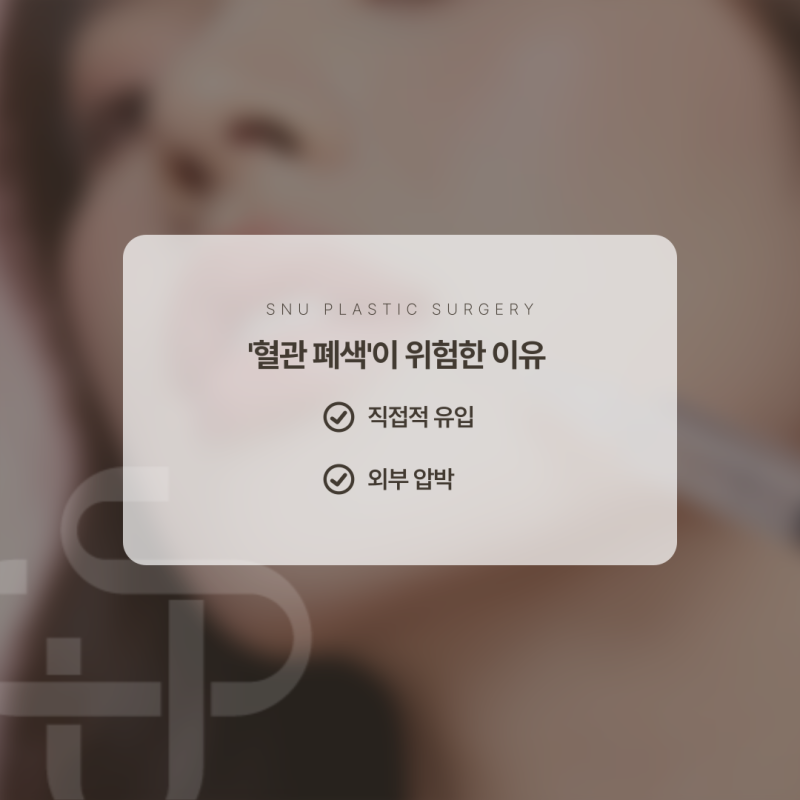
Vascular occlusion is a phenomenon where filler material directly blocks a blood vessel (intravascular injection) or where injected filler compresses surrounding blood vessels, cutting off blood flow.
📍 Direct Intravascular Injection:
This occurs when the needle penetrates a blood vessel, and filler enters and blocks the vessel.
📍 External Compression:
This happens when a large amount of filler is injected into one area, physically pressing on surrounding blood vessels.
If tissues do not receive oxygen and nutrients due to this, skin necrosis (tissue death) can occur. Rarely, blood flow can reverse into the eyes or brain, leading to serious complications such as vision loss or cerebral infarction.
🚨 Symptoms to check immediately: Emergency signals
Symptoms of vascular occlusion appear immediately after the procedure or within a few hours.
If any of the following symptoms are observed, you must contact or visit a hospital immediately.
Symptom | Description and Specifics |
Severe Pain | • During or immediately after the procedure, pain stronger than expected may occur. • If a local anesthetic was used, the pain might be temporarily masked, requiring caution. |
Skin Discoloration | ✅ Blanching: The skin turns white or grayish-white due to blocked blood flow. ✅ Bluish Discoloration: Over time, due to blood stagnation, the skin turns bluish or dark purple. |
Sensory Abnormalities | • Dull sensation such as tingling, numbness, or prickling may appear, and it needs to be differentiated from sensory changes caused by local anesthesia. |
Decreased Skin Temperature | • The skin temperature in the affected area becomes noticeably lower than in surrounding areas. |
Skin Pattern Changes | • An irregular, net-like discoloration (Livedo pattern) may be observed on the skin. |
🏥 Immediate Hospital Treatment: Time to save viable tissue
If vascular occlusion is suspected,
the golden hour is very short.
Hospitals promptly perform the following treatments:
1. Hyaluronidase Injection
- This treatment dissolves hyaluronic acid filler to reopen blocked blood vessels.
- The sooner it is injected after symptoms appear, the higher the chance of saving the tissue.
- It is not effective for non-hyaluronic acid fillers.
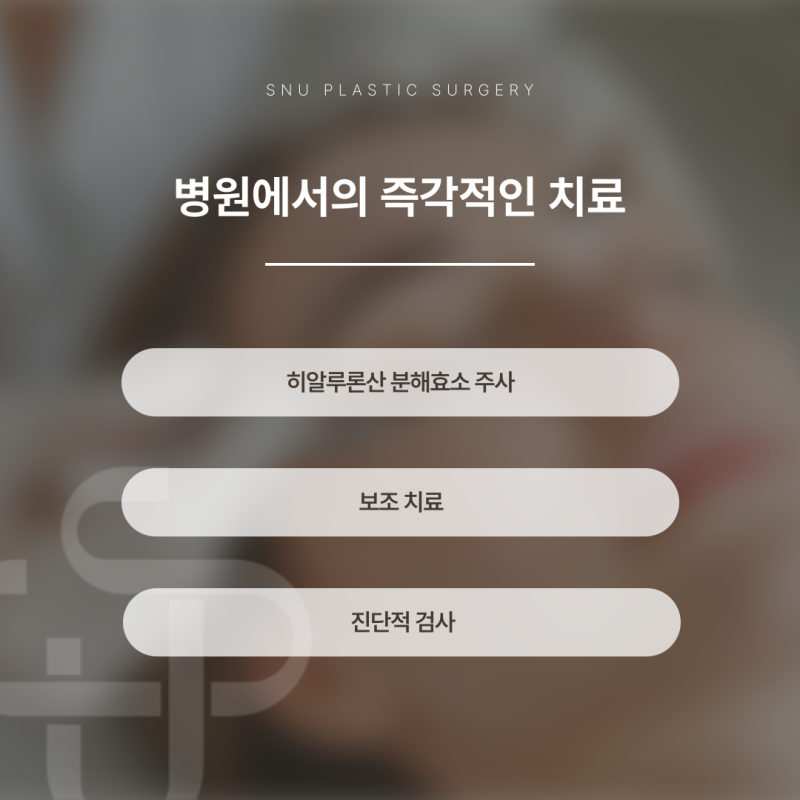
2. Supportive Treatment
- Peripheral vasodilators:
(e.g., nitroglycerin ointment) Widen blood vessels to improve blood flow.
- Antiplatelet/Anticoagulants:
(e.g., aspirin) Inhibit clot formation.
- Antibiotics:
Prevent secondary infections.
- Steroids:
Alleviate severe inflammation.
3. Diagnostic Tests
- Doppler Ultrasound:
Recent studies show that ultrasound can accurately locate vascular occlusion and confirm blood flow status in real-time, allowing for more precise treatment.
💡 Prevention is the best treatment! Choosing a safe procedure

To reduce risks,
check the following before and after the procedure:
✅ Choosing a Medical Professional
It is crucial to be treated by an experienced specialist who is well-versed in anatomy.
Choose a clinic that adheres to safety protocols, such as using blunt-tipped cannulas or performing aspiration tests before injection.
✅ Awareness of High-Risk Areas
Be aware that nasolabial folds, nasal tip, nasal bridge, and glabella (between eyebrows) are areas requiring special caution.
✅ Post-Procedure Observation
It is necessary to stay at the clinic for the recommended time (usually 30 minutes to 1 hour) after the procedure to be observed for any unusual symptoms.
Persistent dull sensation after filler injection is a signal that should never be overlooked.
The time spent waiting and thinking ‘it will be fine’ can determine the survival of the tissue.
If these symptoms appear,
it is advisable to immediately contact your doctor or the nearest hospital emergency room for a professional evaluation.
Website
📌 KakaoTalk Channel (Click image below to navigate)