2026-07-21
SNU Plastic Surgery: Is Ptosis Surgery Always the Answer? The Efficacy of ‘Ptosis Botox’
Explore ptosis symptoms and non-surgical treatments like ptosis Botox. Learn how Botox can rebalance eyelid muscles for pseudoptosis, offering an alternative to surgery for suitable candidates.


Hello,
This is SNU Plastic Surgery.
Today, we will discuss ptosis symptoms and a non-surgical treatment method:
ptosis Botox injections.
1. Ptosis may not be just ‘sagging’

Ptosis refers to a condition where the upper eyelid sags, preventing the eye from opening properly.
It is generally known to occur due to weakened strength in the muscle that opens the eye (levator palpebrae superioris), so surgical correction is common.
However, in some patients, especially middle-aged and older individuals, the muscle that closes the eye (orbicularis oculi) can be excessively strong, leading to ‘pseudoptosis’ where the eye cannot open properly.
In such cases, adjusting muscle balance using Botox can be an alternative.
2. Addressing Ptosis with Botox: Principles and Mechanism
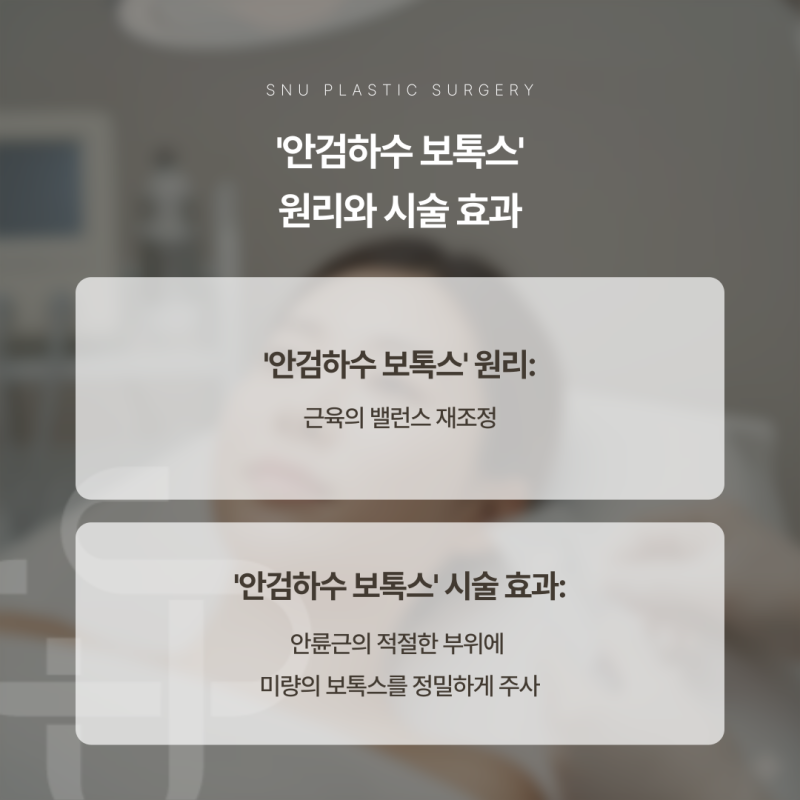
The principle of ptosis Botox treatment is ‘muscle balance readjustment’.
This idea was inspired by existing treatments for blepharospasm.
📍 Fundamental Principle:
The raising and lowering of the eyelid are controlled by the balanced interaction between the muscle that opens the eye (levator palpebrae superioris) and the muscle that closes the eye (orbicularis oculi).
If the orbicularis oculi muscle is relatively too strong, it can create the appearance of ptosis, where the eye does not open well.
📍 Treatment Effect:
A small amount of Botox is precisely injected into the appropriate area of the orbicularis oculi muscle, temporarily adjusting its strength.
This creates an effect as if the muscle that opens the eye has become relatively stronger, making the eyelid appear more lifted.
📍 Application of Blepharospasm Treatment:
This method is an application and advancement of the principle of Botox treatment used to alleviate symptoms in patients with blepharospasm (involuntary eyelid spasms) by relaxing the excessively contracting orbicularis oculi muscle.
Patients with blepharospasm experience symptoms like ptosis or eye twitching due to strong contraction of the orbicularis oculi muscle. The expertise in controlling this has been integrated into improving ptosis.
3. Who is it suitable for? Advantages and Precautions
✅ Suitable Cases
1) Pseudoptosis judged to be caused by a strong orbicularis oculi muscle.
2) Early or mild ptosis where surgery is burdensome.
3) Ptosis accompanied by blepharospasm symptoms.
4) Those desiring natural improvement with minimal recovery time.

⚠️ Points to Consider
(Limitations and Precautions)
1) Significant individual differences.
The degree and duration of effect (usually 3-6 months) vary depending on muscle condition, strength balance, and skin condition.
2) Not applicable to all types of ptosis.
It is difficult to be a fundamental solution for ‘true ptosis’ where the muscle that opens the eye is inherently weak.
3) Requires precise diagnosis and skilled procedure.
The results can vary greatly depending on which part of which muscle, and how much quantity is injected, thus requiring consultation and procedure by a specialist well-versed in facial anatomy.
4) Possibility of temporary side effects.
Bruising at the injection site, temporary weakening of surrounding muscles (e.g., eyebrows may appear raised) can occur, but most are temporary.
4. SNU Plastic Surgery's Approach: Customized Muscle Balance Treatment
At SNU Plastic Surgery, we thoroughly analyze each patient's eyelid condition, not just from a simple aesthetic perspective, but from the viewpoint of muscle function and balance.
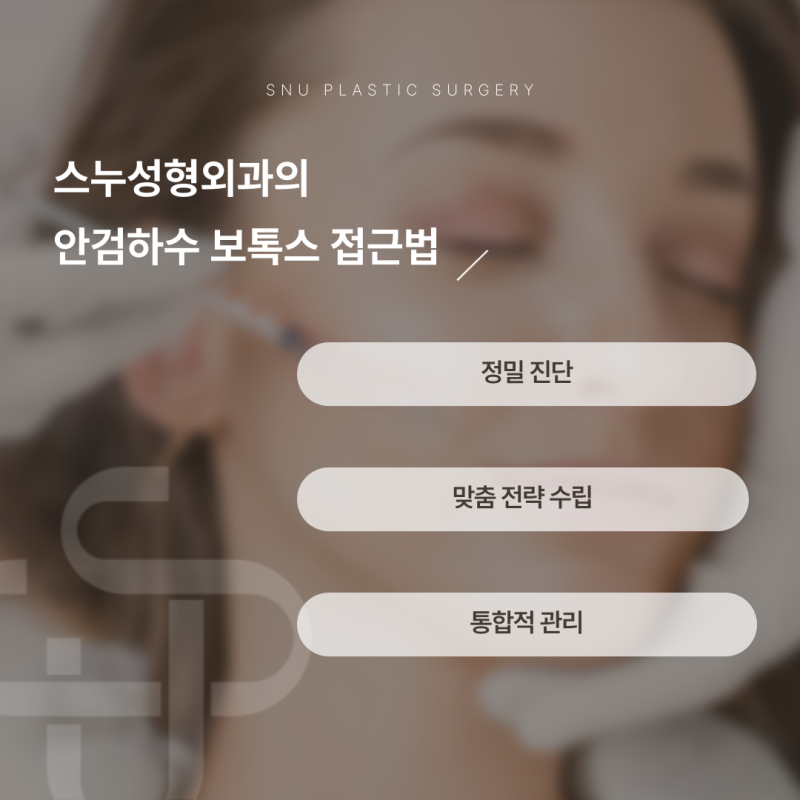
1) Precise Diagnosis
We carefully evaluate whether the underlying cause of ptosis is ‘weakness of the muscle that opens the eye’, ‘strength of the muscle that closes the eye’, or a combination of both.
2) Customized Strategy Formulation
Depending on the diagnosis, surgery might be the best option, or non-surgical muscle balance adjustment through Botox might be more suitable.
Especially in the latter case, based on accumulated clinical experience and expertise in blepharospasm treatment, we design the injection sites and dosages tailored to each individual patient.
3) Integrated Management
If necessary, after adjusting muscle tension through Botox injections, we can observe the results and collectively decide whether surgery is ultimately required.
Ptosis can never be explained by a single cause.
When viewed from the new perspective of a delicate balance between muscles,
a path to effective approaches beyond surgery opens up.
Improving ptosis with Botox is a non-surgical option that creatively applies the principles of existing disease treatments, and it can provide satisfactory results, especially for suitable candidates.
However, this is not a panacea but a customized treatment that must be performed under accurate diagnosis.

If your eyelids feel heavy,
we recommend listening to the story of the muscles hidden behind the simple sagging.
SNU Plastic Surgery is committed to understanding each patient's unique facial structure and function, and providing assistance through safe and natural methods.
*The treatments introduced in this article are for general information purposes only, and the appropriate treatment may vary depending on the individual patient's condition.
For accurate diagnosis and treatment, direct consultation with a specialist is essential.
Homepage
📌 KakaoTalk Channel (Click image below to navigate)