2026-07-21
Scar Revision Surgery, The Art of ‘Improvement’: Realistic Expectations and Approaches
Scar revision surgery aims to significantly improve the appearance of scars, making them less noticeable rather than completely removing them. This article explains why complete removal is impossible, outlines the goals and methods of scar revision, and emphasizes the critical role of post-operative care, including silicone treatment, laser therapy, and sun protection, for optimal results.

Hello,
This is SNU Plastic Surgery Clinic in Cheongdam.
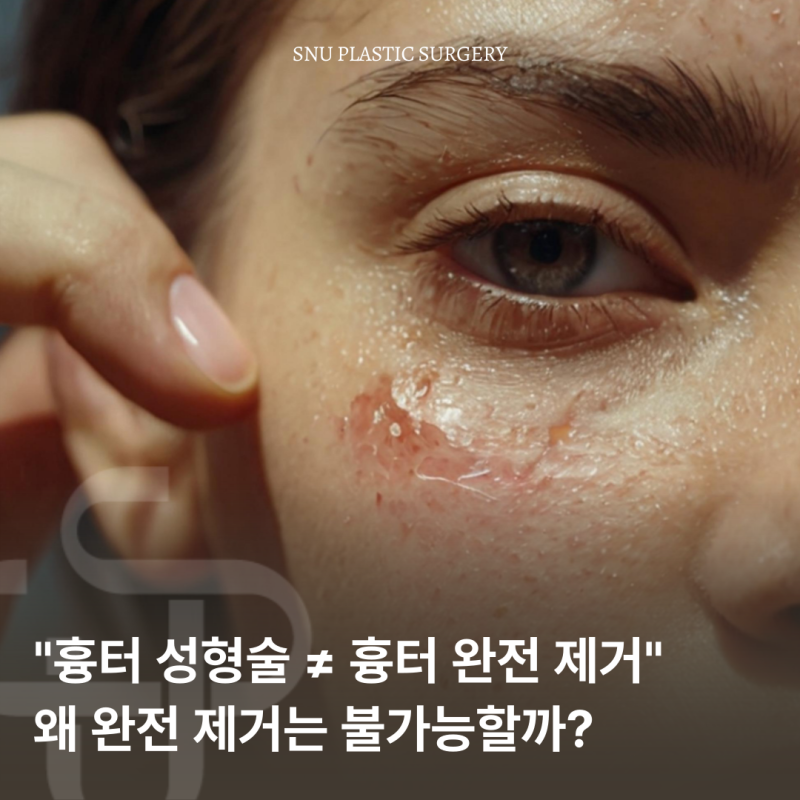
Many people often misunderstand that
‘scar revision surgery = complete scar removal’.
However, this differs from an important truth.
Once a scar forms,
it is absolutely impossible
to return to the original skin.
The true goal of surgical scar revision
is to improve the scar to be as inconspicuous as possible,
making it look natural and aesthetically pleasing
to the naked eye from a conversational distance (about 1 meter).
#1. Why is complete scar removal impossible?
The Nature of Scars
Fibrous tissue (collagen) formed during the wound healing process
is fundamentally different from normal skin in terms of structure, pigmentation, and flexibility.
The Body's Response
Surgery itself creates a new wound, so even with the best suturing techniques,
a certain degree of new scarring will inevitably remain.
Plastic surgery is a process of creating a scar that is much better
and less aesthetically prominent than the original.
#2. Key Goals and Indications for Scar Revision Surgery
Plastic surgery targets scars with the following issues.
The goal is not ‘complete removal’ but ‘optimized improvement’.
1) Excessively Wide Scars
Narrows the width of the scar, making it a fine and clear line.
2) Scars Misaligned with Skin Crease Lines
Scars that cross the natural creases of the face or the tension lines of the body's skin
are realigned with these lines to make them less noticeable.
3) Contracted Scars
Scars that cause skin pulling due to burns, etc., and restrict joint function or movement
are released to improve both function and appearance.
4) Uneven or Depressed Scars
The surface is flattened or depressed areas are filled to improve overall skin texture.
5) Scars with Severe Pigmentation Abnormalities
Excessively red or bluish-black scars are removed and re-sutured,
providing an opportunity to alleviate pigmentation issues.
#3. Main Surgical Methods: Approaches Tailored to Scar Characteristics
1) Simple Excision and Re-closure
This is the most common method, where irregular or wide scars
are neatly excised, and then the skin is precisely aligned using fine suturing techniques
to create a new, finer scar line.
Aligning the direction with the skin tension lines is key.
2) Z-plasty
The skin is incised in a Z-shape, and triangular skin flaps
are transposed and sutured.
It is primarily used to release contractures or to change the direction of scars
that have an angle close to the skin crease lines.
While the length of the scar increases, the effects of contracture relief and direction improvement are significant.
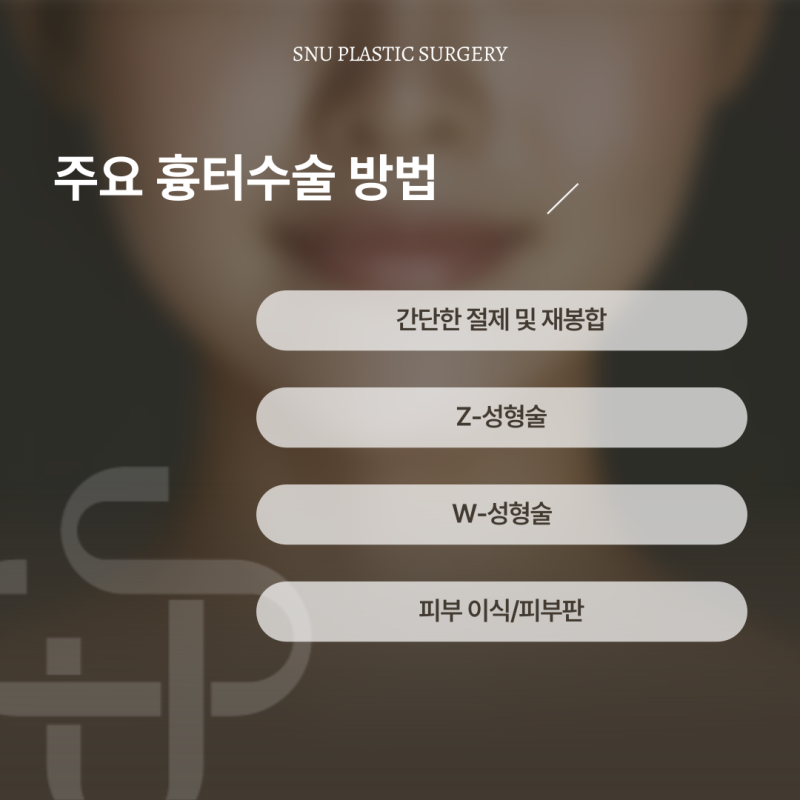
3) W-plasty
The edges of the scar are excised in a W-shaped zigzag pattern.
This is useful for softening the boundary and making a straight scar less noticeable
when it crosses natural skin crease lines.
4) Skin Graft / Flap
After removing very wide or severely contracted scars,
the defect is filled using skin from another area (graft) or
surrounding skin/tissue (flap).
This method is more complex and can result in new scars,
but it is used when functional recovery is essential.
#4. Half the Success, and Completion: Thorough Post-Operative Care (Aftercare)
The end of surgery is not the end of scar treatment!
It is no exaggeration to say that post-operative care determines more than 50% of the outcome.
1. Suture Line Management
Infection Prevention:
Keep the wound clean and apply medication as directed by the doctor.
Tension Management:
Use special tapes (micropore tape) or supports
to minimize tension on the new scar.
This prevents the scar from widening.
Suture Removal Timing:
Sutures must be removed at the appropriate time determined by the doctor.

2. Silicone Treatment (Silicone Gel/Sheets)
Standard treatment for scar management
Mechanism of Action:
By moisturizing, maintaining temperature, and providing pressure to the scar,
it regulates collagen production and suppresses excessive hypertrophy.
How to Use:
Start using continuously for at least 12 hours a day (preferably 24 hours)
immediately after the sutures are removed and the skin has completely healed (usually 1-2 weeks later).
Consistent use for several months is necessary to achieve maximum effect.
3. Pressure Therapy
Especially for hypertrophic scars or those with a tendency towards keloids,
special compression garments or silicone pads are used to apply continuous and uniform pressure to the scar,
preventing it from thickening and hardening.
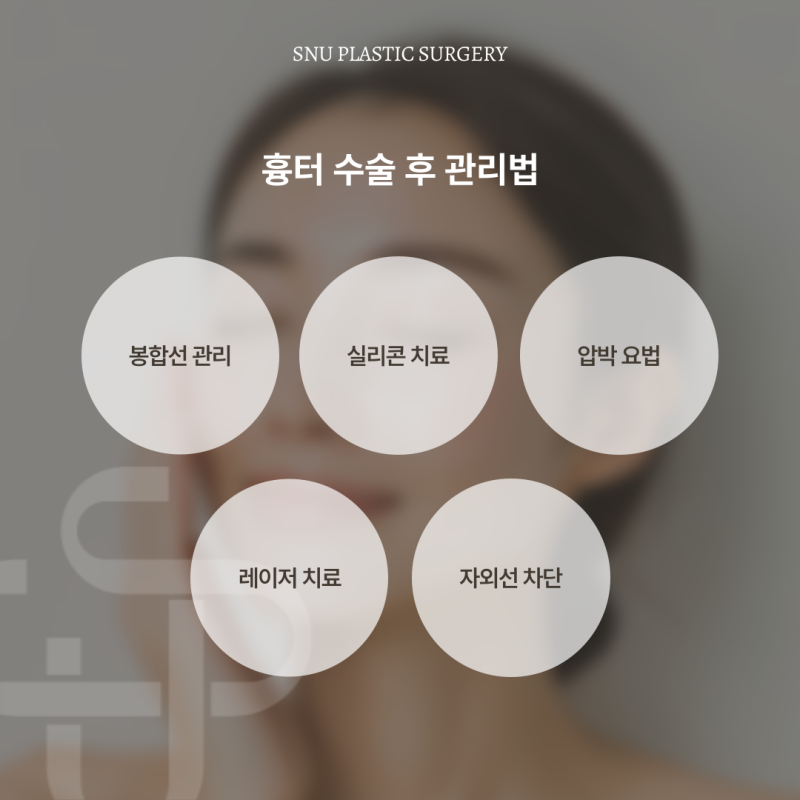
4. Laser Therapy
The crucial final stage of post-operative care
Generally starts 4-6 weeks after surgery, when the new scar begins to stabilize,
and is performed over several sessions (usually 3-6 times or more).
It quickly eliminates dark pigmentation or redness (erythema) of the new scar,
and prevents/treats hyperpigmentation.
It smooths uneven surfaces and promotes the reconstruction of scar tissue,
improving texture.
It can help suppress the thickening and hardening of scars.
If surgery optimizes the shape and direction of the scar,
laser treatment refines the color and texture to be closer to normal skin,
making it an essential step that significantly enhances the final aesthetic result.
5. Sun Protection
New scars are very sensitive to UV rays.
Avoid direct sunlight, and always apply SPF 30 or higher sunscreen
thoroughly to the new scar.
UV rays can make scars redder, brown, or darker (hyperpigmentation),
which can undermine the effects of surgery and laser treatment.
This must be done thoroughly for at least 6 months to 1 year, or until the scar turns completely white.
#5. Realistic Expectations and a Comprehensive Approach

Scar revision surgery is not a magic eraser.
‘Complete removal’ is impossible, and ‘maximum improvement’ is the goal.
The doctor analyzes the problems of the existing scar (width, direction, contracture, shape)
and selects the most appropriate surgical technique.
However, it doesn't end with surgery alone!
Post-operative care,
especially consistent silicone treatment, timely laser treatment,
and above all, thorough sun protection,
are as important as the surgery itself in determining the final outcome.
Scar improvement is a journey that requires patience.
Consulting with a plastic surgeon to set realistic expectations tailored to your scar characteristics
and establishing a comprehensive post-operative care plan together
is the shortcut to achieving beautiful and natural results.
While scars may not completely disappear,
improving them to a level where they are no longer noticeable and you feel comfortable in daily life
is the true success of scar revision surgery.
✔️ Website
✔️ KakaoTalk Channel (Click image below to go)