2026-07-21
PRP vs. Blood Stem Cells vs. SVF Stem Cell Therapy: Types and Differences
Explore the differences between PRP, blood stem cell, and SVF stem cell therapies, including their mechanisms, applications, and regulatory considerations in regenerative medicine.

Hello,
This is Dr. J from Cheongdam SNU Plastic Surgery Clinic.
Recently, regenerative medicine procedures based on autologous blood using centrifugation technology have surged in popularity, leading to increased interest in PRP, blood stem cell, and adipose-derived SVF therapies.
These three treatments share the common goal of utilizing the body's natural healing mechanisms, but they exhibit distinct differences in cell composition, mechanism of action, and indications.
Today, we will analyze the scientific background and current application status of stem cell therapies gaining attention in the domestic clinical field.
# Differences Among the Three Treatment Methods
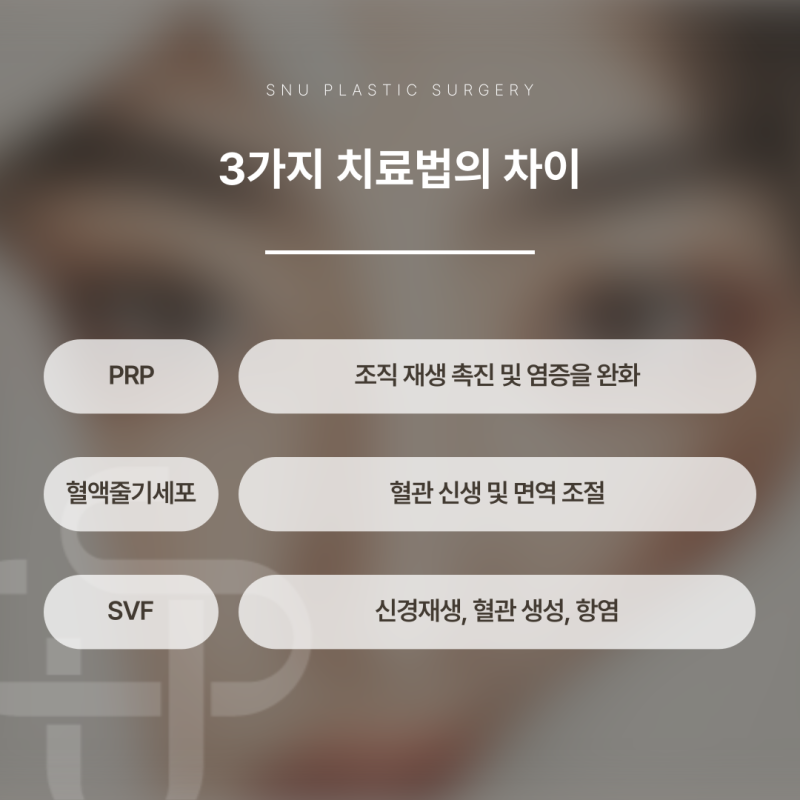
1. PRP
(Platelet-Rich Plasma)
PRP is rich in highly concentrated platelets (3-7 times the baseline concentration) and growth factors separated from blood, but contains negligible levels of stem cells.
🔗 Extraction Method:
Approximately 20cc of the patient's blood is drawn → Platelets are concentrated using a centrifuge → The procedure can be performed within 30-90 minutes.
✅ Main Action:
Promotes tissue regeneration and reduces inflammation through the secretion of over 3,000 types of growth factors.
⚠️ Indications:
- Tennis elbow/golf elbow (recognized as a new medical technology)
- Osteoarthritis, tendinitis, ligament injuries
- Skin regeneration (whitening, wrinkle improvement, pigmentation management, etc.), hair loss treatment
2. Blood Stem Cells
Primarily hematopoietic stem cells (HSCs), mainly involved in blood production.
🔗 Extraction Method:
Peripheral blood or bone marrow is collected → Cultured in a laboratory (takes 2-3 weeks) → Re-injected.
✅ Main Action:
Angiogenesis and immune modulation.
⚠️ Indications:
- Treatment of intractable blood diseases (primarily transplant therapy)
- Expected systemic immunomodulatory effects when administered intravenously (research stage)
Some clinics use the term ‘blood stem cells’ to perform procedures at a higher cost than PRP, without the 2-3 week culture process.
Some claim to ‘promote the proliferation of a small number of contained stem cells’ through centrifugation alone, but without culture, the concentration of mesenchymal stem cells (MSCs) is less than 100-1,000 cells per 1 mL. This is insufficient to achieve systemic therapeutic effects, such as those from intravenous injections, rather than localized treatment.
A 2020 Seoul National University study and others demonstrated that 2-3 weeks of culture are essential to isolate CiMS (circulating pluripotent stem cells) from 10 mL of peripheral blood, and that it is impossible with centrifugation alone.
Therefore, the stem cell content of blood centrifugates is less than 0.001%, and cannot be called ‘cell therapy’.
3. SVF Stromal Vascular Fraction
Structure:
A heterogeneous cell population derived from adipose tissue
- Mesenchymal stem cells (MSCs, 1-5%)
- Endothelial cells, preadipocytes, macrophages, etc.
🔗 Extraction Method:
Liposuction (abdomen/hips) → Collagenase treatment → Centrifugation → Procedure within 4 hours.
✅ Main Action:
- Multi-differentiation potential (differentiation into bone/cartilage/fat cells)
- Nerve regeneration, angiogenesis, anti-inflammatory effects
⚠️ Indications:
- Arthritis, ligament injuries
- Autoimmune diseases (Crohn's disease, multiple sclerosis)
- Neurodegenerative diseases (Parkinson's disease, ALS)
- Promotes wound healing and used in aesthetic skin procedures
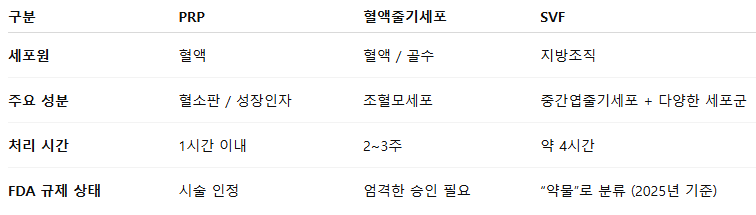
📌 Comparison of Treatment Characteristics
# Effects and Mechanisms of Local Injection vs. Intravenous Injection
📍 Local Injection Application
✅ PRP
Direct injection into the damaged area under ultrasound guidance is effective.
- For tennis elbow treatment, pain reduction effect after 3 months compared to steroids.
- For knee osteoarthritis, sustained effect after 6 months compared to hyaluronic acid.
✅ SVF
Intra-articular injection promotes cartilage regeneration and reduces inflammation.
- Nerve regeneration effect in spinal cord injury models (clinical trials ongoing).
📍 Intravenous Injection Application (Expected Systemic Effects)
✅ Blood Stem Cells
Used for autoimmune diseases due to systemic immunomodulatory effects.
Difficulty crossing the blood-brain barrier → Limitations in treating neurological diseases.
✅ SVF
Pulmonary embolism risk reported with intravenous administration.
Has anti-inflammatory effects, but low target tissue delivery rate.
✅ PRP
Intravenous injection is not recommended (risk of thrombus formation).
# Limitations and Clinical Considerations
📍 PRP
- Duration of effect:
Re-treatment needed after 3-12 months.
- Concentration variation:
Platelet concentration varies by 3-7 times depending on centrifugation technology.
📍 Blood Stem Cells
- Risk of culture contamination, safety guaranteed only in GMP facilities.
- Cultured cell preparations are subject to the ‘Pharmaceutical Affairs Act’ (Korean regulations).
📍 SVF
- FDA regulates collagenase treatment as drug manufacturing.
- Few side effects with local injection, but concerns about complications with intravenous injection.
- Ethical issues: many cases of exaggerated advertising for unapproved procedures.

💡 Tips for Choosing a Procedure in Korea
✅ PRP
Check the specifications of the hospital's centrifuge (use sterile, single-use kits).
✅ SVF
Under the ‘Medical Service Act’, if there is no culture, it is classified as ‘cell transplantation’ rather than stem cell therapy/procedure, and the doctor's experience is essential.
✅ Intravenous Injection
Systemic administration of blood stem cells (after culture) and SVF is not recommended outside of clinical trials.
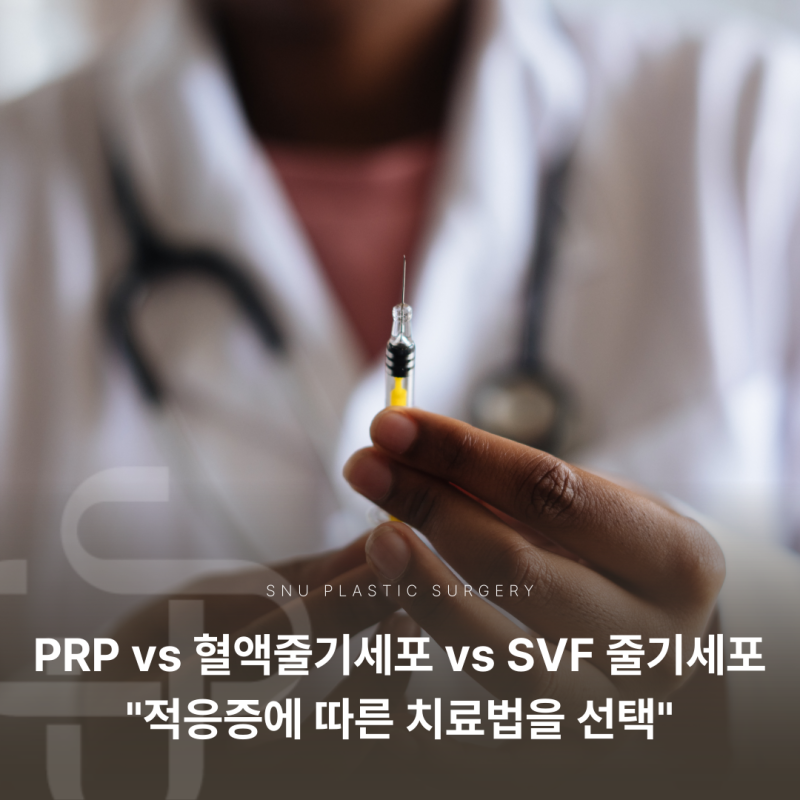
Choose the treatment method according to the indication.
Musculoskeletal injuries (arthritis, ligaments), hair loss, skin regeneration
↓
PRP
(Excellent cost-effectiveness)
Tissue defects/chronic inflammatory diseases, skin regeneration
↓
SVF
(Synergy of various cell populations)
Blood diseases/immune modulation
↓
Blood Stem Cells
(Intravenous injection after culture)
Currently in Korea,
PRP is a highly accessible option, and SVF is a promising next-generation treatment despite regulatory barriers.
Regardless of the procedure you are considering,
it is crucial to carefully check the medical staff's proficiency and the equipment level, and to be wary of exaggerated effects.
Given the rapid pace of regenerative medicine, keep in mind that the regulatory environment and technological landscape may change significantly within the next 2-3 years.
Homepage
📌 KakaoTalk Channel (Click image below to navigate)

Frequently Asked Questions
What diseases is PRP mainly used for?
PRP is mainly used for treating tendinitis such as tennis elbow and golfer's elbow, ligament injuries, and degenerative arthritis. It can also be used for skin regeneration (whitening, wrinkle improvement, pigmentation management) and hair loss treatment.
How does blood stem cell therapy differ from PRP?
Blood stem cells primarily involve hematopoietic stem cells in blood production and are used to treat intractable blood diseases. PRP is rich in platelets and growth factors but has minimal stem cells, differing in mechanism of action and indications.
What are the characteristics of SVF stem cells?
SVF stem cells are a diverse group of cells derived from adipose tissue, including mesenchymal stem cells (MSCs). They have multi-differentiation potential, nerve regeneration, angiogenesis, and anti-inflammatory effects, and are applied to conditions such as arthritis, ligament injuries, and autoimmune diseases.
What should be noted when undergoing PRP treatment in Korea?
When undergoing PRP treatment, it is important to check the centrifuge specifications of the hospital and ensure that sterile, single-use kits are used. Additionally, re-treatment may be necessary after 3 to 12 months for sustained effectiveness.
Is intravenous stem cell therapy safe?
No, intravenous administration of blood stem cells (after culture) and systemic SVF is not recommended outside of clinical trials. Pulmonary embolism risk has been reported with intravenous SVF, and PRP is not recommended for intravenous injection due to the risk of thrombus formation.