2026-07-21
My Experience Training at Stanford Hospital, USA: Reflections on the Korean Medical Training Environment
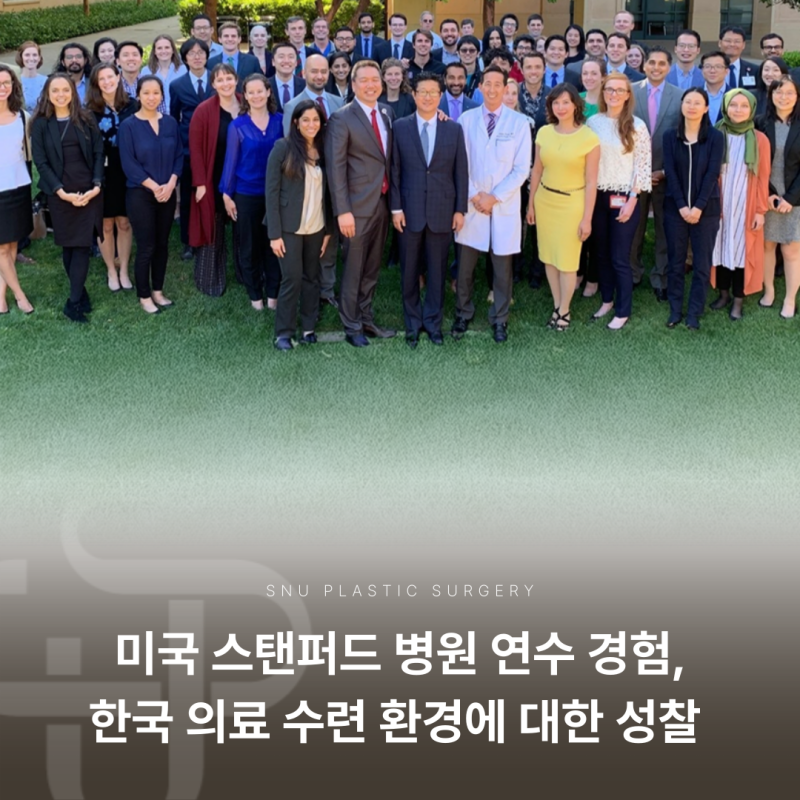
Dr. J of Cheongdam SNU Plastic Surgery Clinic shares insights from his 2019 Stanford University Hospital training, comparing US and Korean medical residency cultures and proposing improvements for Korea's system.
Hello,
This is Dr. J from Cheongdam SNU Plastic Surgery Clinic.
Recently, I had the opportunity to hear about the life of a resident at a university hospital from a doctor working as a paid doctor.
According to them, the residency training environment has significantly improved compared to the past, only recently, after experiencing the medical-government dispute.
Hearing this, my experience during my plastic surgery fellowship at Stanford University Hospital in 2019 came vividly to mind.
The training methods of American residents I observed then were quite different from those in Korea and provided many insights.
In this article, based on that experience, I would like to propose changes for the development of our medical training environment by comparing the training culture differences between Korea and the US.
# A Different World Witnessed at Stanford University Hospital
📍 Structural Differences in the Training Process
During my fellowship at Stanford University Hospital, I was deeply impressed by the systematic training system for American residents.
Even after their daily work, they would go straight to the library to thoroughly prepare for the surgical cases scheduled for the next day.
For every case, they would proactively search for papers and refer to textbooks to build up relevant knowledge.
📍 Relationship between Professors and Residents
If training in Korea was passive education, here it was a place of active learning.
In the operating room, they questioned and answered each other, discussing cases as equal colleagues with the professors.
It was truly impressive to see professors humbly answer residents' questions, and sometimes, if they didn't know something themselves, they would say, ‘Let me see that paper too.’
# Comparing Training Cultures in Korea and the US
American residents trained with their minds, while we trained with our bodies.
👉🏻 Fundamental Differences in Learning Attitudes
Residency training in Korea was a process endured with the body.
I remember staying up all night seeing patients, assisting professors, and being desperate to get a single piece of advice.
We regarded professors only as those who give instruction, and we were in a passive position to receive it.
In contrast, American residents engaged in active learning based on prior preparation.
They entered the operating room with a complete understanding of the theoretical background for the case, even before the surgery.
The operating room became a place to gain additional knowledge and to experience and confirm theory in practice.
👉🏻 Balance between Work Environment and Self-Development
It was rare to see Stanford University Hospital residents relaxing, except during vacation periods.
After work, they immediately headed to the library to prepare for the next day, week, or month.
This culture was possible not merely because residents were expected to learn by expending physical energy and time, providing cheap labor, but because the system guaranteed time for self-development.
# The Reality of the Korean Medical Training Environment and the Need for Change
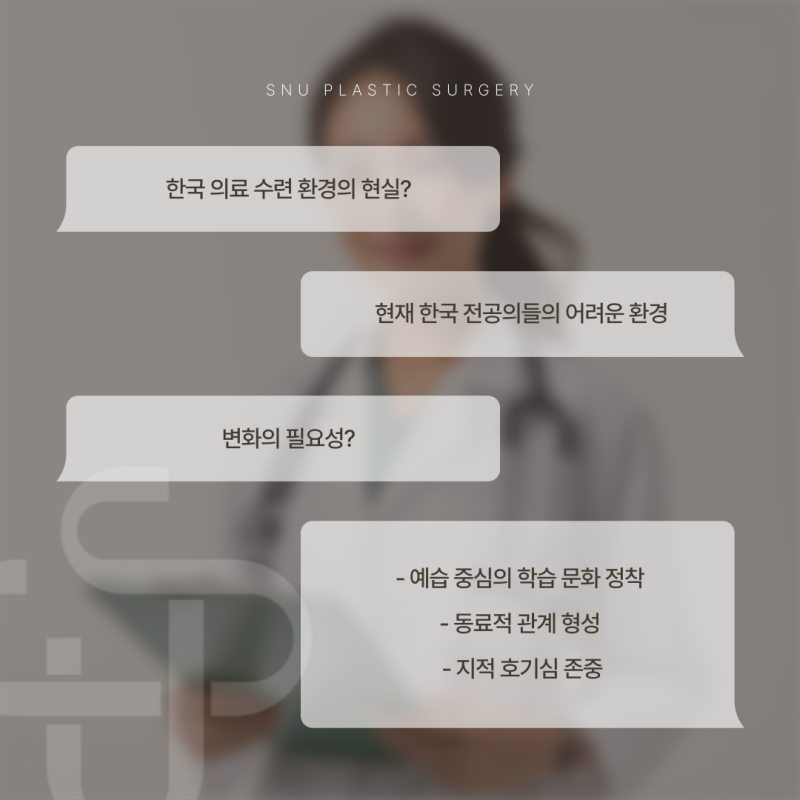
✅ Current Difficult Environment for Korean Residents
According to recent newspaper reports, as 7,648 residents who gave up training poured into private practice, the salaries of paid doctors fluctuated significantly.
The concentration in popular fields like dermatology and plastic surgery was severe, and some articles even stated that these fields are already saturated.
✅ Proposals for Fundamental Change
As the current medical-government conflict enters a resolution phase, fundamental changes in the Korean medical training environment are necessary.
Beyond merely improving working conditions, a paradigm shift in learning methods and the professor-resident relationship is needed.
1) Establishing a Learning Culture Centered on Prior Preparation
An environment must be created where residents do not passively receive knowledge but can actively prepare and ask questions.
2) Fostering Collegial Relationships
A culture where professors and residents can communicate as colleagues, transcending hierarchical relationships, must be established.
3) Respect for Intellectual Curiosity
An atmosphere must be created where professors are not ashamed to admit when they don't know something.
# The Path Forward: Training with the Mind, Not the Body
What I saw at Stanford showed that the profession of a doctor is not merely that of a technician but a true professional.
We, too, must now shift our paradigm from training endured with the body to training that involves thinking and analyzing with the mind.
If an attitude of prior case preparation, continuous questioning and inquiry, and collegial respect and communication take root in our training culture, Korean residents will be able to grow into internationally recognized doctors, not just in Korea.
I wish boundless development and achievement for Dr. Kim, who is returning to the university with a clear purpose.
Furthermore, I hope that our medical community will create a better training environment and culture.
Homepage
📌 KakaoTalk Channel (Click image below to navigate)
Frequently Asked Questions
What is the biggest difference between medical training methods in Korea and the US?
The biggest difference is the learning attitude. Korean training is a passive, experience-based method, whereas US training involves active learning based on preparation, accumulating knowledge, and then applying it in practice.
How do Stanford University Hospital residents train?
They train within a systematic framework. After their daily work, they thoroughly prepare for the next day's surgical cases in the library, consulting papers and textbooks to fully master relevant knowledge before entering the operating room.
How do the relationships between professors and residents differ in Korea and the US?
In Korea, professors were regarded as teachers, and residents passively received instruction. In contrast, in the US, professors and residents are equal colleagues who ask questions, discuss, and solve cases together.
What are your suggestions for improving the medical training environment in Korea?
There are three suggestions. First, establishing a preparation-oriented learning culture; second, fostering collegial relationships between professors and residents; and third, creating an atmosphere that respects intellectual curiosity. Through these, training should shift from being physically demanding to intellectually driven.
What is needed for Korean residents to be internationally recognized?
The paradigm needs to shift from physically enduring training to intellectually thinking and analyzing training. Case preparation, continuous questioning and exploration, and collegial respect and communication must be rooted in the training culture.