2026-07-21
Why ‘Sedation Anesthesia’ Requires Caution in Facial Surgery
This article explains why sedation anesthesia should be used with caution in facial surgery, highlighting the risks of involuntary movements and contamination, and emphasizing the necessity of professional general anesthesia for patient safety and optimal surgical outcomes.
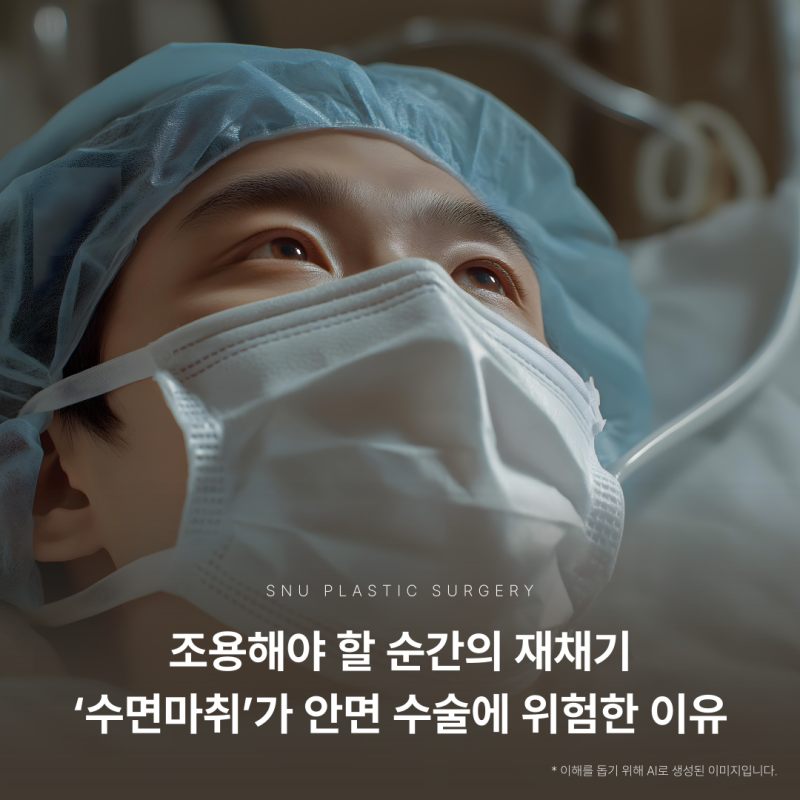
Why ‘Sedation Anesthesia’ Requires Caution in Facial Surgery

Hello.
This is SNU Plastic Surgery.
Towards the end of the surgery, the patient suddenly sneezed without warning.
This single sentence encapsulates one of the most terrifying moments many plastic surgeons experience.
With a sneeze, the surgical field is instantly contaminated, and precise incisions can be disrupted.
Today, beyond the differences between ‘sedation anesthesia’ and ‘general anesthesia,’ we will explain why professional anesthesia, rather than sedation, is essential for surgeries involving the face or near vital structures.
‘Falling asleep’ is not the end. The hidden dangers of sedation anesthesia.
Many people believe that ‘sedation anesthesia’ means being completely asleep and unaware of anything.
However, a state of medical sedation (IV Sedation) is close to deep sleep, but the brain can still react to external stimuli.
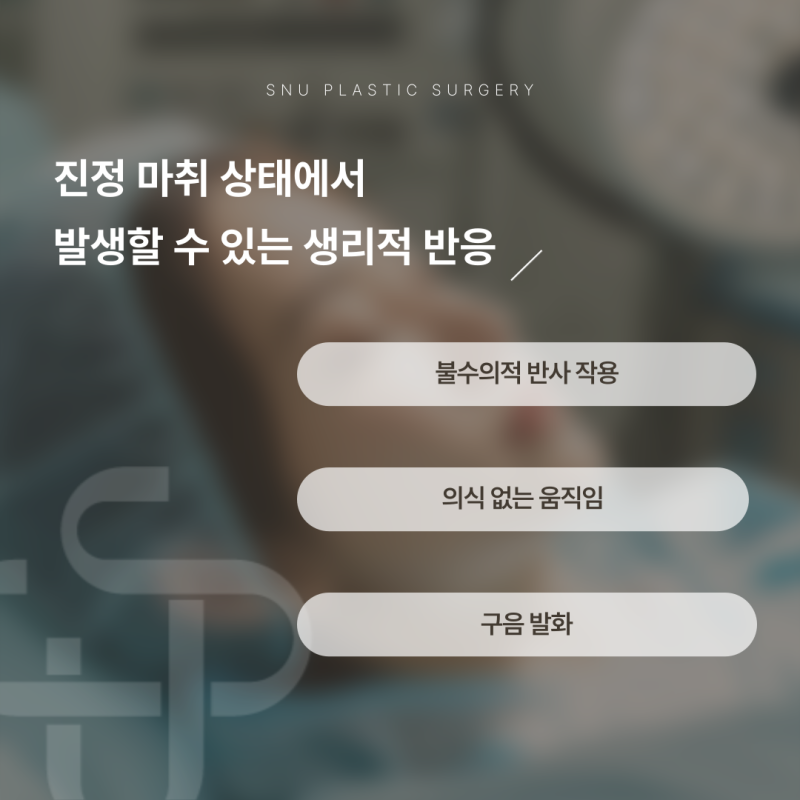
Unexpected situations that can arise in this state include:
✅ Involuntary reflexes
If the airway is stimulated, sneezing or coughing may occur.
✅ Unconscious movements
Patients may reflexively turn their head or twitch their body due to pain or discomfort.
✅ Verbalizations
Patients may mumble or make sounds in their sleep.
These situations are not the patient’s fault.
They are natural physiological responses that occur because pain blockage and motor reflex suppression are not perfect under sedation anesthesia.
Why is this issue critical in facial surgery?
The face is the most delicate part of our body.
Small differences can significantly impact the outcome, and especially for the reasons below, even a patient’s slight movement is often unacceptable.
In fact, if the patient is conscious under local anesthesia and can communicate with the medical staff, sudden movements can be controlled by the patient themselves or anticipated through warnings. However, inadequate sedation anesthesia often hinders the surgical process.
Risk Factor | Potential Problems | Particularly Risky Surgical Areas |
Sudden movements | Distortion of precise suture lines, tissue damage, increased bleeding | Lower blepharoplasty, facelift, rhinoplasty |
Sneezing / Coughing | Surgical field contamination, internal bleeding due to rapid pressure | Rhinoplasty (most common), all facial incision surgeries |
Risk of aspiration | Oral/nasal bleeding or secretions entering the airway | Rhinoplasty, orthognathic surgery, facial contouring, intraoral procedures |
Potential for contamination | Nose/mouth are bacteria-colonized areas, secretions contaminate sterile surgical field | Rhinoplasty, orthognathic surgery, facial contouring |
The nose and mouth are always contaminated areas.
Numerous bacteria reside in the nasal and oral mucosa.
Sneezing or coughing is akin to forcefully spraying these bacteria into the surgical wound.
This can be a direct cause of infection.
Furthermore, bleeding that occurs during nasal or oral surgery can flow into the airway while the patient is unconscious, leading to a risk of suffocation (aspiration).
A ‘calm’ surgical environment managed by experts.
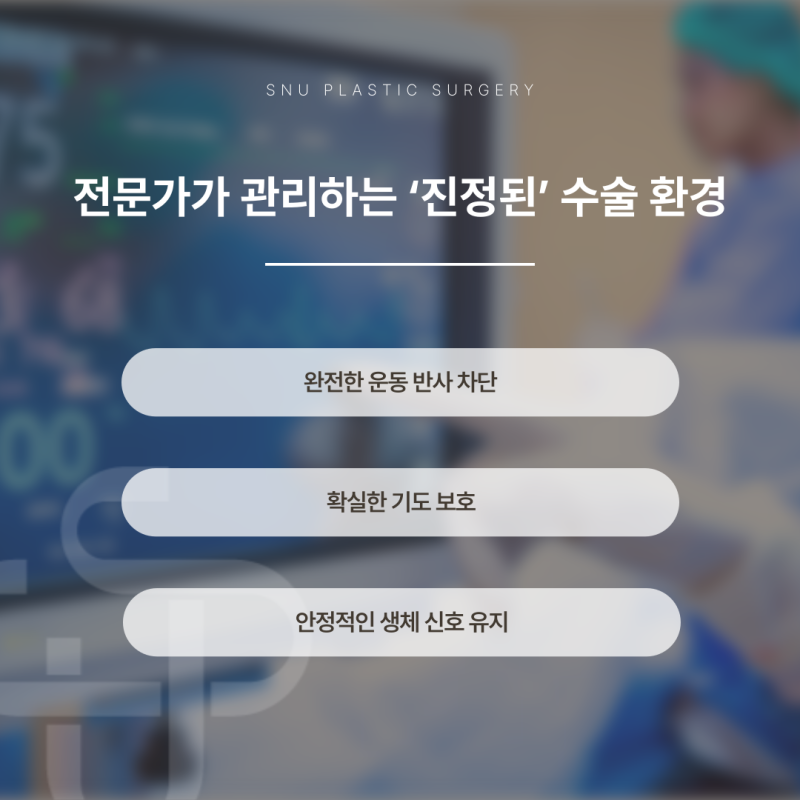
Controlling all these risk factors and allowing the surgeon to concentrate in a completely calm and stable surgical environment is precisely what general anesthesia or deep intravenous anesthesia, managed by an anesthesiologist, provides.
✨ Complete motor reflex blockade
The patient will not move at all.
Medication controls to prevent sneezing, coughing, or twitching.
✨ Secure airway protection
An independent airway is secured through endotracheal intubation or respiratory assistance.
Completely blocks secretions or bleeding from the nose or mouth from entering the lungs.
✨ Stable vital sign maintenance
An anesthesiologist continuously monitors and adjusts blood pressure, pulse, and oxygen saturation to minimize bleeding and create stable surgical conditions.

A safe choice begins with clear distinctions.
There is a word ‘全靜’ (jeonjeong), which is different from ‘鎭靜’ (jinjeong, sedation).
It means ‘to be completely still.’
What is needed for facial surgery, where the surgeon must perform delicate work for an extended period, is this state of ‘全靜’ (complete stillness), not mere ‘鎭靜’ (sedation).
In Korean clinics, ‘sedation anesthesia’ performed solely by the practitioner without the assistance of an anesthesia specialist, strictly speaking, carries the risk of being an insufficiently still state, i.e., merely sedation induction (鎭靜誘導).
This is a factor that threatens both patient safety and surgical outcomes.
Therefore,
If you are considering surgeries that involve major facial structures, such as facelifts, rhinoplasty, or facial contouring, or if you are having multiple surgeries together, or a long surgery lasting more than 2 hours,
please make sure to check not just ‘how you fall asleep,’ but ‘which expert will manage your safety while you fall asleep.’
Truly safe anesthesia is only possible with the involvement of an anesthesiologist.
Homepage
📌 KakaoTalk Channel (Click image below to go)