2026-07-21
Pediatric Facial Lacerations: First Aid and Suturing Methods
Learn effective first aid and suturing techniques for pediatric facial lacerations, especially for children around 5 years old.

Hello,
This is Dr. J from Cheongdam SNU Plastic Surgery Clinic.
Today, I would like to share effective ways to deal with
pediatric facial lacerations and some tips.
I will introduce useful methods, especially when treating
children around 5 years old who are beginning to understand speech.
1. Characteristics and First Aid for Pediatric Facial Lacerations
Pediatric facial lacerations
are common in boys under 4 years old
and frequently occur on the forehead.
Children have a larger head-to-body ratio than adults
and are more active, leading to frequent
falls and collisions.
When a laceration occurs,
prompt first aid is necessary.
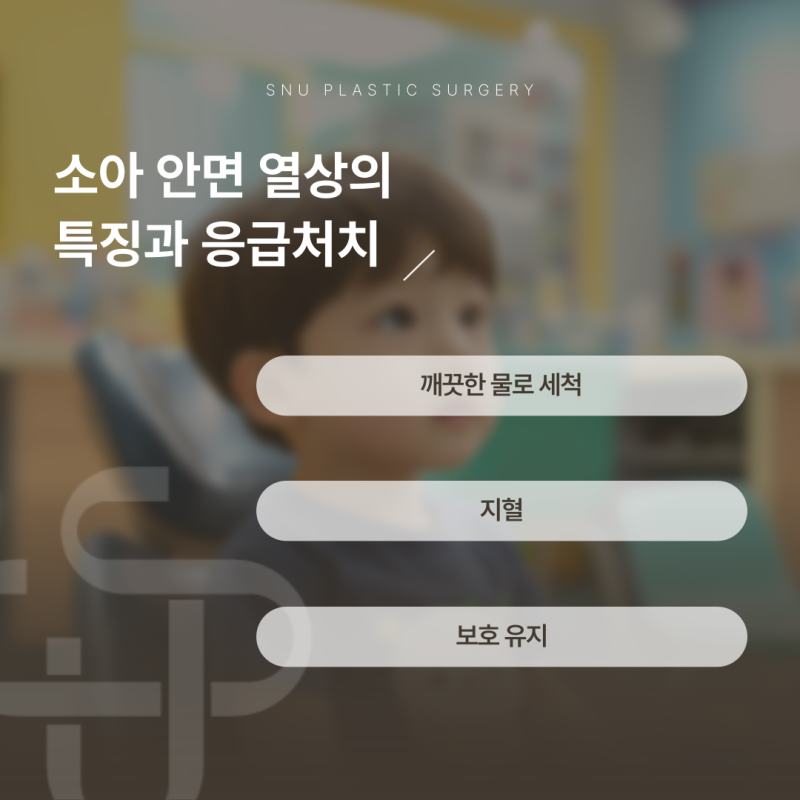
✅ Clean with clean water
If foreign matter remains, the risk of infection increases,
and immediate suturing may be difficult, so
the wound should be cleaned with clean water.
✅ Stop the bleeding
Apply pressure to the wound with clean gauze or a towel
to stop the bleeding.
✅ Maintain protection
Cover the wound with a bandage to prevent it from drying out
and to prevent secondary infection.
2. Suturing Tips for Children Who Understand Speech

Children around 5 years old hear the word ‘suture’
and associate it with needles and thread, causing fear.
Parents do not need to scare them in advance either.
In such cases, it is important to use techniques
to stabilize the child's psyche
for the procedure.
✅ Disguise it as applying medicine
Reassure the child by explaining, ‘We’re just going to apply medicine a few times and then go home.’
✅ Minimize pain induction
After applying disinfectant 1-2 times, if the child
says ‘It hurts,’ quickly administer the anesthetic injection.
At this time, explain in advance, ‘It will sting for a moment,’
to reduce fear.
✅ Distract attention
Since there is virtually no pain due to the injected anesthetic,
continue by saying something like, ‘We’re applying medicine again,’
and ‘If you close your eyes, the medicine won’t go in,’
then carefully proceed with suturing.
Simultaneously, during the procedure, occasionally
provide orientation, such as ‘We’ve applied the medicine this many times,’
to help the child understand the progress.
Using this method,
9 out of 10 children feel almost no pain
and tolerate the suturing process well.
3. When General Anesthesia is Needed
Not all lacerations can be treated with local anesthesia.
In the following cases,
general anesthesia should be considered.
1) For very young children who do not understand speech.
2) For severely contaminated or extensive wounds.
3) For wounds near the airway (nose, mouth, tongue).
4) For complex cases requiring internal exploration of the wound.
Especially,
general anesthesia may be necessary for pediatric patients
where airway management is difficult.
4. Post-Suture Care: Minimizing Scars
Even after suturing, proper care
significantly influences scar formation.
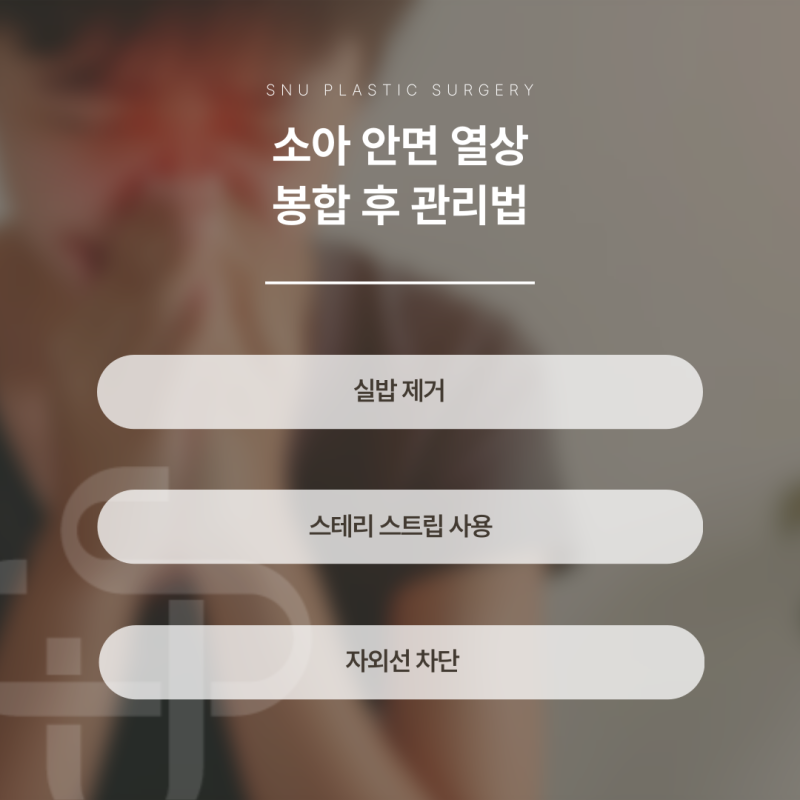
✅ Suture removal
Sutures on the face should be removed
within 5-7 days.
✅ Use of Steri-Strips
For 2 weeks to 2 months after suture removal,
use Steri-Strips (skin closure tapes) to
prevent the wound from reopening.
✅ UV protection
The scar area should not be exposed
to ultraviolet rays.
Using sunscreen and physical barriers
(such as covering with bangs) can
reduce pigmentation.
5. Pediatric Facial Lacerations: Prevention is Key!

As pediatric facial lacerations frequently occur indoors,
home safety management is necessary.
✔️ Install protective covers
on furniture corners.
✔️ Lay safety mats in areas where
children play.
✔️ Parental supervision is required.
When dealing with pediatric facial lacerations,
an approach that considers the child's psychological state
is necessary.
For children who understand speech,
methods utilizing calming techniques are effective, and
in complex cases, suturing should be performed
under general anesthesia.

For the precious future of our children,
prevention is paramount, and
if an accident occurs,
appropriate treatment by a plastic surgeon
can aid in the subsequent scar healing process.
Homepage
📌 KakaoTalk Channel (Click image below to navigate)