2026-07-21
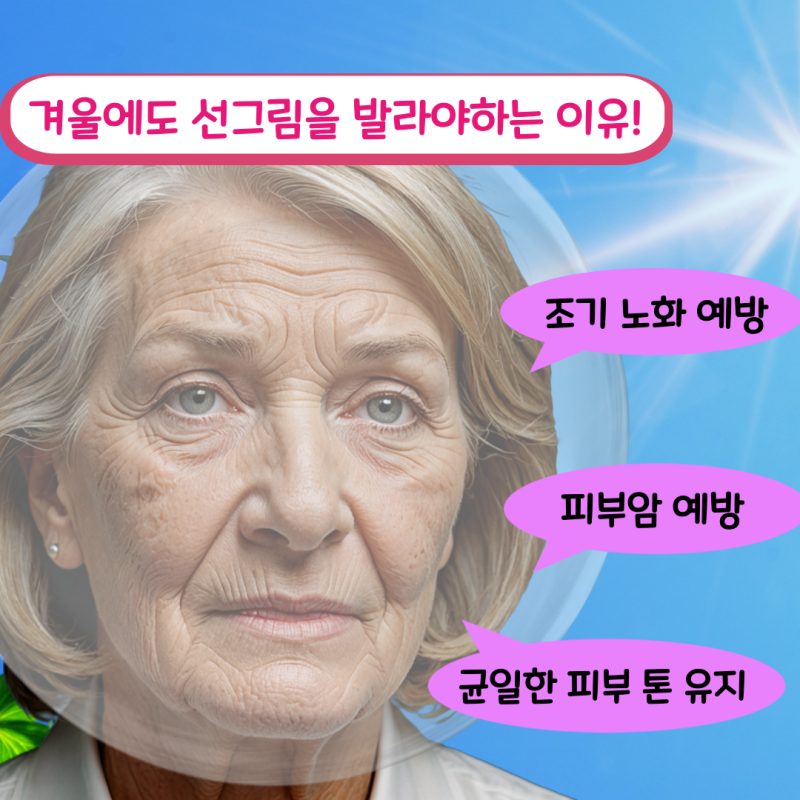
Why You Should Wear Sunscreen Even in Winter
Discover why sunscreen is essential year-round, even in winter. Learn about UVA/UVB rays, reflection from snow, and high-altitude exposure. Protect your skin from premature aging and skin cancer.
Hello. This is Dr. J.
Today, let's find out why you should wear sunscreen, which is often overlooked in winter!
When most people think of sunscreen, they usually imagine the hot summer heat, outdoor swimming pools, and beach trips.
However, protecting your skin from harmful UV rays is a year-round task,
and wearing sunscreen in winter is just as important as in summer.
Shall we find out why?
●UV Rays Don't Rest in Winter!
UV rays are always present
The sun emits two types of harmful UV rays (UVA, UVB).
While UVB rays are weaker in winter compared to summer,
UVA rays, which penetrate deep into the skin and cause premature aging and long-term damage, are consistently present throughout the year.
UV rays reflected by snow
Snow can reflect up to 80% of UV rays, effectively doubling your exposure to the sun.
This is especially important when enjoying winter sports like skiing or snowboarding.
UV exposure at high altitudes
If you spend time in mountainous areas during winter, UV exposure increases with higher altitude.
At higher altitudes, the atmosphere is thinner, leading to less UV filtration.
●Benefits of Winter Sunscreen
Prevents premature aging
UVA rays are a major cause of deep wrinkles, fine lines, and hyperpigmentation.
Daily use of sunscreen can help keep your skin looking healthy and youthful.
Prevents skin cancer
Continuous exposure to UV rays, even in winter, increases the risk of skin cancer.
Sunscreen acts as a barrier to protect your skin.
Maintains an even skin tone
Sunscreen helps prevent dark spots and discoloration caused by UV rays,
contributing to a more even and uniform skin tone.
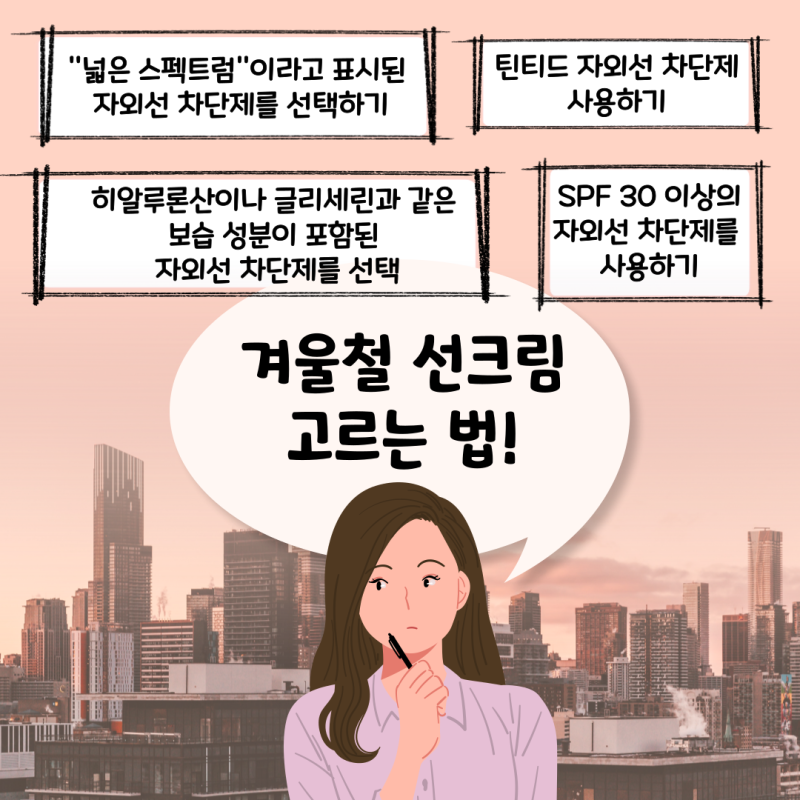
●How to Choose Sunscreen for Winter
Broad-spectrum protection
Choose a sunscreen labeled ‘broad-spectrum’.
This protects against both UVA and UVB rays.
SPF 30 or higher
Even in winter, using sunscreen with at least SPF 30 is recommended for effective protection.
Products with moisturizing ingredients
Winter air is dry,
so it's good to choose a sunscreen that contains moisturizing ingredients like hyaluronic acid or glycerin.
Tinted sunscreen
Tinted sunscreens provide additional coverage and protection,
and help prevent pigmentation caused by visible light in addition to UV rays.
●How to Use Sunscreen in Winter
Use daily
Sunscreen should be applied as the last step in your morning skincare routine, after moisturizer.
Reapply regularly
Even in winter, sunscreen should be reapplied every 2-3 hours,
and more frequently if you spend a long time outdoors.
Don't forget key areas
Pay attention to often-forgotten areas such as your lips (use a lip balm with sunscreen ingredients), ears, and the backs of your hands.
●Common Misconceptions About Winter Sunscreen
‘I don't need to wear sunscreen on cloudy days.’
Clouds don't block up to 80% of UV rays, so your skin is still exposed to UV radiation on cloudy days.
‘My skin is covered by clothes, so I don't need sunscreen.’
While clothes block some UV rays, they cannot block all of them.
Also, exposed areas like your face, neck, and hands still need sunscreen.
‘I don't spend much time outside in winter, so I don't need sunscreen.’
Because UVA rays can penetrate glass,
you can still be exposed to UV rays when driving a car or working in a room with windows.
§ Conclusion §
Winter is not the time to stop using sunscreen,
as UV rays continue to affect your skin regardless of the season.
Using sunscreen daily in winter is a small habit for skin health, with significant long-term benefits.
Next time you go out on a clear, cool winter day, or sit by a sunny window, be sure to apply sunscreen.
Your skin will thank you!
Frequently Asked Questions
Should I apply sunscreen even in winter?
Yes, you should apply sunscreen even in winter. This is because UVA rays, which penetrate deep into the skin and cause premature aging and long-term damage, are consistently present throughout the year.
How does winter UV radiation affect the skin?
Winter UV radiation can be a major cause of premature aging (deep wrinkles, fine lines, hyperpigmentation) and skin cancer. It can also lead to uneven skin tone.
How should I choose sunscreen for winter?
For winter, choose a "broad-spectrum" product that protects against both UVA and UVB, and an SPF of 30 or higher is recommended. It's good to choose a product that contains moisturizing ingredients, considering the dry air.
Do I need sunscreen on cloudy days or indoors?
Yes, you do. Clouds do not block up to 80% of UV rays, and UVA rays can pass through glass, meaning you can be exposed indoors as well.
How often should I reapply sunscreen in winter?
Even in winter, sunscreen should be reapplied every 2-3 hours. It is even more effective to reapply more frequently, especially when spending long periods outdoors.
Is sun protection more important in snowy areas?
Yes, it is more important. Snow can reflect up to 80% of UV rays, effectively doubling your exposure to the sun, making it even more crucial during winter sports like skiing or snowboarding.