2026-07-21
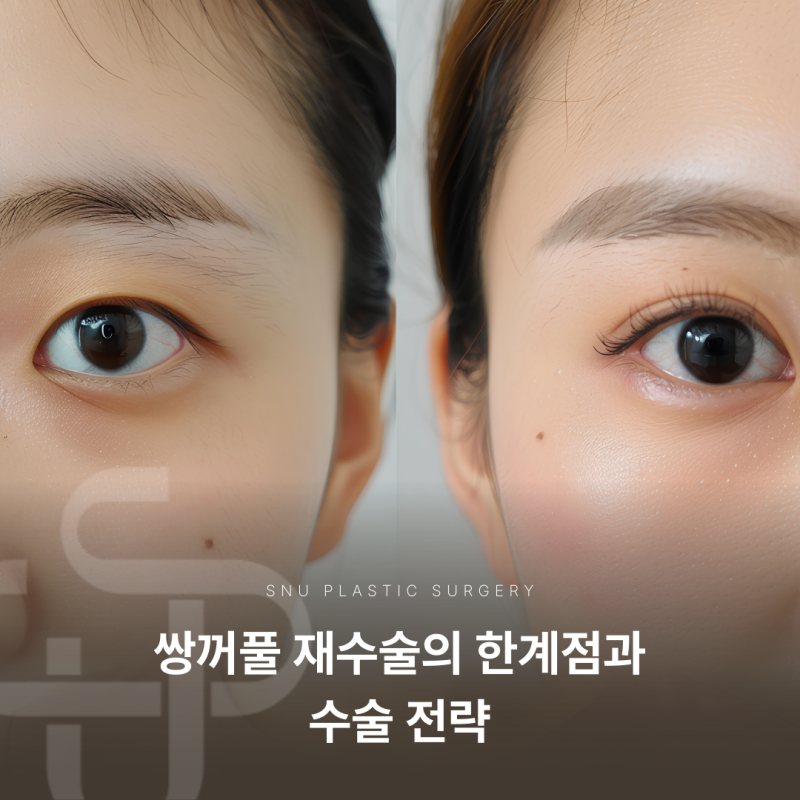
Limitations and Surgical Strategies for Double Eyelid Revision Surgery
Double eyelid revision surgery, especially after multiple attempts, faces significant anatomical and technical challenges. This article outlines key limitations like tissue depletion and scar tissue accumulation, and proposes surgical strategies such as reusing incision lines, fat repositioning, and micro-adjustment techniques. It also emphasizes critical considerations for third-time revisions and beyond, including adequate recovery time, concurrent ptosis correction, and prioritizing functiona


Hello,
This is Dr. J from Cheongdam SNU Plastic Surgery Clinic.
With each subsequent double eyelid revision surgery,
the anatomical limitations and technical complexities
increase dramatically.
Especially in cases like a certain celebrity who underwent
four or more surgeries,
the following core principles and strategies apply.
# Key Limitation of Double Eyelid Revision Surgery: Decreased Tissue Availability
✅ Limited Regeneration of Skin and Muscle
Repeated excisions gradually deplete the eyelid skin and
muscle tissue.
For third-time revision surgeries or more,
the risk of skin deficiency
increases by over 40%,
which can lead to impaired eyelid closure
or aesthetic asymmetry.
✅ Accumulation of Scar Tissue
Fibrosis occurs in previously operated areas,
making the tissue hard and
reducing blood supply.
This delays post-operative recovery,
and increases the risk of infection or hypertrophic scars.
🔎 Medical Judgment
In fourth-time revision surgeries or more,
‘repositioning’ is key, rather than ‘excision’.
An approach that maximally preserves remaining tissue and
realigns structures is essential.
# Surgical Strategies to Overcome Limitations
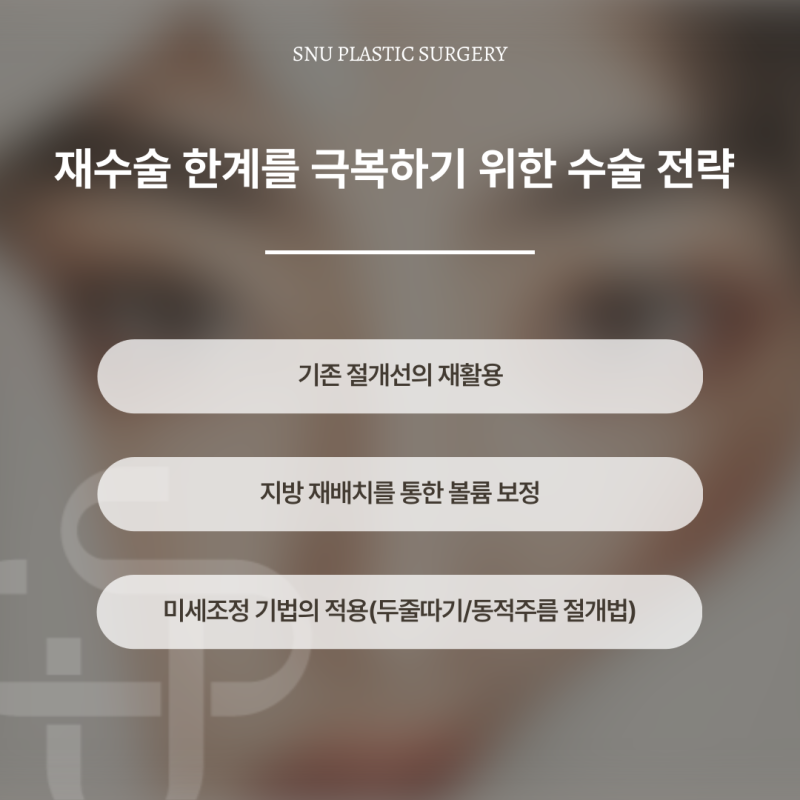
📍 Reutilization of Existing Incision Lines
Reusing the incision site from the initial surgery
prevents new scar formation and
minimizes blood loss.
Especially for second-time surgeries or more,
changing the incision line can lead to unstable tissue adhesion,
so it is safer to utilize the existing line.
📍 Volume Correction through Fat Repositioning
Displaced fat is moved to the upper part of the eyelid support (tarsal plate)
to naturally secure the double eyelid line.
📍 Application of Micro-Adjustment Techniques
☑ Double-line creation:
Without skin excision,
only the deep fixation layer is released,
and a new line is formed.
This is suitable for elastic, younger skin
and can reduce the thickness of the existing double eyelid
by 30-50%.
☑ Dynamic Crease Incision Method:
To correct an unnatural eye shape caused by
strong fixation,
deep fixation is avoided,
and a flexible double eyelid line is created.
This technique compensates for the drawbacks of
conventional incision methods.
# Essential Considerations for Third-Time Revision Surgery or More
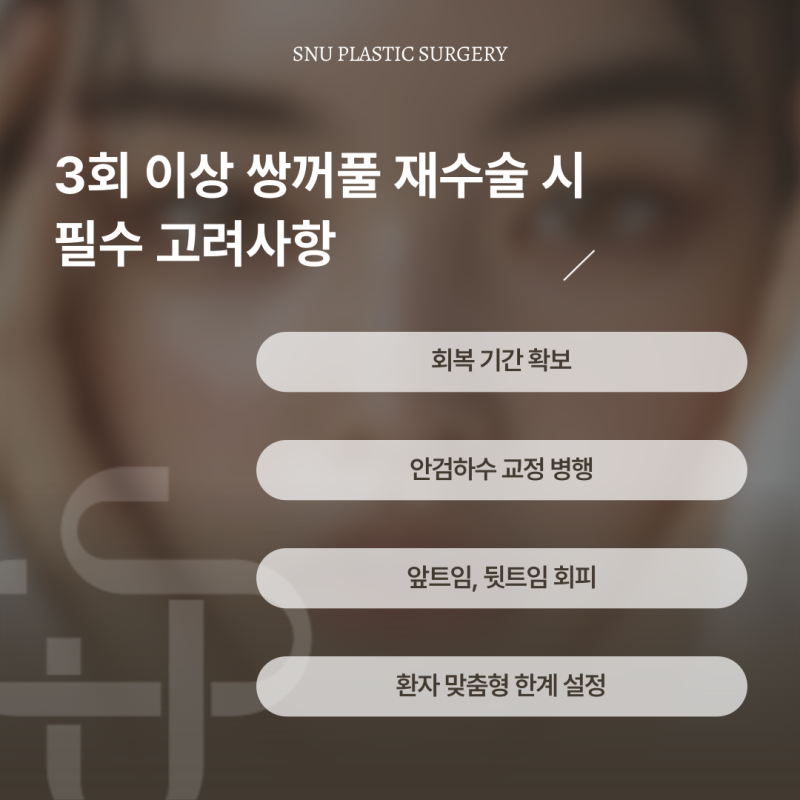
✅ Secure Adequate Recovery Period
A minimum interval of 6 months or more
is required for tissue stabilization.
Early revision surgery
worsens scar adhesion.
✅ Concurrent Ptosis Correction
The damage rate to the levator palpebrae superioris muscle (which opens the eye)
due to repeated surgeries reaches 35%.
During revision surgery, ptosis correction, which adjusts muscle tension,
must be performed concurrently.
✅ Avoid Epicanthoplasty and Lateral Canthoplasty
It is recommended to avoid performing multiple surgeries
at once, if possible,
and to proceed in stages.
Especially for Asians,
the structural influence of the epicanthal fold
must be considered.
✅ Patient-Specific Limitation Setting
If the residual thickness of the eyelid skin is thin or
impaired eyelid closure is confirmed,
additional excision can threaten visual function.
Botox and fillers are
auxiliary procedures to temporarily
soften deep lines,
and are recommended when further surgery
is no longer possible.
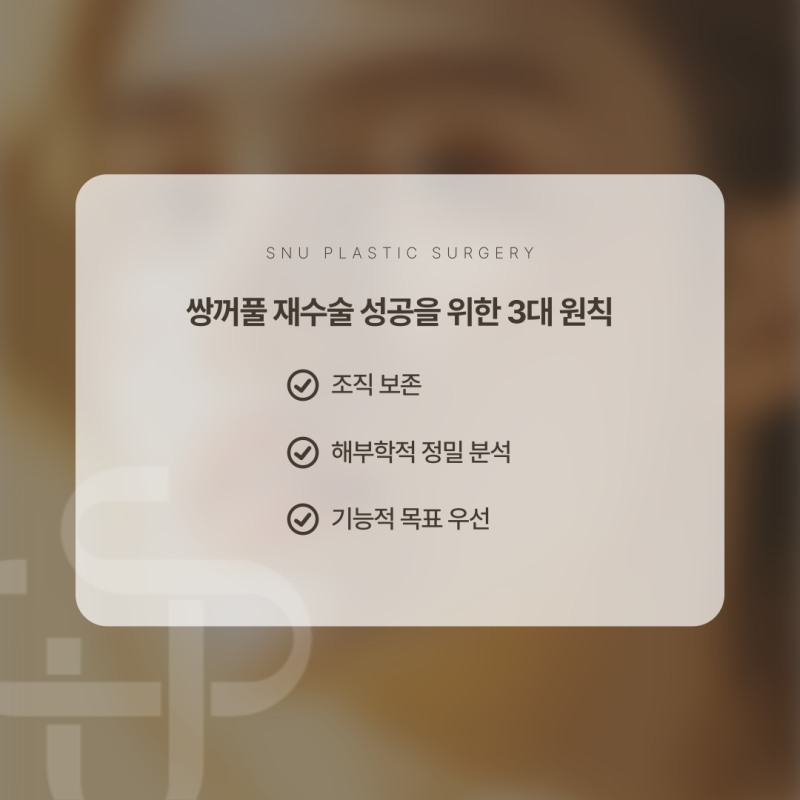
📌 Three Major Principles for Successful Double Eyelid Revision Surgery
1. Tissue Preservation
Maximize the use of remaining resources through repositioning rather than excision.
2. Precise Anatomical Analysis
Pre-evaluate current major problems, adhesion sites, and muscle damage.
3. Prioritize Functional Goals
Normalization of eyelid closure and opening function
is key, more than aesthetics.
From the fourth surgery onwards, satisfaction
drops sharply to less than 50%.
It is essential to set realistic expectations,
and prioritize functional recovery
as the primary goal.
Revision surgery is like untangling a tangled ball of yarn.
To minimize the possibility of failure,
consultation with a revision specialist with over 10 years of experience
is essential.
Homepage
📌 KakaoTalk Channel (Click image below to navigate)