2026-07-21
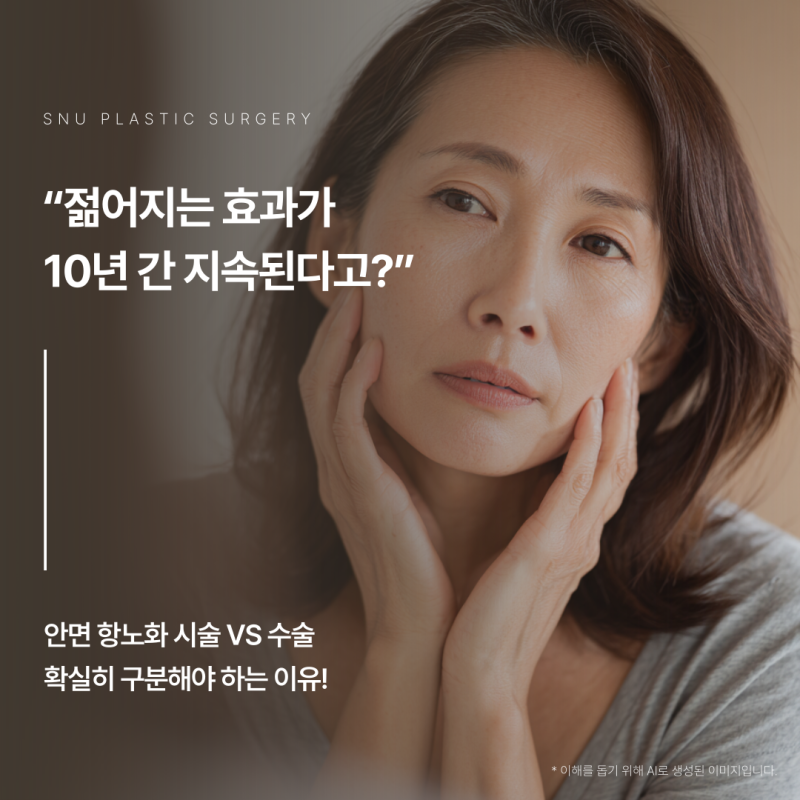
Facial Anti-Aging: Why You Need to Distinguish Between Facelift Surgery and Non-Surgical Procedures
Understand the fundamental differences between facelift surgery and non-surgical anti-aging procedures to make an informed decision based on your goals, health, and lifestyle.
Facial Anti-Aging: Why You Need to Distinguish Between Facelift Surgery and Non-Surgical Procedures

Hello,
This is SNU Plastic Surgery.
For many contemplating changes for aesthetic reasons,
the first dilemma they face is:
Should I choose a non-surgical procedure or surgery?
While some information promotes non-surgical procedures
as if they can replace surgery,
or suggests that surgical recovery is simple,
these two approaches fundamentally
differ in their goals, processes, and outcomes.
In this article, we will delve into the clear differences between facelift surgery
(including facelifts, lower blepharoplasty, brow lifts, etc.)
and non-surgical anti-aging procedures,
along with appropriate selection criteria for each.
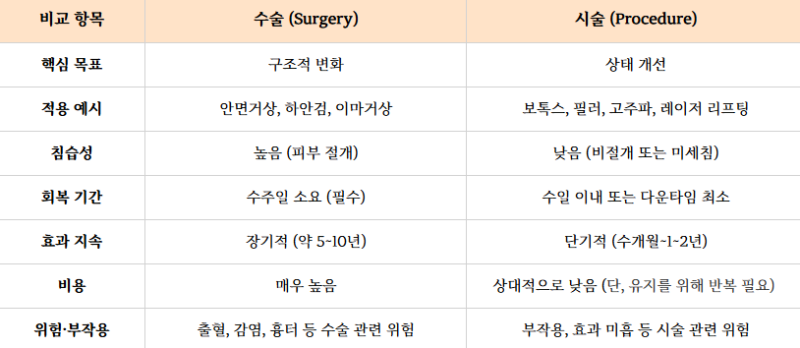
# Surgery vs. Non-Surgical Procedures
The table below provides a quick comparison of the key differences between the two methods.
# Surgery: Fundamental Change, But Requires a Recovery Process
Surgery addresses structural issues by
repositioning the SMAS layer and tissues beneath the skin.
Its significant advantages include clear and long-lasting effects,
but it also necessitates a recovery period.
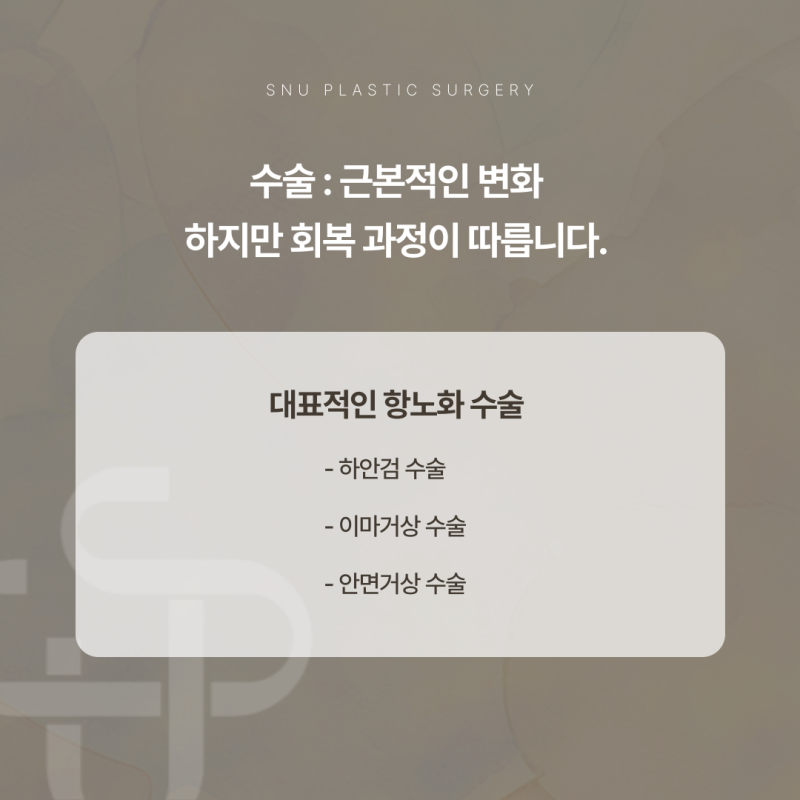
1. Representative Anti-Aging Surgeries and Recovery Processes
✨ Lower Blepharoplasty
This procedure addresses sagging skin and fat under the eyes.
Swelling peaks 1-3 days after surgery,
and stitches are removed on days 7-8.
It takes about 2 weeks to recover sufficiently for social interactions,
and the final results may be visible after 2-3 months.
✨ Brow Lift Surgery
This lifts a sagging forehead and eyebrows.
Swelling and bruising are most severe 3-5 days after surgery,
and mostly subside by the time stitches are removed a week later.
After initial recovery,
the time it takes to resume social activities varies by individual,
but it can be as early as 7-14 days.
For a more natural appearance,
4 weeks or more is recommended.
Scalp sensation abnormalities gradually recover over several months.
✨ Facelift Surgery
This is a major surgery that corrects overall facial sagging.
Intensive care for 3 months after surgery is emphasized
as a factor determining long-term results.
2. Advantages and Considerations of Surgery
✅ Advantages
The effects are distinct and long-lasting.
For example, the effects of a properly performed facelift
can last approximately 5-8 years.
This reflects a realistic expectation of looking 2-3 years younger than your current appearance.
✅ Considerations
A mandatory recovery period of several weeks and
scars from incisions will occur.
Additionally, the risks associated with anesthesia during surgery
must be taken into account.
# Non-Surgical Procedures: Gradual Improvement, Quick Return to Daily Life

Non-surgical procedures focus on improving the condition of the skin and superficial tissues
using injections, lasers, radiofrequency, and other energy sources.
1. Characteristics of Non-Surgical Procedures
✅ Goal
Partial and gradual improvement, such as wrinkle reduction, skin elasticity enhancement, and volume replenishment.
✅ Advantages
Downtime is very short or non-existent,
allowing for an immediate return to daily life.
✅ Disadvantages
The effects are temporary,
often requiring repeated procedures every few months to a year
to maintain the results.
The cumulative cost can sometimes exceed the cost of surgery.
✅ Suitable for
Improving early signs of aging, pre/post-surgical management,
or for those who are hesitant about surgery.
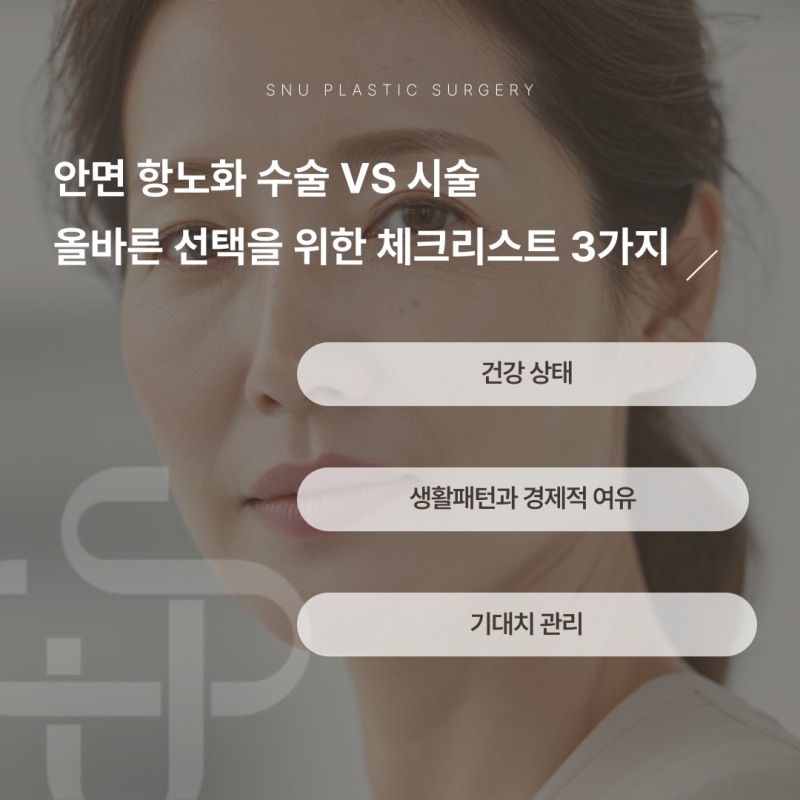
# 3 Checklists for Making the Right Choice
To choose the most suitable method for you,
carefully review the following three points.
1. Health Status
└ Basic prerequisite for surgery
If severe chronic diseases (diabetes, high blood pressure, heart disease, etc.) are
uncontrolled, or if you are in a recovery phase from an illness
(e.g., chemotherapy),
cosmetic surgery must be postponed.
If necessary, consider non-surgical procedures with faster recovery,
but consultation with your primary physician is essential.
2. Lifestyle and Financial Resources
└ Calculate hidden costs
✅ Time Cost
If you choose surgery,
you must plan for a recovery period of 2 weeks to a month
during which intensive social activities
may be difficult.
Check if remote work is possible or if you can take time off.
✅ Financial Cost
In addition to the surgery cost, you must consider
indirect costs due to limitations on income-generating activities
during the recovery period.
While the cost per non-surgical procedure is lower,
it is wise to calculate and compare the long-term maintenance costs over 10 years or more.
3. Expectation Management
└ Set realistic goals
Surgery is for ‘change’.
It is impossible to return to your appearance from 10 years ago;
a realistic goal is to recreate your best recent look,
making you appear 2-3 years younger.
Non-surgical procedures are for ‘improvement’.
They help to enhance your existing condition,
but cannot fundamentally alter your structure.
# Conclusion: For a Wise Decision Aligned with Your Goals
There is no absolute right answer for how to address facial aging.
You must comprehensively weigh your ultimate goal (change vs. improvement),
health status, and the recovery period and cost you can manage.

If you desire fundamental and dramatic changes
and can secure sufficient recovery time,
surgery may be the appropriate choice.
If you prefer gradual improvement
and want quick management within a busy daily life,
non-surgical procedures can be a good starting point.
The most important thing is to have a thorough consultation with a trusted medical professional
to accurately diagnose your facial structure,
skin condition, and health,
and find a customized solution that suits you.
Rather than unrealistic expectations,
we hope you make a choice that brings you confidence and satisfaction
based on realistic goals.🙏🏻
Homepage
📌 KakaoTalk Channel (Click image below to move)