2026-07-21
Everything You Need to Know About Sedation Anesthesia!
Understand sedation anesthesia: it's sedation, not full anesthesia. Learn about common misconceptions, safety, and essential precautions for a comfortable medical experience.
Hello. This is Dr. J.
Today, we're going to explore 'sedation anesthesia,' which you'll frequently encounter during procedures or surgeries.

Misconceptions and Precautions Regarding Sedation Anesthesia: A Correct Understanding is Essential
In Korea, many people have strong trust in 'sedation anesthesia' (propofol-based sedation), which is commonly used in medical procedures.
However, some misunderstandings about this process exist, which can lead to false expectations or unnecessary worries. ★It is especially important to accurately understand that sedation anesthesia is 'sedation,' not 'anesthesia.'★
What is Sedation Anesthesia?
Sedation anesthesia refers to the process of making a patient comfortable and calm using a sedative.
The commonly used drug, **propofol**, acts quickly and helps patients relax during the procedure.
*Sedation: Calms the patient and relieves tension.
*Different from Anesthesia: Its role differs from anesthesia, which completely blocks pain or puts the patient in a state of complete unconsciousness.
Common Misconceptions Koreans Have About Sedation Anesthesia
1. Is sedation anesthesia the same as anesthesia?
Many patients confuse sedation anesthesia with general anesthesia.
However, when used alone, sedation anesthesia does not block pain, and for procedures where pain is expected, local anesthetics or other analgesics are used concurrently.
2. Will I be completely unconscious during sedation anesthesia?
Sedation anesthesia induces a state similar to deep sleep, but patients may still respond to weak stimuli,
and consciousness may not be completely blocked.
3. Is sedation anesthesia completely safe?
While sedation anesthesia is a relatively safe drug, the possibility of side effects cannot be entirely ruled out.
Unexpected reactions such as respiratory depression or hypotension can occur, so management by skilled medical staff is absolutely necessary.
※What Patients Should Be Aware Of When Receiving Sedation Anesthesia※
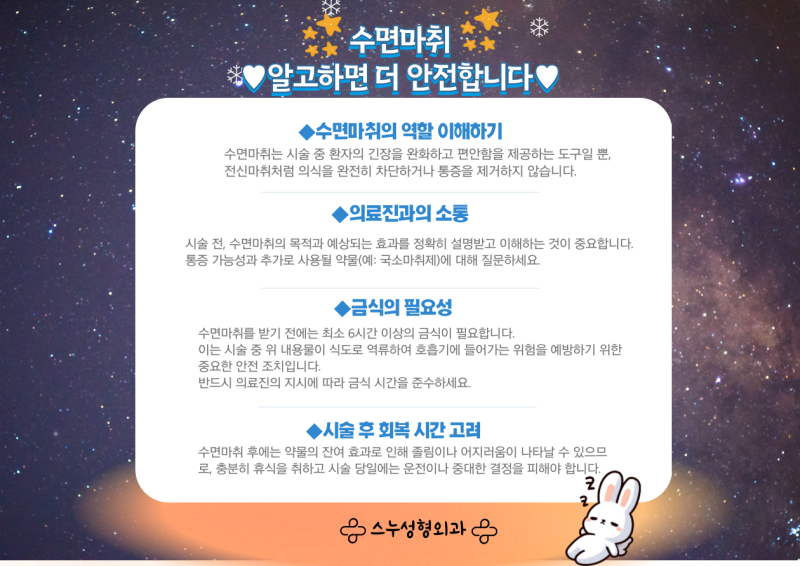
◆Understanding the Role of Sedation Anesthesia
Sedation anesthesia is merely a tool to relieve patient tension and provide comfort during a procedure; it does not completely block consciousness or eliminate pain like general anesthesia.
◆Communication with Medical Staff
Before the procedure, it is crucial to receive and understand an accurate explanation of the purpose and expected effects of sedation anesthesia.
Ask about the possibility of pain and any additional medications (e.g., local anesthetics) that will be used.
◆Necessity of Fasting
Fasting for at least 6 hours is required before receiving sedation anesthesia.
This is an important safety measure to prevent the risk of stomach contents refluxing into the esophagus and entering the respiratory tract during the procedure. Always adhere to the fasting time as instructed by the medical staff.
◆Consider Recovery Time After the Procedure
After sedation anesthesia, drowsiness or dizziness may occur due to residual effects of the medication, so it is important to get enough rest and avoid driving or making important decisions on the day of the procedure.
☞Problems That Can Arise from Over-reliance on Sedation Anesthesia☜
If you have excessive trust in sedation anesthesia, you may experience excessive disappointment or anxiety about discomfort or unexpected situations that may occur during the actual procedure.
Furthermore, if you do not have sufficient prior consultation with the medical staff, you may miss out on the appropriate procedure methods necessary for you.
Conclusion: Prepare with Correct Information
Sedation anesthesia is an effective way to make a procedure comfortable, but it should not be equated with general anesthesia or over-relied upon to eliminate all pain.
As a patient, it is important to accurately understand the nature of sedation anesthesia and to thoroughly discuss your condition and the procedure with your medical staff.
With correct information and preparation, you can enjoy a safer and more comfortable medical experience.
Healthy medical choices begin with a correct understanding.
Understand your role in all medical processes, including sedation anesthesia, and communicate with trusted medical staff to achieve the best results.
Frequently Asked Questions
What is sedation anesthesia?
Sedation anesthesia is a process that uses sedatives to make a patient comfortable and calm. Propofol is commonly used and helps to relieve patient tension during the procedure.
Is sedation anesthesia the same as general anesthesia?
No, sedation anesthesia is 'sedation' and is different from 'anesthesia.' It does not completely block pain or render the patient completely unconscious, so local anesthetics may be used concurrently for procedures where pain is expected.
Is sedation anesthesia completely safe?
Sedation anesthesia is relatively safe, but it cannot be said to be completely safe. Unexpected side effects such as respiratory depression or hypotension can occur, so management by skilled medical staff is absolutely necessary.
Do I need to fast before sedation anesthesia?
Yes, fasting for at least 6 hours is required before receiving sedation anesthesia. This is an important safety measure to prevent the risk of stomach contents refluxing into the respiratory tract during the procedure, so you must follow the medical staff's instructions.
Can I drive immediately after sedation anesthesia?
No, you should avoid driving on the day of the procedure. After sedation anesthesia, drowsiness or dizziness may occur due to residual effects of the medication, so it is advisable to get enough rest and avoid making important decisions.
Will I be completely unconscious during sedation anesthesia?
No, sedation anesthesia induces a state similar to deep sleep, but patients may still respond to weak stimuli, and consciousness may not be completely blocked. It is not a state of complete unconsciousness.