2026-07-21
Causes and Precautions for Revision Rhinoplasty
Learn about the common reasons for revision rhinoplasty, including anatomical vulnerabilities, limitations of artificial implants, and aesthetic complexities, along with essential precautions.
Hello,
This is Dr. J from Cheongdam SNU Plastic Surgery Clinic.
Today, we will discuss the causes of revision rhinoplasty and
the precautions to take.
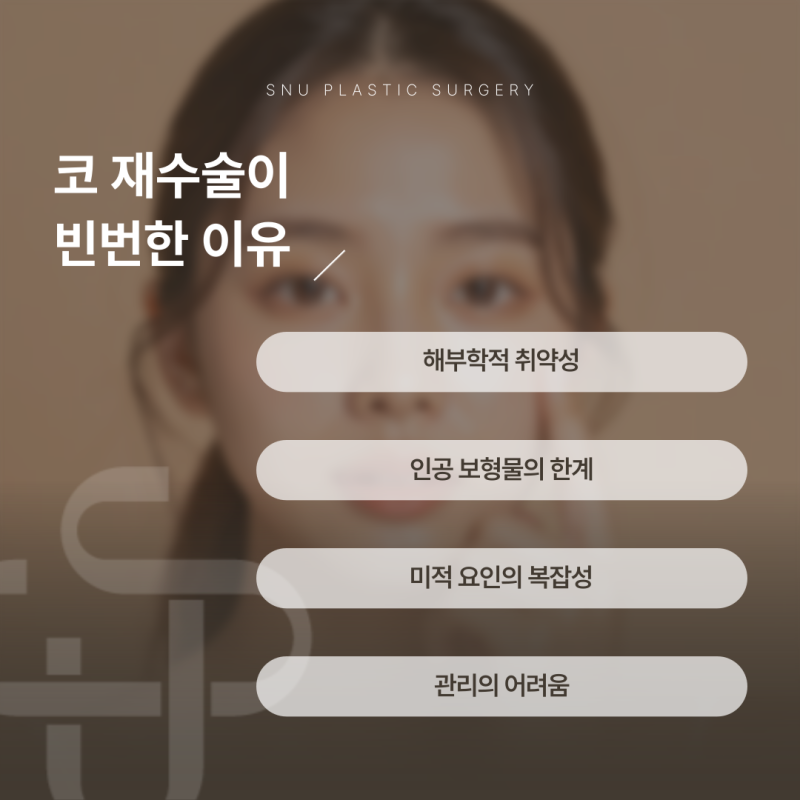
# Why Revision Rhinoplasty is More Frequent Compared to Other Plastic Surgeries

📍 Anatomical Vulnerability
The nose is located at the center of the face,
making it susceptible to trauma (impact, wearing glasses) and
infections (colds, rhinitis). Its rich blood supply
can easily amplify inflammatory responses.
📍 Limitations of Artificial Implants
Artificial materials like silicone and Gore-Tex
can trigger foreign body reactions in the body,
leading to capsular contracture (capsule shrinkage).
Deformities resulting from this (e.g., upturned nose, asymmetry)
account for 65% of revision surgeries.
📍 Complexity of Aesthetic Factors
The nose is a key factor in determining facial balance,
leading to a significant discrepancy between expectations and actual results.
During the initial surgery, excessive correction
(e.g., an ‘Avatar-like’ high bridge)
increases the risk of contracture.
📍 Difficulties in Patient Management
Post-operative smoking, drinking, and failure to prevent trauma
can cause inflammation. Notably, infectious complications are reported
in 30% of revision rhinoplasty patients.
Cases of celebrities or influencers undergoing 2nd or 3rd revision surgeries are abnormal.
As the number of surgeries increases,
the incidence of complications
rises exponentially.
(Approximately 9 times higher for 3rd surgery compared to 1st)
Human tissue is a biomechanical system, not a machine,
and repeated surgeries accelerate tissue necrosis
and scar adhesion.
# Nose Shapes Prone to Contracture and Causes of Adverse Reactions

📍 High-Risk Shapes:
✅ Pointed Upturned Nose
Excessively lifting or raising the nasal tip
increases skin tension, promoting
capsular contracture.
✅ L-shaped Silicone Insertion
If the implant extends to the nasal tip,
bacterial invasion increases the risk of
inflammatory contracture.
📍 Mechanism of Adverse Reactions:

# Methods to Minimize Adverse Reactions During Revision Rhinoplasty
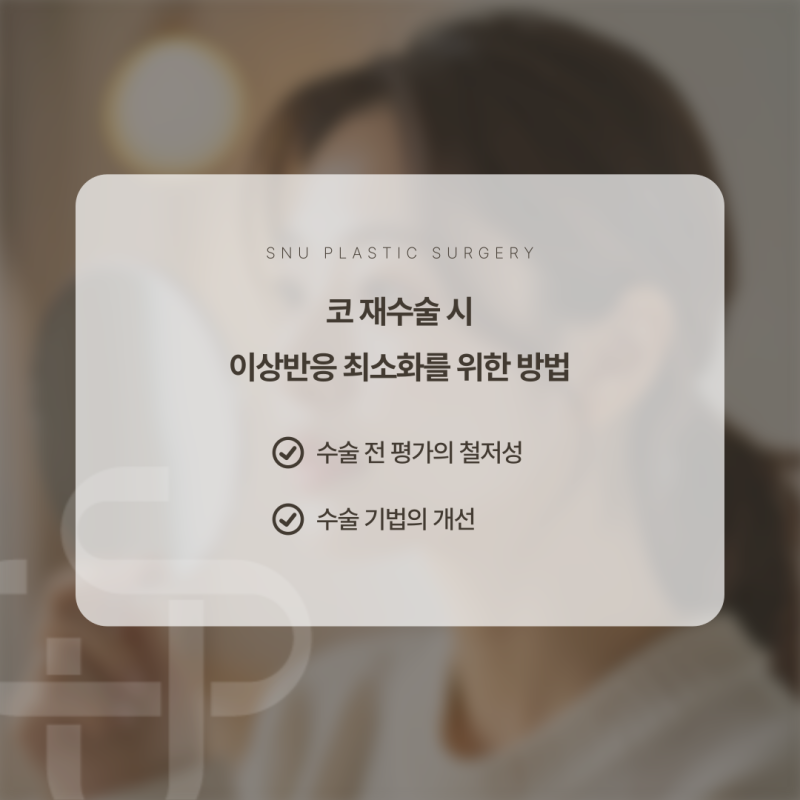
🌟 Thorough Pre-operative Evaluation
After removing artificial implants,
autologous costal cartilage (excellent support) and
autologous dermis (skin thickness reinforcement) are used
to reduce the rate of re-contracture.
🌟 Improved Surgical Techniques
1) Complete removal of inflammatory tissue
2) Skin relaxation to secure nasal tip length
(If insufficient, autologous temporalis fascia graft may also be considered)
3) Reconstruction of a stable support structure
(autologous cartilage framework)
🌟 Conservative Height Setting
The bridge height is lowered by 10% compared to the first surgery
to alleviate skin tension.
✨ How to Manage!
For infection prevention,
we recommend no smoking or drinking for 4 weeks post-surgery,
and using a nasal saline rinse.
For tissue stabilization,
observe the progress for at least 6 months to 1 year
after surgery.
→ Consider revision surgery after adhesion has subsided.
⚠️ Precautions
‘Do not ignore even minor symptoms’
Redness at the nasal tip and recurrent swelling are
early signs of contracture.
Even if symptoms temporarily improve with antibiotics,
a permanent solution is not possible.
‘Criteria for choosing medical staff’
You must choose a hospital and medical professional
with extensive experience in revision surgery.
# Lessons from a Preventive Perspective
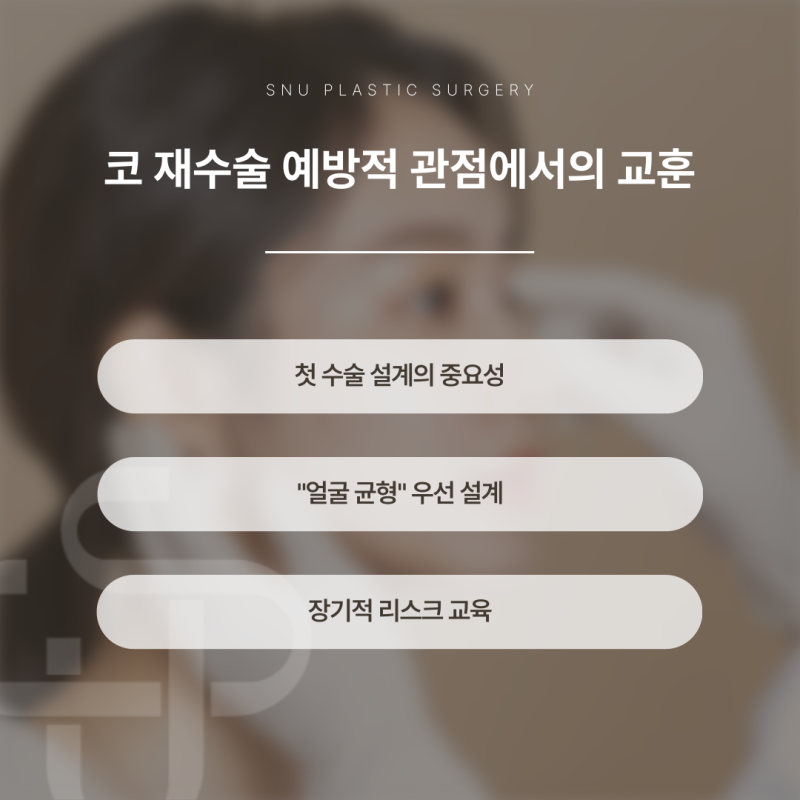
✅ Importance of Initial Surgery Design
The nasal tip should be constructed with autologous cartilage (septum, ear),
and the implant height for the nasal bridge should be limited
to match the skin thickness.
✅ Prioritizing ‘Facial Balance’ in Design
Biometric standards such as the forehead-nose-lip angle (120-130 degrees)
and nasal length (1/3 of facial length) must be adhered to.
✅ Education on Long-Term Risks
Medical professionals should state that the maintenance of surgical results
using implants averages 10-15 years,
and explain the advantages of autologous tissue surgery
to guide patients towards a rational choice from the first surgery.

The success of revision rhinoplasty depends on the principle of
‘on time, in moderation, and safely.’
Surgeries beyond the second carry a high risk of exceeding tissue limits.
Medical professionals should present the non-linear correlation between
the number of surgeries and complications with objective data,
and aim for perfection in the first surgery.
Homepage
📌 KakaoTalk Channel (Click image below to navigate)

Frequently Asked Questions
Why is nose revision surgery more frequent than other plastic surgeries?
Yes, the nose is at the center of the face, making it vulnerable to trauma and infection, and its rich blood supply allows inflammation to spread easily. Additionally, factors such as capsular contracture due to artificial implants, discrepancies with aesthetic expectations, and difficulties in patient management collectively contribute to the frequent occurrence of revision surgeries.
What are the characteristics of nose shapes prone to contracture?
Yes, the risk of contracture is high in sharp, upturned noses or noses with L-shaped silicone implants. This is because excessively lifting or raising the nasal tip increases skin tension, and if the implant extends to the nasal tip, the risk of inflammatory contracture due to bacterial infiltration increases.
How can adverse reactions be minimized during nose revision surgery?
Yes, thorough pre-operative evaluation is crucial to remove artificial implants and utilize autologous costal cartilage or autologous dermis, completely remove inflammatory tissue, and reconstruct a stable support structure. Additionally, a conservative height setting, reducing the bridge height by 10% compared to the first surgery, is important.
What management methods are necessary after nose revision surgery?
Yes, refraining from smoking and drinking for 4 weeks after surgery and using a nasal rinse helps prevent infection. For tissue stabilization, it is advisable to observe the progress for at least 6 months to 1 year after surgery and consider revision surgery after adhesion has softened.
What lessons can be learned to prevent nose revision surgery?
Yes, in the first surgery, careful planning is important: using autologous cartilage for the nasal tip and limiting implant height for the nasal bridge according to skin thickness. Also, prioritizing facial balance is key, and medical staff should explain the duration of implant surgery results and the advantages of autologous tissue surgery to guide reasonable choices.
What are the risks of undergoing multiple nose revision surgeries?
Yes, the incidence of complications increases exponentially with the number of surgeries. Human tissue is vulnerable to repeated surgeries, which can accelerate tissue necrosis or scar adhesion, so surgeries beyond the second carry a very high risk of exceeding tissue limits.