2026-07-21
Autologous Fat Grafting: From Volume Restoration to Regenerative Medicine
Autologous fat grafting has evolved significantly, from early open procedures to modern techniques like Coleman's method and nanofat grafting, offering natural, long-lasting results and regenerative benefits.

Hello.
This is Dr. J from Cheongdam SNU Plastic Surgery Clinic.
While anti-aging procedures using synthetic materials are on the rise,
autologous fat grafting continues to hold a unique position in plastic surgery
due to its excellent efficacy and safety.
Autologous fat grafting
provides natural results based on 100% biocompatibility,
theoretically enabling semi-permanent improvement.
In this article, we will delve into the historical evolution of autologous fat grafting,
recent technological advancements, particularly Dr. Coleman's groundbreaking centrifugation method,
and the regenerative medicine approach of nanofat grafting.
# The Origin and Development of Autologous Fat Grafting
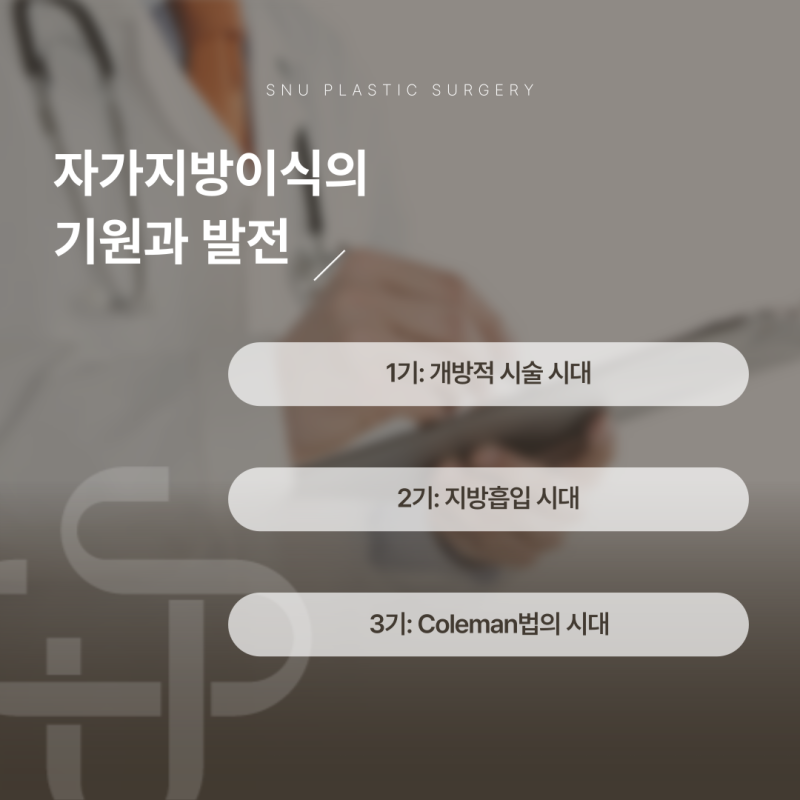
The history of autologous fat grafting has evolved over three centuries,
divided into the following three periods:
📍 Period 1 - Open Surgical Era (1889-1977)
In 1893, Neuber performed the first fat graft to correct facial depressed scars.
At that time, fat tissue was surgically excised for harvesting.
📍 Period 2 - Liposuction Era (1977-1994)
With the introduction of liposuction in the mid-1970s,
an innovative method emerged to extract fat without incision.
However, fat processing methods during this period were relatively crude.
📍 Period 3 - Coleman Method Era (1994-Present)
With the standardization of fat processing through centrifugation and injection
by Dr. Coleman (an American plastic surgeon),
autologous fat grafting became a procedure that could yield relatively more
predictable and stable results than before.
His low-trauma principle significantly increased the survival rate of fat cells.
# 21st Century Innovation: The Emergence of Nanofat Grafting

While Coleman's technique primarily aimed to increase the survival rate of fat injection,
the emergence of nanofat grafting was an innovation in the physical method
of directly extracting adipose-derived stem cells.
🔎 Principle of Nanofat Grafting
This method involves passing fat through a fine mesh developed by Tulip Medical (USA),
which physically pulverizes mature fat cells while allowing smaller stem cells to survive.
This is essentially a process of directly creating an adipose-derived stem cell extract.
✨ Key Effects
Nanofat has shown excellent effects in collagen regeneration and elasticity restoration,
and even before the introduction of synthetic materials like Rejuran, Juvelook, Radiesse,
and HiloWave, it effectively served the realm of regenerative therapy through autologous fat grafting.
# The Current State of Autologous Fat Grafting: Complementary Use of Two Techniques
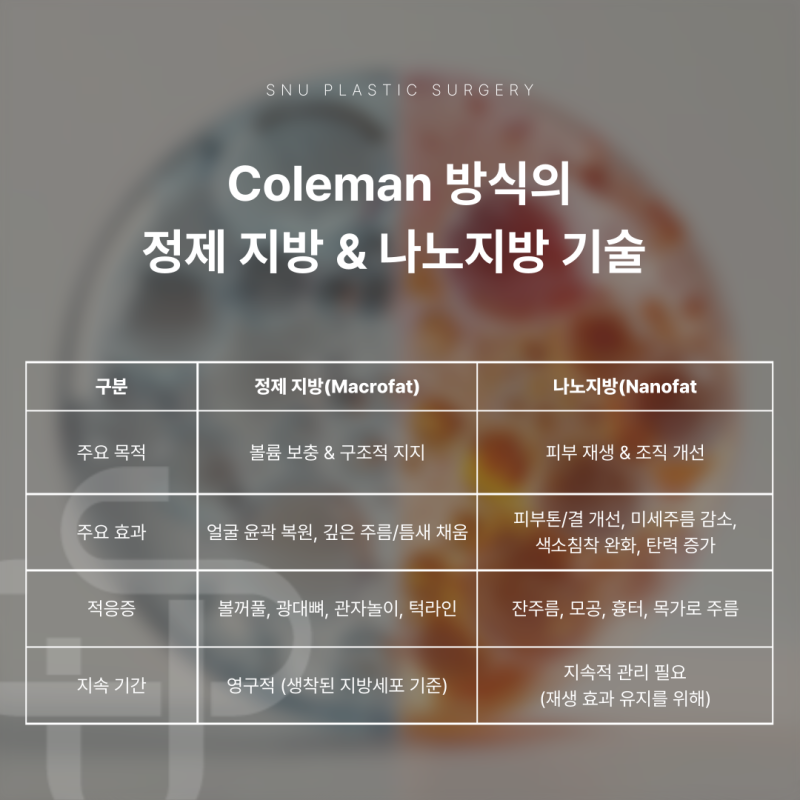
Today, autologous fat grafting utilizes the refined fat from the Coleman method
and nanofat in a complementary manner, each leveraging its own advantages.
The table below compares the main features and indications of the two techniques.
# Advantages and Precautions
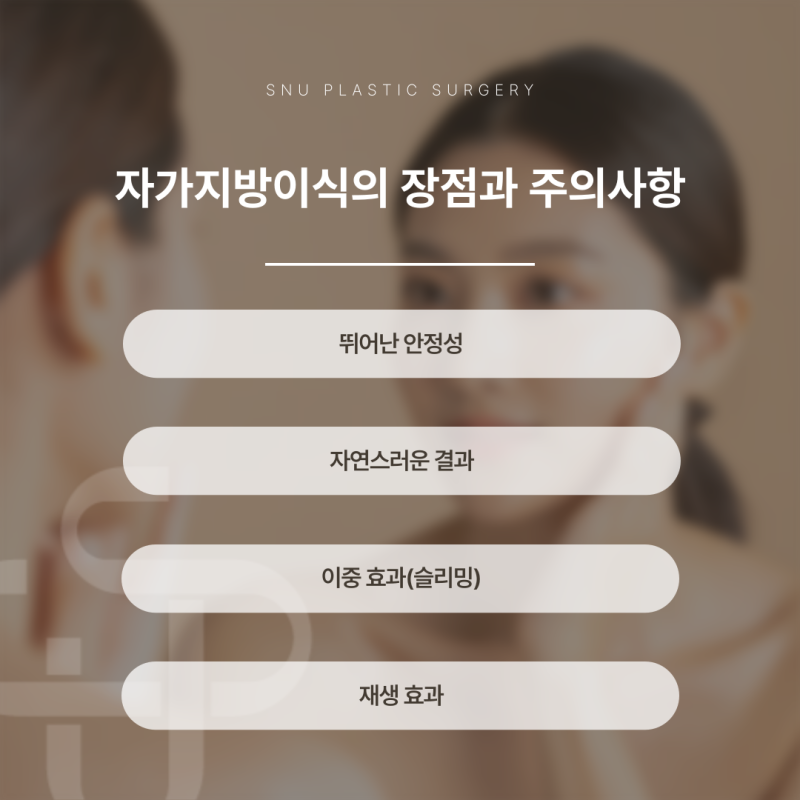
✨ Excellent Safety
Since autologous tissue is used,
the risk of allergic reactions or rejection is low.
✨ Natural Results
Provides a more natural appearance and feel than traditional implants.
✨ Dual Effect
By harvesting fat from the donor site,
a slimming effect in that area can also be expected.
✨ Regenerative Effect
Mesenchymal stem cells abundant in fat tissue promote blood vessel formation
and collagen production at the graft site,
improving skin quality and tone.
# Disadvantages and Precautions
⚠️ Volume Limitations
Generally, only small volume increases are possible,
primarily limited to the facial area, and occasionally applicable to the breasts,
but not suitable for those desiring significantly larger breasts.
⚠️ Unpredictability
20-50% of the grafted fat may not survive and can be reabsorbed,
potentially requiring additional procedures.
⚠️ Importance of Medical Team's Expertise
The results can vary significantly depending on the skill and experience of the medical team
in all stages of harvesting, processing, and injection.

Autologous fat grafting achieved improved survival rates and predictability
with the standardization of the centrifugation method by Dr. Coleman,
and with the advent of nanofat grafting,
its scope has expanded to the realm of regenerative medicine.
The complementary combination of refined fat for structural support and volume augmentation,
and nanofat for skin regeneration and collagen activation,
presents a new paradigm in modern anti-aging treatment.
Even in an era where synthetic materials like Rejuran are gaining attention,
autologous fat grafting, with its biocompatibility and proven efficacy,
remains an attractive anti-aging procedure in plastic surgery.
Homepage
📌 KakaoTalk Channel (Click image below to navigate)