2026-07-21
6 Types of People Who Should Reconsider Plastic Surgery Before Going Under the Knife!
Before undergoing plastic surgery, it's crucial to assess your readiness. This article outlines 6 types of individuals who should reconsider surgery, including those with excessive anxiety, perfectionists, and those undergoing major life changes.
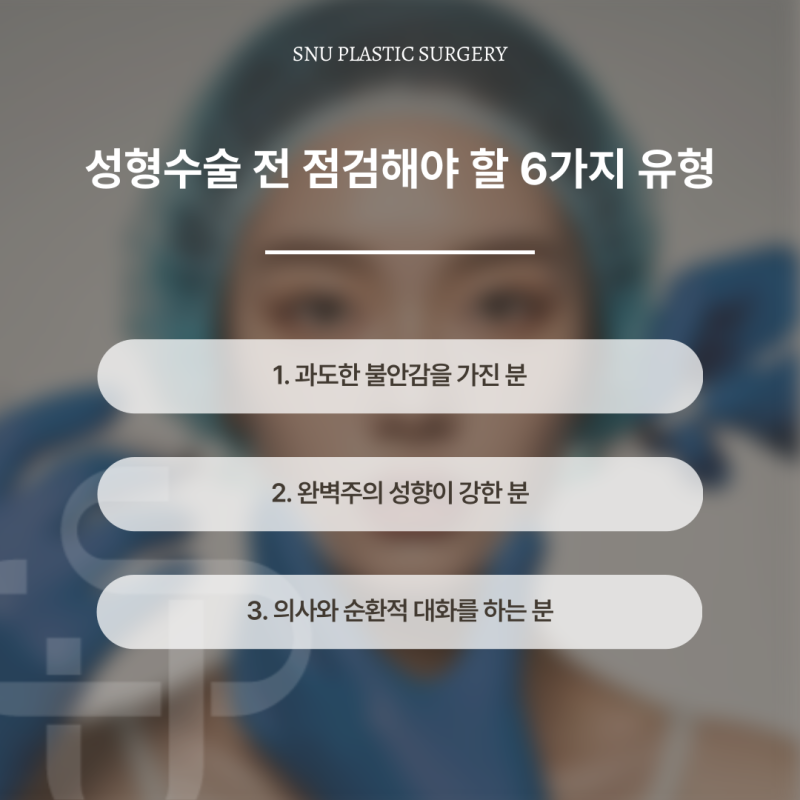
Before plastic surgery, be sure to check! 6 types of people who should reconsider surgery!

Hello,
This is Dr. J from Cheongdam SNU Plastic Surgery Clinic.
Among plastic surgery medical staff, a more common regret than surgical failure is the disparity between expectation and reality.
Today, I will analyze the key factors that determine post-surgical satisfaction and present medical reasons why certain individuals should reconsider plastic surgery.
# 6 Types of People Who Should Be Checked Before Plastic Surgery
1. Individuals with excessive anxiety
✅ Problem:
Anxiety promotes the secretion of stress hormones like cortisol, which slows down wound healing.
🔎 Case Study:
According to a Seoul National University Hospital study, individuals with higher anxiety levels experienced swelling for over 30% longer after surgery.
🪄 Solution:
Ensure psychological stability before surgery.
2. Individuals with strong perfectionist tendencies
✅ Problem:
The idea that ‘corrections must be made down to the millimeter’ leads to unrealistic expectations. Biological tissues naturally have some asymmetry.
📍 Warning:
If ‘90% improvement is still unsatisfactory,’ there is a risk of severe complications such as nasal cartilage damage or skin necrosis from repeated revision surgeries.
3. Individuals who engage in ‘circular conversations’ with their doctor
✅ Symptom:
Repeated questions like the following:
Q. Can the tip of my nose be at a 45-degree angle?A. Due to biological structure, 40 degrees is the limit.Q. Then what about 44.9 degrees?
✅ Meaning:
This indicates an inability to accept medical limitations and an excessive obsession with the surgical outcome.
🪄 Solution:
Seek objective opinions from 2-3 specialists and set realistic goals.
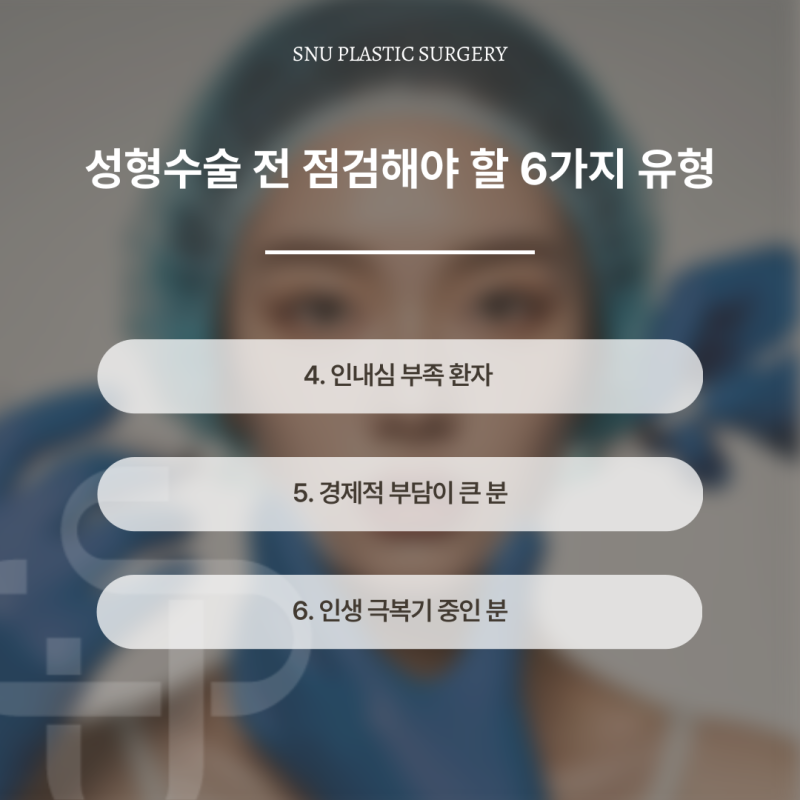
4. Impatient patients
✅ Symptom:
Individuals who demand perfect results immediately after surgery.
✅ Meaning:
Biological tissues undergo three stages of healing: inflammatory phase (1-2 weeks) → proliferative phase (3-6 weeks) → remodeling phase (3-12 months). Early evaluation of swelling/bruising is the cause of 90% of misjudgments.
🪄 Solution:
Post-surgical satisfaction is 30% skill and 70% patience. If your personality matches this type, start by training yourself to trust the natural healing process.
5. Individuals with significant financial burdens
✅ Statistics:
38% of patients who visited for plastic surgery complications responded, ‘I even took out a loan for a satisfactory result.’
✅ Problem:
Financial stress leads to pressure like, ‘If I spent this money, it must be perfect,’ making even minor dissatisfactions difficult to bear.

6. Individuals going through a major life event such as divorce or breakup
✅ Risk:
During periods of emotional instability, it’s easy to have an irrational expectation that ‘changing my appearance = solving my problems.’
📍 Warning:
Plastic surgeons emphasize, ‘Surgery is forbidden during depression or identity confusion.’
💡Key Formula💡Happiness = Reality – Expectations
If expectations are excessively high, even excellent results can feel like ‘disappointment.’
# List of ‘Problematic Surgeries’ that require special attention: Facelift, Forehead Reduction, Dimple Creation, Alar Reduction
We have compiled procedures that are not well-suited for Koreans or have a high incidence of side effects.
📌 Risky procedures that must be considered before plastic surgery (representative examples)

# 3 Tips to Increase Surgical Satisfaction
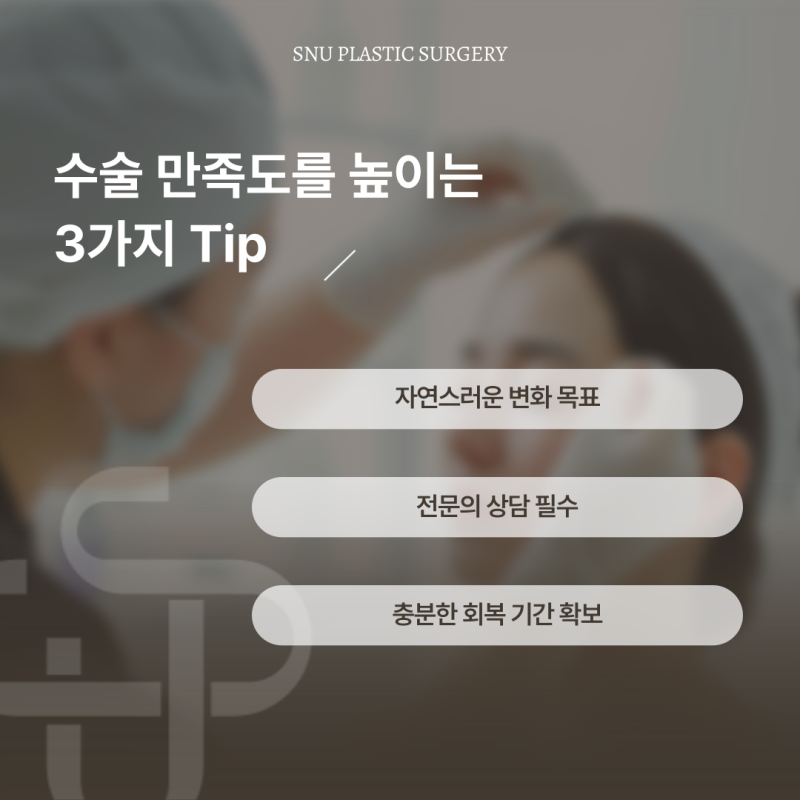
1. Aim for natural changes
Approach it with the concept of ‘an upgraded version of your former face.’
2. Specialist consultation is essential
Plastic surgeons differ from general practitioners in their ‘ability to manage safety.’
3. Secure sufficient recovery time
Abandon rigid timelines like ‘if swelling doesn’t go down within a month, it’s a failure.’ Tissue stabilization takes 6-12 months.
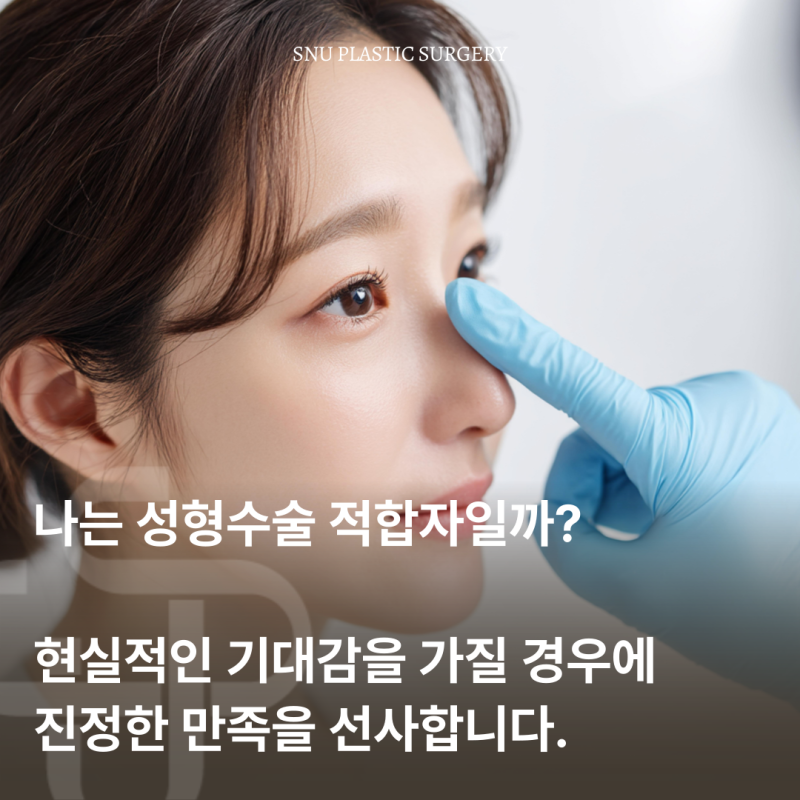
Am I a suitable candidate for plastic surgery?
Even if a doctor says, ‘This much is a success,’ if you think, ‘My jawline needs to be 1mm sharper to be perfect,’ it’s wise to avoid surgery with your current mindset.
Plastic surgery is not a modification of the body but an expansion of the self.
It brings true satisfaction only to those with realistic expectations.
If you fall into any of the above 6 types, I recommend taking a 3-6 month grace period before making a decision.🙏🏻
Homepage
📌 KakaoTalk Channel (Click image below to move)