2026-07-21
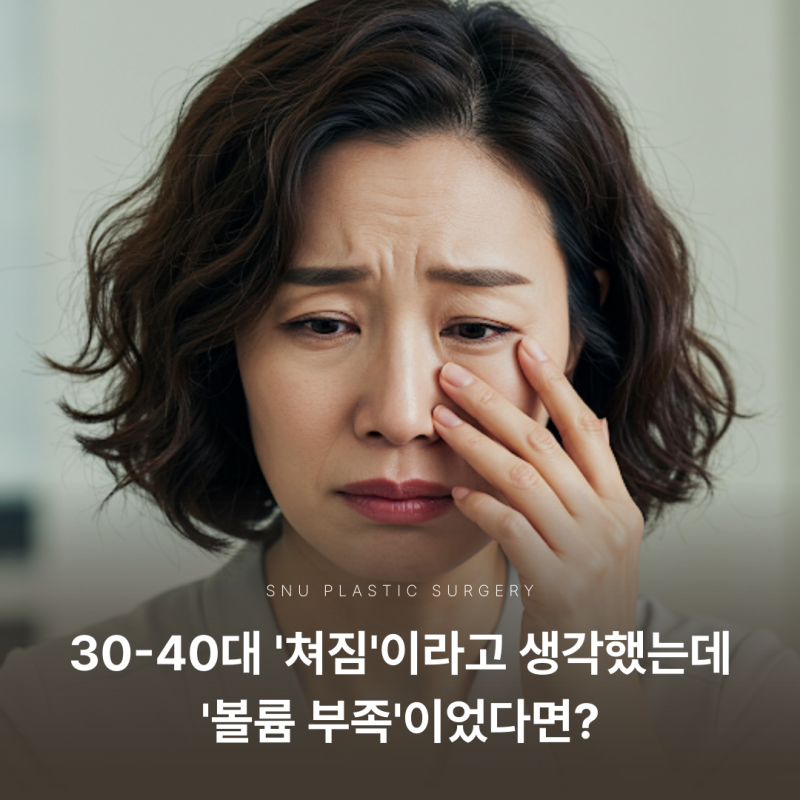
If you thought it was 'sagging' in your 30s-40s, but it was actually 'volume loss'?
Many in their 30s-40s mistake volume loss for sagging. This article explains how to distinguish between true sagging and volume deficiency, offering non-surgical solutions like fillers, biostimulators, and skin tightening treatments for a natural, youthful appearance.
If you thought it was 'sagging' in your 30s-40s, but it was actually 'volume loss'?

Hello.
This is Dr. J from Cheongdam SNU Plastic Surgery Clinic.
Many individuals, especially those in their 30s and 40s
who lack facial fat,
often complain that their ‘face is sagging’
and seek lifting procedures.
However, upon closer inspection,
the cause is often entirely different
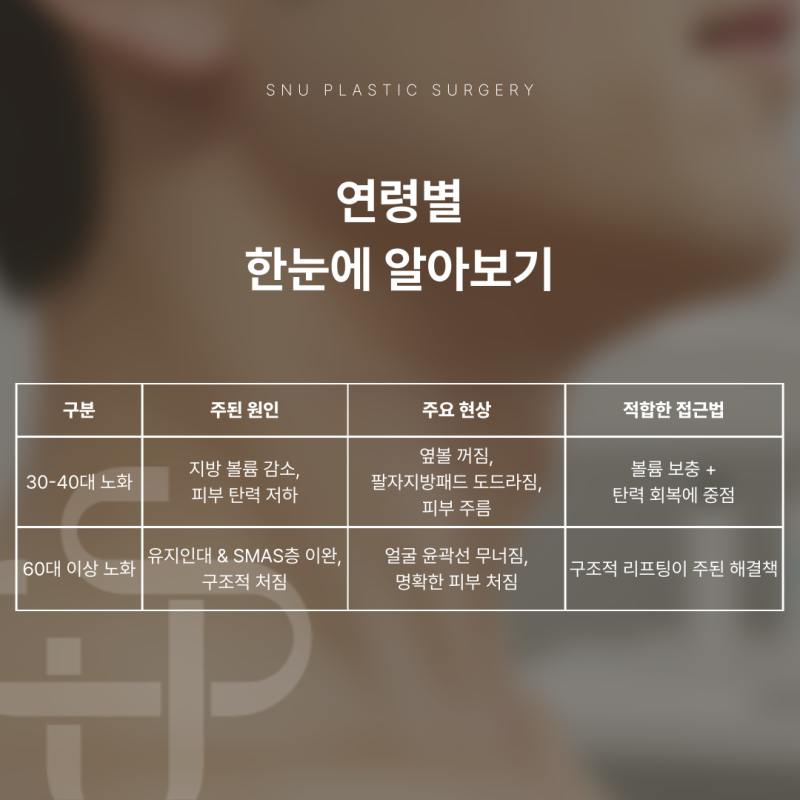
from the structural sagging of the SMAS layer
seen in individuals aged 60 and above.
Did you know that your feeling of ‘sagging’
might actually be an optical phenomenon
created by ‘decreased volume in the buccal fat pad’
and ‘reduced skin elasticity’?
Don't rush into lifting procedures.
Focusing solely on one or two treatments
can actually lead to a counterproductive effect
where facial volume is further lost.
The real problem isn't 'sagging,' but 'volume loss'
The main characteristics of early aging in your 30s and 40s
are changes in fat volume
and a decrease in skin elasticity.
🔎 Key Symptoms
1) Sunken temples
2) Nasolabial fat pads appear relatively prominent
3) Overall tired and fatigued impression
This is like a pillowcase without a pillow;
as the supporting volume disappears,
the overlying skin and fat
appear to sag.
It's not ‘sagging’ in the true sense,
but rather a state that requires ‘volume redistribution’.
Aging in 30s-40s vs. Aging in 60s+
In such cases, a recommended non-surgical solution
is to replenish lost volume and restore skin elasticity
as much as possible, rather than focusing on lifting,
which yields more natural improvement.
✨ Methods to replenish volume
✅ Filler Injections
Hyaluronic acid fillers
provide immediate volume
to sunken areas such as under the eyes, nasolabial folds, and chin.
Injecting filler into the depressed areas of the maxilla (below the nose, next to the cheeks)
and the cheek fat pad position
can help conceal the contour of the nasolabial fat pads.
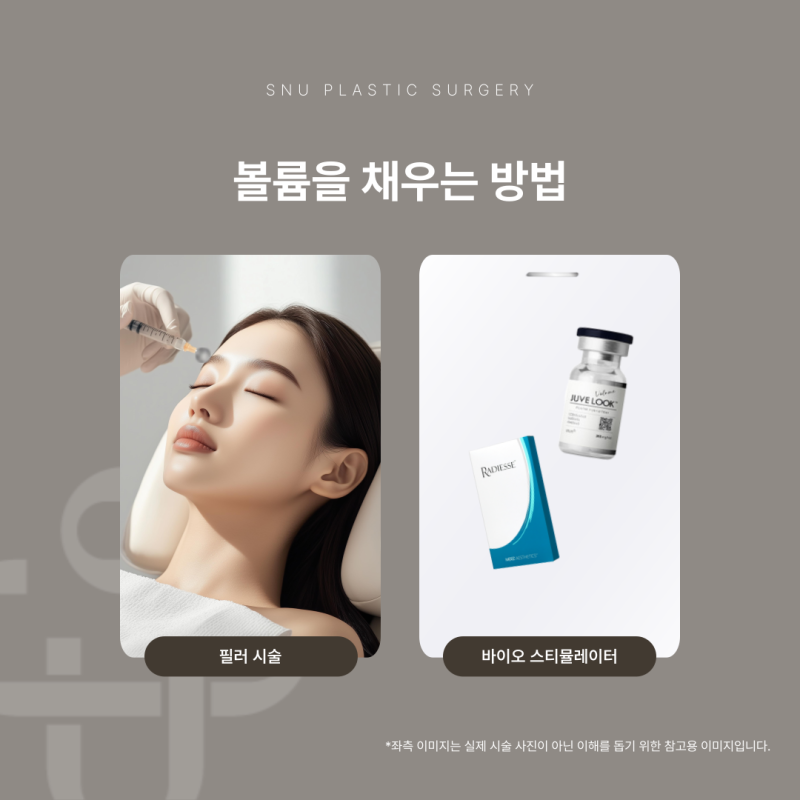
✅ Bio-stimulators
Preparations containing PLLA (Poly-L-lactic acid),
CaHA (Calcium Hydroxylapatite),
and DHC (Dual Hyaluronic Complex)
promote collagen production within the skin.
JuveLook Volume, Radiesse, and Hilo Wave are examples,
allowing for natural and long-lasting
volume restoration (typically 1-2 years or more).
Effects appear gradually (1-3 months),
making them suitable for those who desire
non-artificial changes.
✨ Methods to restore skin elasticity
✅ Thermage
Thermage, using radiofrequency laser,
applies heat deep into the skin
to induce collagen production.
It restores elasticity to sagging skin,
providing a natural lifting effect.
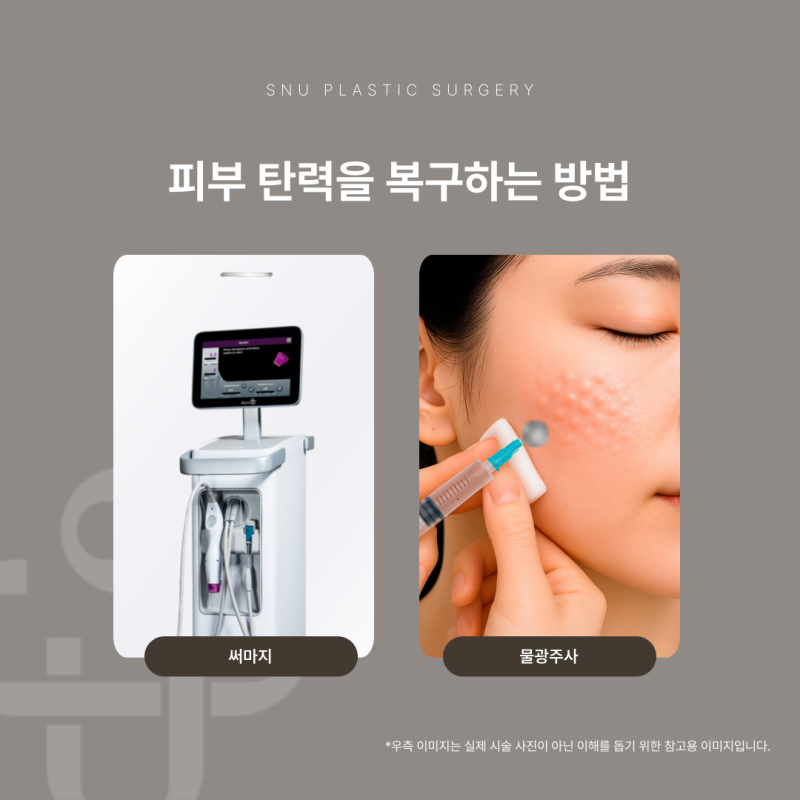
✅ Skin Boosters
Hyaluronic acid is injected
into the dermal layer of the skin,
making it moist and radiant.
Hydrated skin itself gives the effect
of appearing more elastic.
Concealing Nasolabial Fat Pads with 'Volume Redistribution'

For prominent nasolabial fat pads,
a strategy of supplementing volume from above and below
to conceal the contour in between is effective.
✔️ Upper replenishment
Fill the cheek fat pad with filler
to increase central volume.
✔️ Lower replenishment
Use filler or bio-stimulators
in the sunken temples
to create lower support.
✔️ Elasticity enhancement
Thermage and skin boosters
increase overall skin tension,
preparing a firm foundation
where volume can be maintained.
Through this comprehensive approach,
the nasolabial fat pads naturally
settle between the contours,
and overall facial hollowness and
fatigue are improved.
Treatment approaches to be cautious of
📍 The trap of simple lifting procedures
Blindly choosing only lifting procedures like Ultherapy
can actually worsen the situation.
If only lifting energy is applied to a face
that already lacks volume,
the remaining fat cells and tissues
may atrophy, leading to further volume loss,
a counterproductive effect.
This is like continuously pressing an iron
on a wrinkled garment.
Just as the fabric can be damaged,
skin tissue can also be damaged.
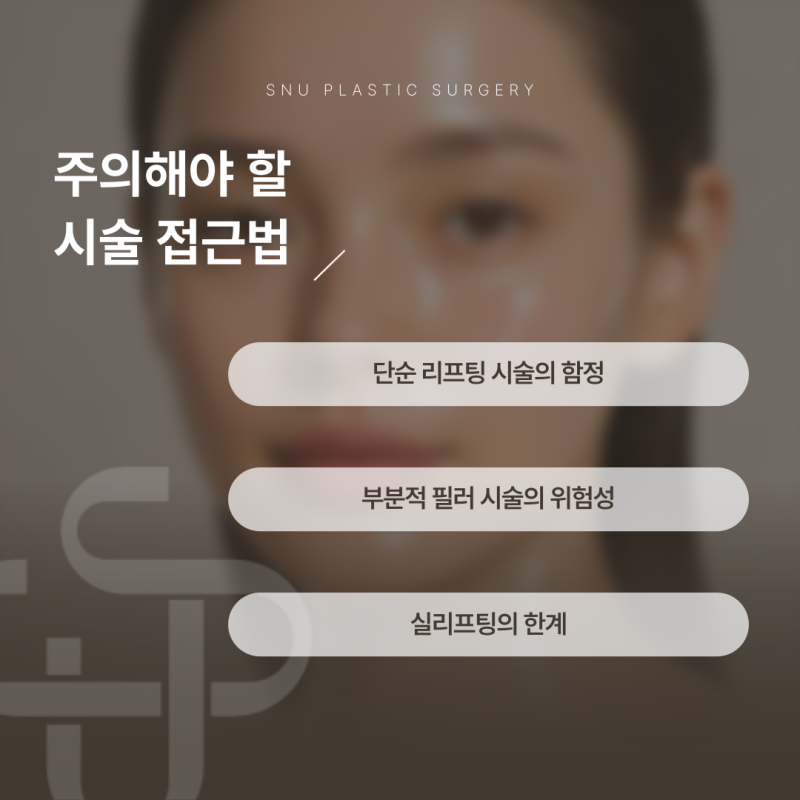
📍 The risk of partial filler injections
Filler injections that selectively
replenish volume only in the nasolabial fold area
can be more risky than expected.
This can emphasize the volume of the nasolabial fat pad even more,
making the wrinkles appear deeper and more pronounced.
It's similar to how piling soil in a valley
can make the depth of the valley
more prominent.
📍 Limitations of thread lifting
Thread lifting, despite its name 'lifting',
mostly provides fascial fixation effect with minimal actual tissue movement.
It is difficult to be a fundamental solution
for the problem of volume loss
in individuals in their 30s and 40s.
Often, patient satisfaction after the procedure is low,
leading to a waste of unnecessary treatment costs and time.
Conclusion: Sufficient consultation with a specialist is essential
Early aging in your 30s and 40s
is a complex issue, not just simple 'sagging'.
Various factors are intertwined, such as
decreased fat volume, bone structure indentation,
soft tissue sagging, and reduced skin elasticity.
Therefore, one should not be fixated on one or two procedures
and overlook the overall facial structure
and aging pattern.

The wisest approach is
to receive a comprehensive diagnosis from a plastic surgeon
to determine what type of facial aging you have
and what solutions are appropriate for you.
A balanced combination of various non-surgical methods,
such as fillers/bio-stimulators for volume redistribution,
and Thermage/skin boosters for skin elasticity restoration,
is the shortcut to achieving natural and satisfying results.
As a plastic surgeon,
I believe it's important not just to recommend procedures,
but to accurately analyze patients' concerns
and provide customized solutions suitable for each individual.
For those in their 30s and 40s who are concerned about
lack of volume and elasticity, I sincerely advise you
to consult with a specialist rather than being swayed by popular procedures
you hear about, to understand what you truly need.
※ This article is based on the medical knowledge of a plastic surgeon,
but individual situations and results may vary.
A hospital visit is recommended for accurate diagnosis and consultation.
Homepage
📌 KakaoTalk Channel (Click image below to go)