2026-07-21
Cosmetic Surgery for Seniors: What are the Criteria for a Rational Choice?
As interest in 'well-aging' grows, more seniors are seeking cosmetic surgery. This article discusses rational approaches to cosmetic procedures for those over 70, emphasizing functional improvement, avoiding excessive changes, prioritizing health, and setting realistic expectations.
Cosmetic Surgery for Seniors: What are the Criteria for a Rational Choice? (An Honest Doctor's Perspective)

Hello.
This is SNU Plastic Surgery.
Recently, the frequency of patients over 70
seeking cosmetic surgery consultations
has clearly increased.
As society pursues a vibrant and healthy
‘well-aging’,
interest in appearance management
has naturally risen.
However, as a doctor,
especially for patients over 70,
I believe that a more cautious and rational approach
is needed for cosmetic surgery that seeks dramatic changes,
such as extensive facelifts.
Cosmetic Surgery for the Elderly: Growing Demand and Reality
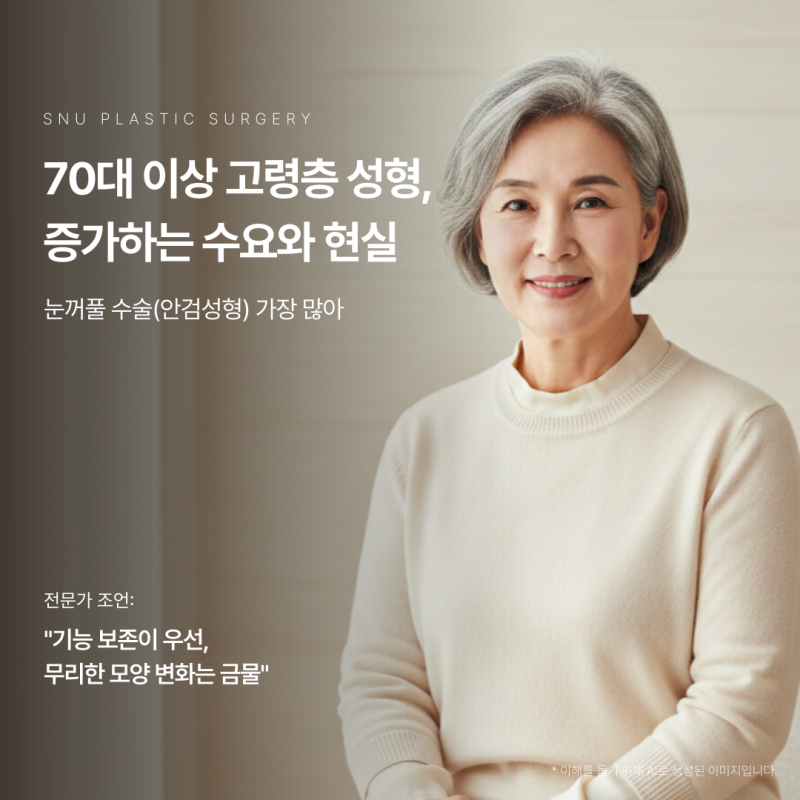
Statistics show that cosmetic procedures for those over 55
have increased by about 28% in the last 10 years.
In Korea, surgeries for this age group are gaining attention
under the names ‘twilight surgery’ or
‘silver tuning’.
Among these, the most commonly performed surgery is
blepharoplasty (upper and lower eyelid surgery)
to correct drooping eyelids.
This aims not just for aesthetics,
but also to solve functional problems that obstruct vision.
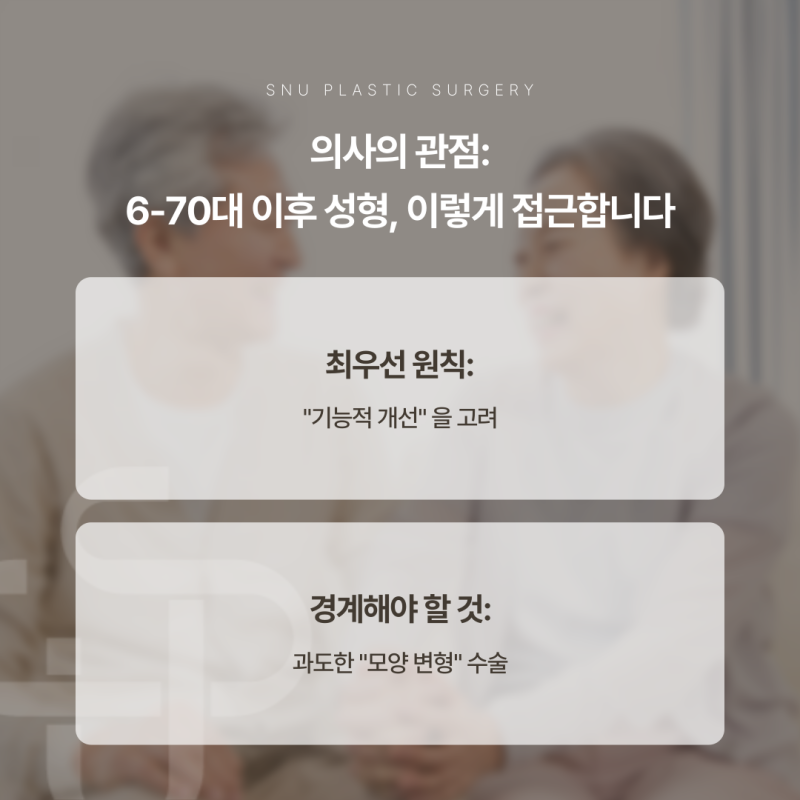
Many fellow doctors would agree that
cosmetic surgery for middle-aged and older individuals
should fundamentally have different goals and approaches than for younger generations.
1. Foremost Principle:
‘Functional improvement’ must be considered.
Aging is accompanied not only by changes in appearance
but also by weakening tissue support, reduced skin elasticity,
and decreased regenerative capacity.
Therefore, the goal of surgery at this stage is not
‘to return to one's past appearance’ but
‘to preserve current function as much as possible,
and to give a healthier and younger-looking
impression’.
👉🏻 Representative example: Eyelid surgery
This surgery widens the field of vision obscured by sagging skin,
improving the quality of life, and naturally
improving the tired impression,
providing a dual benefit.
2. What to be Wary of:
Excessive ‘shape-altering’ surgery
In youth, major surgeries involving bones, such as cheekbone reduction or jawline correction,
are considered.
However, after middle age, such surgeries can
actually cause tissues to sag further,
leading to the counterproductive effect of looking older.
Especially for those over 70,
excessive facelifts should also be approached with caution.
‘Clearly knowing one's physical condition and
limitations’ is
extremely important.
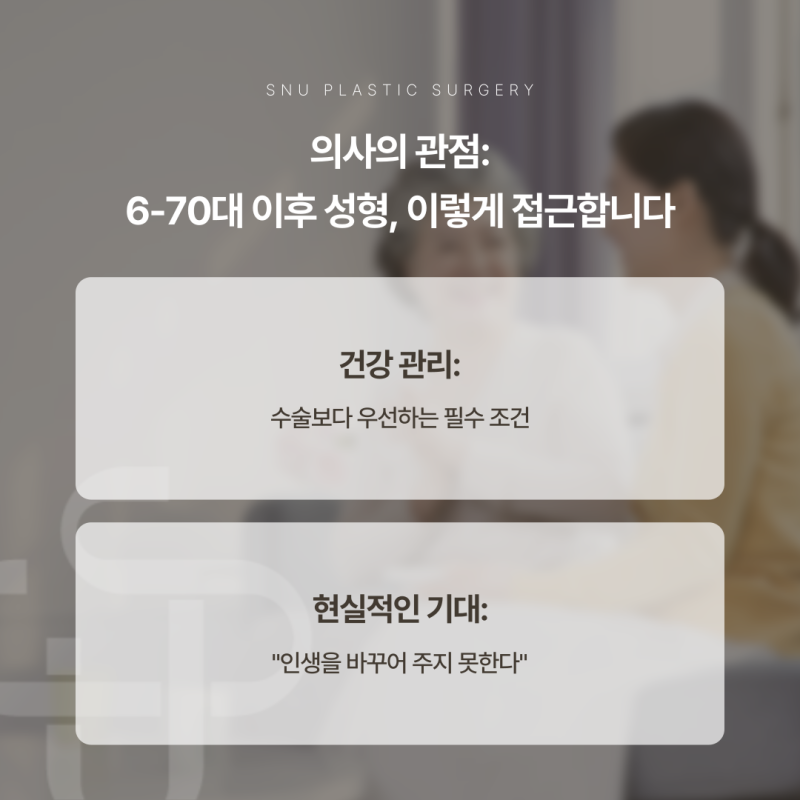
3. Health Management:
A prerequisite that takes precedence over surgery
After the age of 60,
many individuals have underlying conditions such as
diabetes, high blood pressure, and cardiovascular diseases,
and the majority will gradually be exposed to such adult diseases.
These conditions not only increase the risk of general or
sedation anesthesia,
but are also important factors that can
delay post-operative recovery and wound healing.
Furthermore, medical review is essential.
Evaluating the overall physical condition through a precise pre-operative examination,
and if necessary,
consulting with a specialist in the relevant department
is the first step to ensuring safety.
4. Realistic Expectations:
‘It cannot change your life’
Surgery certainly boosts confidence and vitality in life.
However, it is not a magic key that
solves all of life's problems.
Experts also advise, ‘Surgery cannot change your life’.
Instead, building the foundations of life such as
friendships, hobbies,
and positive habits
can be a more fundamental solution.

👉🏻 More important than age:
‘Aging’ and ‘frailty’ always go hand in hand.
What needs medical attention is that
the ‘degree of frailty’ of the body according to ‘biological age’
can have a greater impact on surgical outcomes.
In other words, even if one manages their health well with exercise,
a 70-year-old is absolutely more frail than a body before 50,
and post-operative recovery may be less smooth.
For this reason, doctors must comprehensively assess
the overall lifestyle and health status of elderly patients.
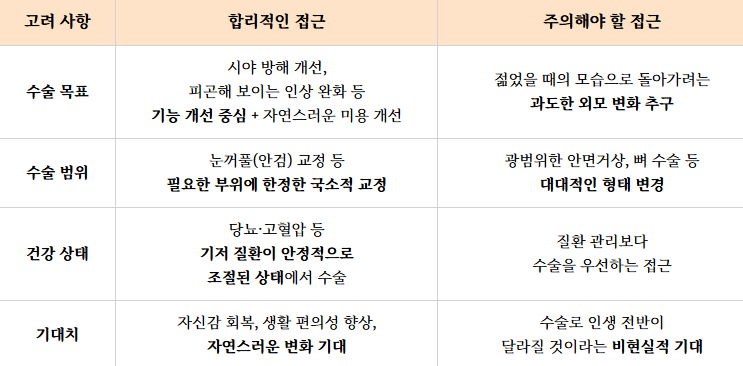
Checklist for Cosmetic Surgery for Seniors
Therefore, if you are considering cosmetic surgery after your 60s or 70s,
we recommend checking the following:
✔️ In conclusion, the principle for cosmetic surgery after 60 is:
‘Less, slowly, and only as much as necessary’.
Rather than drastic changes, pursue natural improvement that complements function,
and even more important than that,
I believe it is the attitude of managing the speed of aging with healthy lifestyle habits
and living a vibrant life appropriate for one's age.
I hope this article provides a small help
in making wiser and
safer choices🙏🏻
Homepage
📌 KakaoTalk Channel (Click image below to move)