2026-07-21
[SNU Plastic Surgery] Facelift, When is the Best Time to Get One?
Learn about the optimal age, effects, and precautions for a facelift. Dr. J from Cheongdam SNU Plastic Surgery discusses who benefits most and potential side effects.
![[SNU Plastic Surgery] Facelift, When is the Best Time to Get One?](/uploads/snuplastic/223966897691/de2458b34a2e6e9e.jpg)

Hello,
This is Dr. J from Cheongdam SNU Plastic Surgery Clinic.
Recently, a popular cosmetic surgery that has become a hot topic among middle-aged individuals is the ‘facelift’.
In the past, mainly people in their 50s and older would come for consultations, but recently, there has been an increasing number of people in their late 40s showing interest. There are even cases where young people in their 20s and 30s come for consultations.
Today, I will discuss the timing of a facelift, its effects, and points to be aware of.
When is the appropriate time to get a facelift?
The most recommended age for a facelift is the 50s.
People in their 50s are actively engaged in social activities and are at an age where they feel the effects of facial aging. Getting a facelift at this time can visibly improve their face, helping them regain confidence and experience high satisfaction.
So, what about people in their 40s or younger?
If the skin is not significantly sagging, I would not particularly recommend this surgery, which leaves scars.
Since the duration of a facelift’s effect is 7-10 years, getting the surgery too early might lead to the skin sagging again in their 50s, raising concerns about needing revision surgery.
Of course, there are exceptions. For those who have skin sagging to a degree similar to someone in their 50s at a relatively early age, we may recommend the surgery.
Effects of a Facelift
A facelift is more effective at sharpening and lifting a sagging jaw and neck area than at smoothing nasolabial folds.
As we age, the skin around the jaw sags, making the jawline appear uneven. People with excessive sagging in the fat layer under the chin can experience significant improvement when they undergo a facelift.
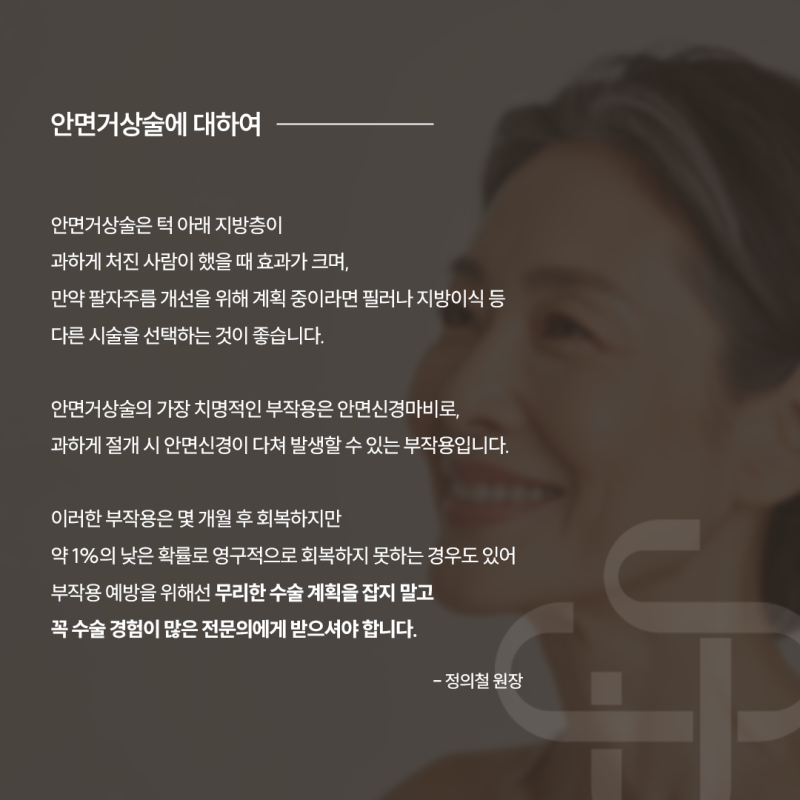
If the primary goal is to improve nasolabial folds, considering other procedures such as fillers or fat grafting might be more suitable.
Facelift Principle and Process
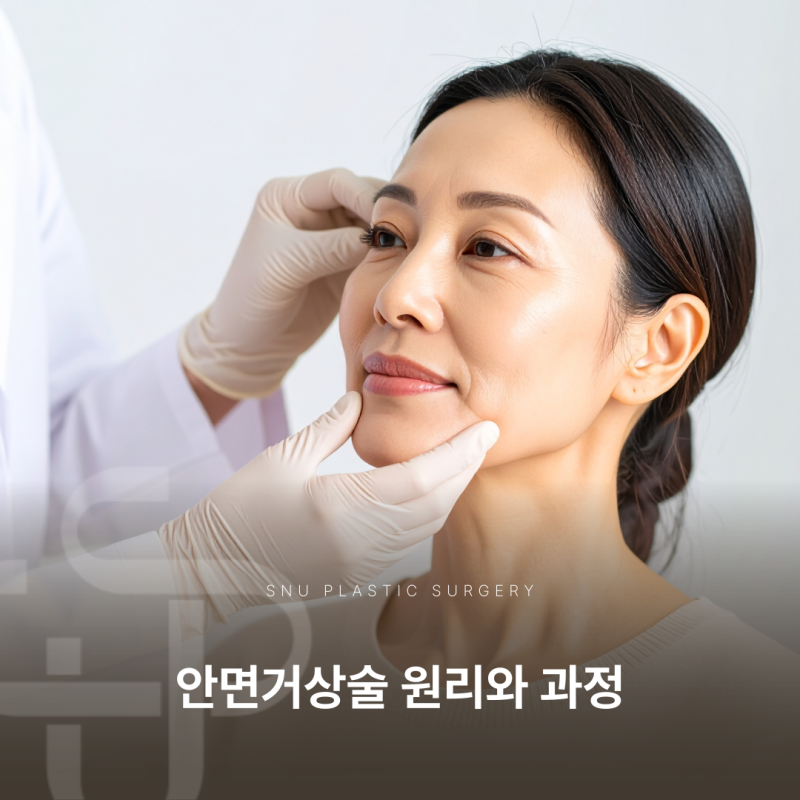
A facelift is a surgery that corrects facial sagging by manipulating the muscle layer (SMAS layer) located between the skin layer and the subcutaneous layer.
After incising the skin in front of and behind the ear to expose the SMAS layer, a decision is made on whether to pull it, remove a part of it, or fix it upwards.
The surgical method varies depending on the decision.
The midface (the area from below the eyes to the corners of the mouth) can be lifted from the front of the ear, and the sagging neck area can be improved from behind the ear.
Performing the surgery by incising around the ear makes it relatively easy to conceal the scars afterward.
However, because the incision is made in front of the ear, there are limitations in accessing the areas next to the nose and around the mouth, where nasolabial folds are deep, to remove them.
Side Effects to Watch Out For
Facelifts can also have side effects.
The most concerning side effect is facial nerve paralysis.
Due to the nature of the surgery, which involves manipulating the muscle layer (SMAS layer) between the skin layer and the subcutaneous layer, excessive incision can damage the facial nerves.
Fortunately, most cases recover within a few months, but there is about a 1% chance of permanent non-recovery.
To prevent such side effects, it is important not to plan an overly aggressive surgery and to have the procedure performed by a specialist with extensive surgical experience.
Cases Where Surgery is Not Recommended: Not Recommended for Elderly, Smokers, or Severely Sagging Skin
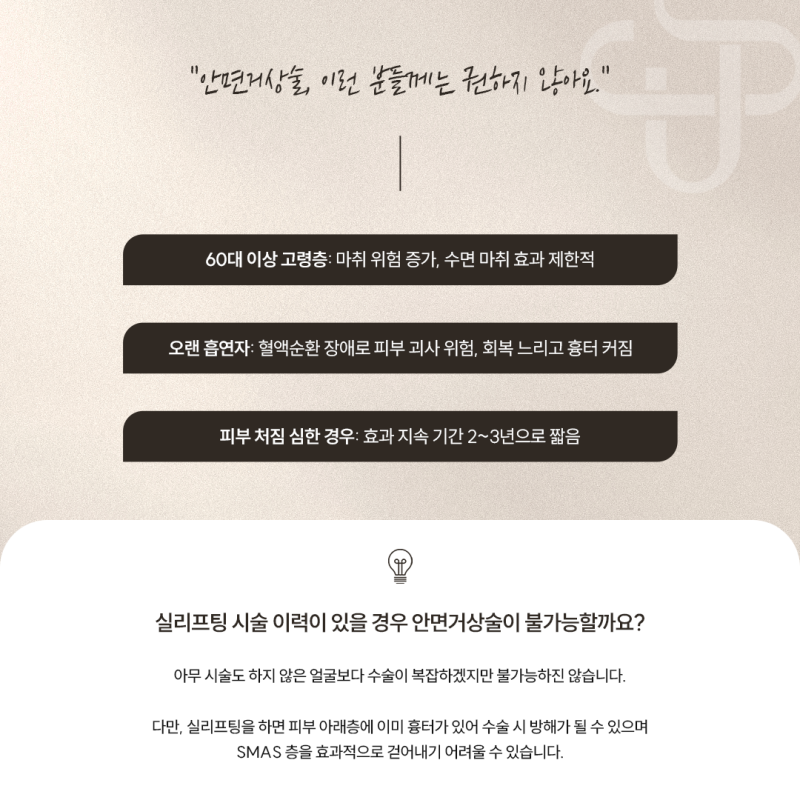
We do not recommend facelifts in certain situations:
✅ For individuals in their 60s and 70s, the risk associated with general anesthesia increases. This age group sees a sudden increase in the risk of sedation anesthesia accidents, requiring the use of low doses. In such cases, the anesthetic effect is almost negligible, leading to a risk of accidents due to pain during surgery.
✅ Smokers are likely to have peripheral circulatory disorders, which can lead to skin necrosis in areas with insufficient blood circulation during surgery. In these cases, the recovery process is slow, scars are larger, and the expected changes may not materialize.
✅ If skin sagging is too severe, we do not recommend it because the post-operative effect is relatively small. In such cases, the duration of the effect is shortened to about 2-3 years.
Facelift After Thread Lift
Is a facelift possible after a thread lift?
There is a rumor online that if you have had a thread lift, you cannot get a facelift, but this is not true.
While the surgery may be more complex than on a face that has not had any procedures, a facelift is still possible.
However, it should be considered that a thread lift can create scars in the underlying skin layer, which may interfere with the surgery, and it might be difficult to effectively manipulate the SMAS layer.
A facelift is not a simple cosmetic procedure. It is a surgery that typically takes more than four hours and requires careful consideration.
If you are considering surgery, please consult thoroughly with a specialist to comprehensively review your condition, age, expected effects, and other factors.
Above all, it is crucial to have the surgery performed by an experienced specialist.
Homepage
📌 KakaoTalk Channel (Click image below to move)