2026-07-21
Can the non-incisional double eyelid surgery (buried suture method) be done after the age of 30 or 40?
For those considering double eyelid surgery after 30 or 40, evaluating eyebrow position and skin elasticity is crucial. Insisting on only the buried suture method may lead to unsatisfactory results and scarring.
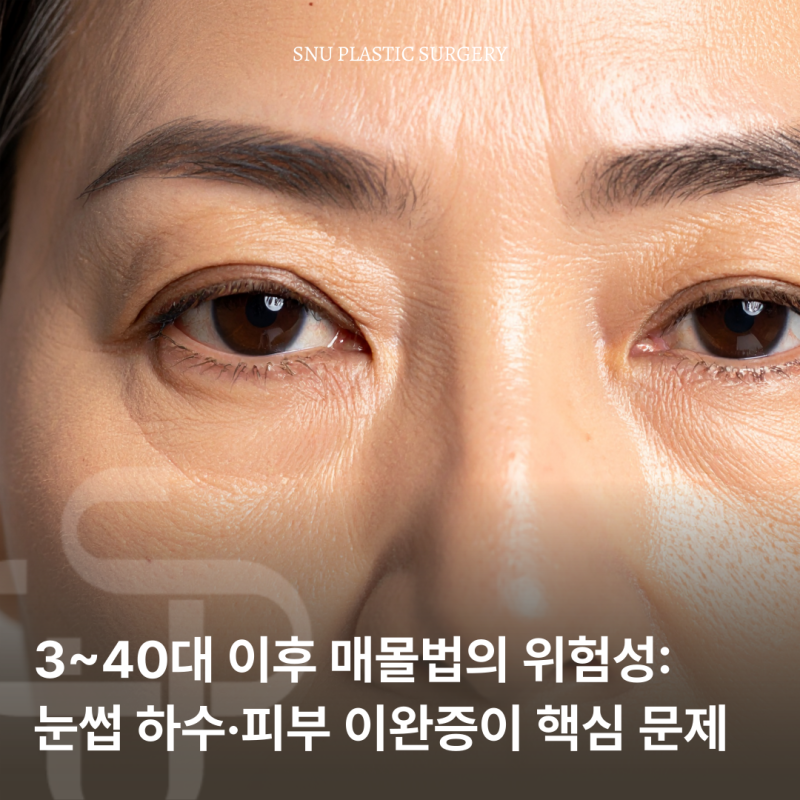
Can the non-incisional double eyelid surgery (buried suture method) be done after the age of 30 or 40?
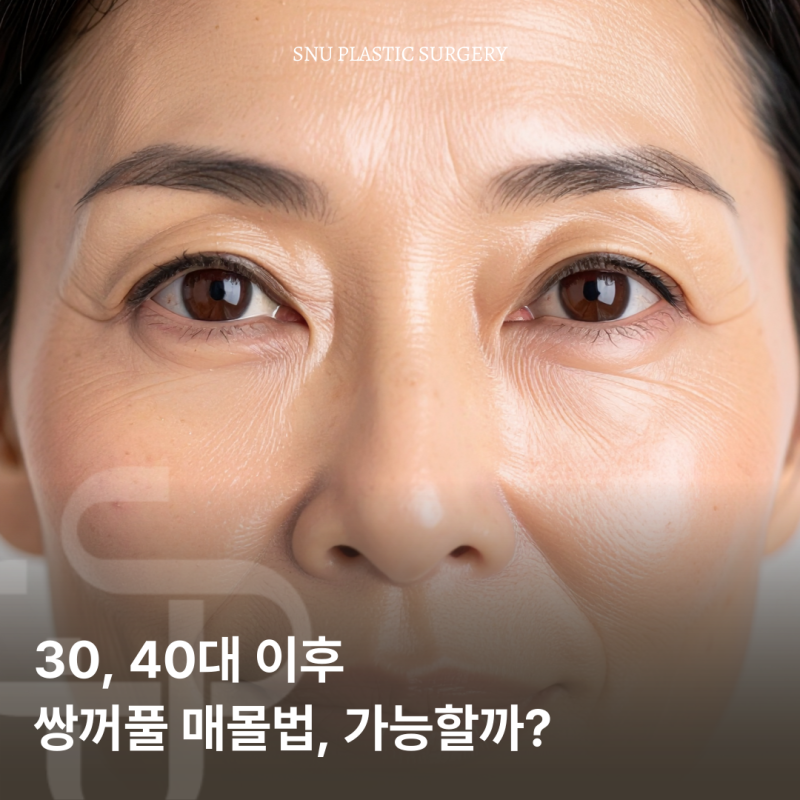
Hello,
This is Dr. J from Cheongdam SNU Plastic Surgery Clinic.
If you are considering double eyelid surgery
after your 30s or 40s,
an evaluation of your eyebrow position and skin elasticity
is paramount.
Insisting solely on the buried suture method
may only leave you with scars.
Today, I offer honest advice
for natural results from double eyelid surgery.
Risks of the buried suture method after the age of 30 or 40
As the population ages, a significant number of people
considering double eyelid surgery after their 30s or 40s
believe that ‘the simple buried suture method will solve it’.
I believe this is due to the perception that the buried suture method is simple and inexpensive,
leading people to try it out, or it's an effect of advertising and promotion for the method.
However, with age, eyebrow ptosis (drooping eyebrows) and upper eyelid skin laxity (sagging eyelid skin) are inevitably accompanied.
This is fundamentally different from the condition of individuals in their teens or 20s,
who have good skin elasticity.
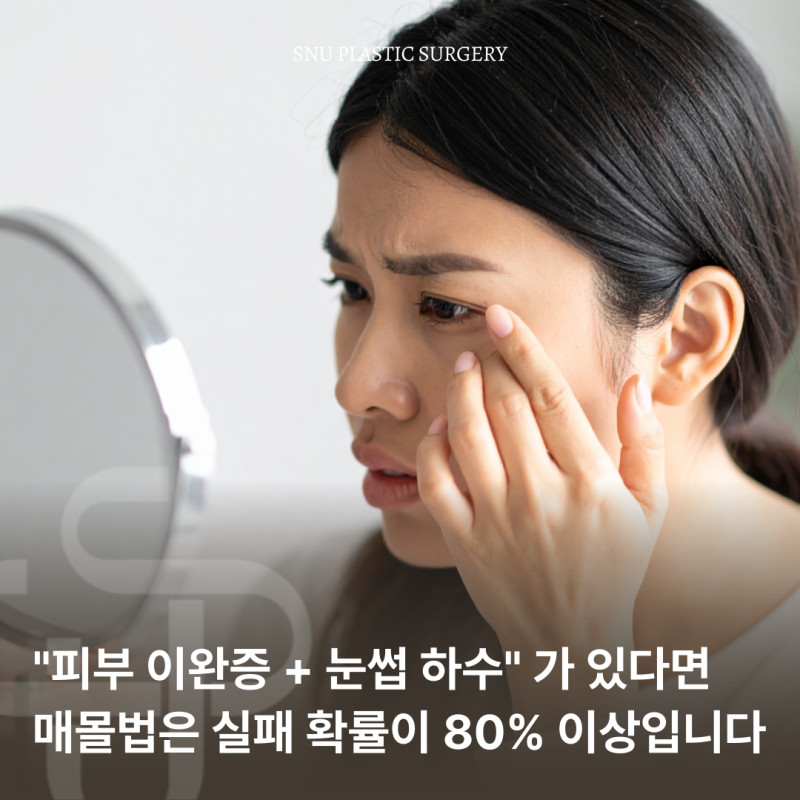
✔️ Impact of Eyebrow Ptosis
As the eyebrows drop,
the eyelid skin appears wrinkled and stretched,
and there's a high probability that the double eyelid line created by the buried suture method
will be hidden or loosen.
The duration of its effect is mostly around 6 months to 1 year.
✔️ Additional Occurrence of Fat Sagging
Tissue changes due to eyebrow ptosis can include
orbital fat (fat in the upper eyelid)
protruding forward.
This cannot be corrected with the buried suture method.
💬 Summary in one sentence:
If you have ‘skin laxity + eyebrow ptosis’,
the buried suture method has a failure rate of over 80%.
I recommend these methods instead of the buried suture method!
1. Incisional Upper Blepharoplasty
This method involves removing excess skin and fat
and correcting the stretched skin by creating a new crease.
This is not merely about creating a double eyelid line
but a process that ‘rejuvenates the eye structure itself’.
❗Key surgical procedures:
Excise sagging skin → Remove excess fat
→ Strengthen and fix the levator muscle if necessary
Simultaneously, natural double eyelid lines such as out-line or semi-out-line can be formed.
❗Caution:
If eyebrow ptosis is severe
and incisional upper blepharoplasty alone
would make the eyelids appear too voluminous,
or if you only wish to expose your natural double eyelid crease,
adding ‘sub-brow lift’ or
‘endoscopic forehead (brow) lift’
to raise the eyebrows is necessary to achieve lasting effects.
✅ For those over 40, the incisional method can actually
shorten the recovery period.
The buried suture method has a higher chance of reoperation due to skin sagging,
leading to a longer total treatment period, whereas the incisional method with a single surgery
can maintain its effect for about 7-10 years.
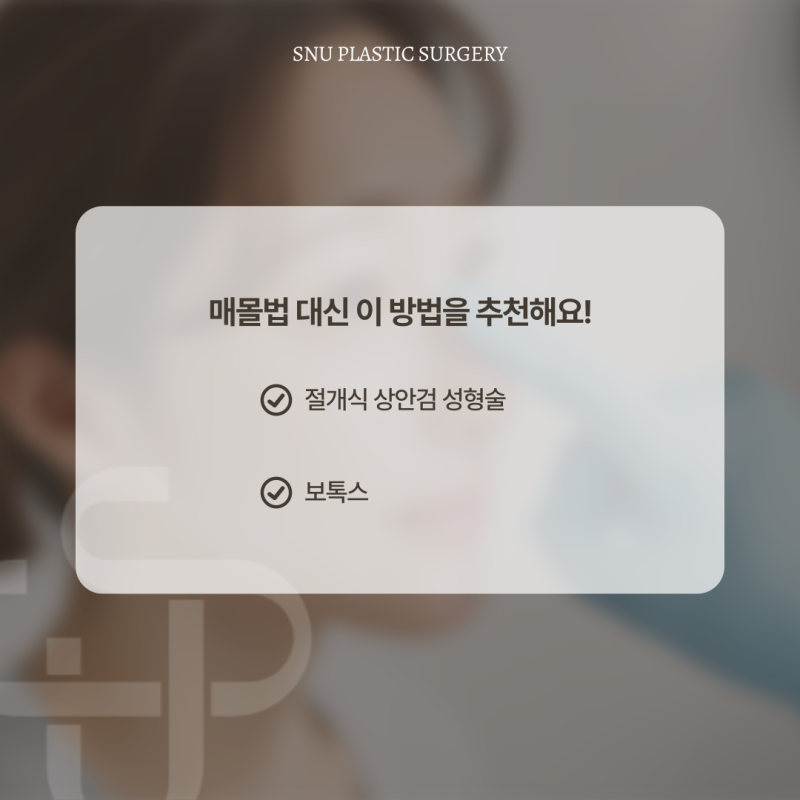
2. Botox
If surgical correction for eyebrow ptosis is too burdensome,
try ‘eyebrow ptosis Botox’ first.
It involves injecting into muscles that pull the eyebrow down, such as the corrugator supercilii and orbicularis oculi,
to improve drooping eyebrows.
❗Advantages:
- Procedure time 10 minutes, effects appear after 3 days
- Cost is about 1/5 of surgery
❗Disadvantages:
About 10% of the surgical effect,
effects are limited to 6 months, requiring continuous management.
❌ Avoid these choices
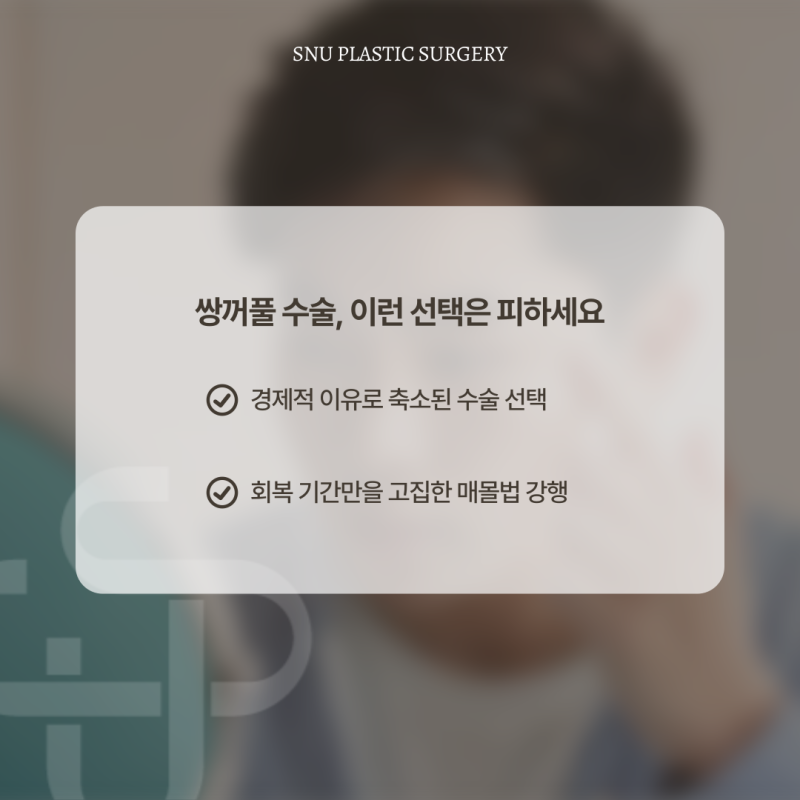
1. Choosing a ‘reduced surgery for economic reasons’
Some clinics may recommend
‘minimizing skin excision’ or
‘buried suture method + partial incision’.
However, this leads to
unsatisfactory results + residual scars.
If the lax skin is not removed,
the double eyelid line may be buried,
or scars may become noticeable.
The more you reduce the surgery
due to economic circumstances,
the more re-operation costs will incur.
2. Insisting on the buried suture method solely for recovery time
Many people are drawn to the quick recovery (3-7 days) of the buried suture method
and choose it,
but for skin conditions after the age of 30-40,
‘double eyelids becoming buried after swelling subsides’
occurs in about 70% within approximately 1 year.
Ultimately, the total recovery period
becomes longer than with the incisional method.
💡Honest advice from an expert
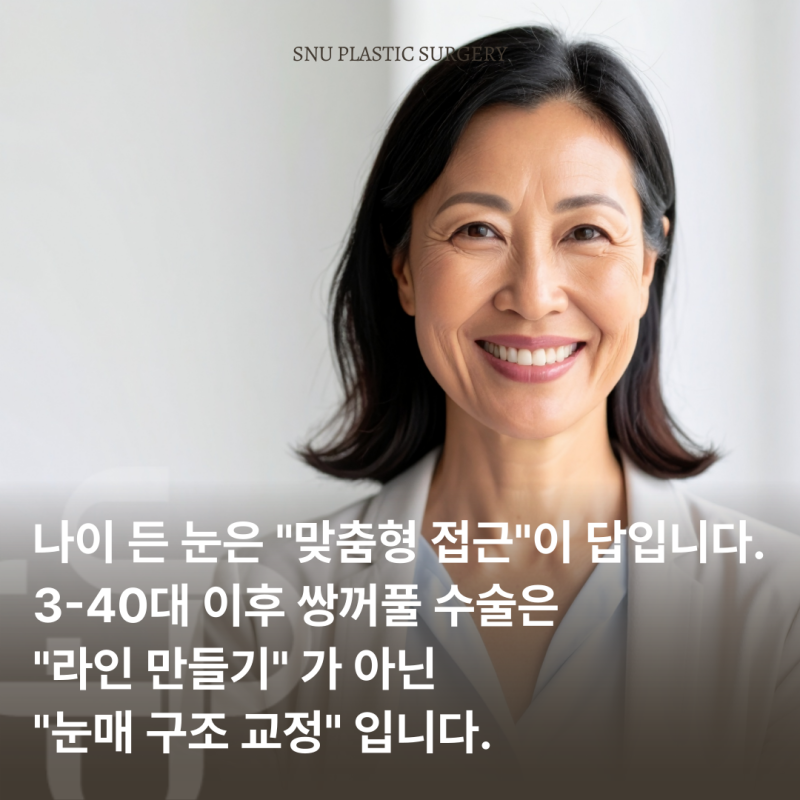
As you age, ‘condition assessment’ comes first.
Be sure to check ‘what is the position of my eyes and eyebrows?’
If the double eyelid line becomes clearer
or your eye shape improves when you lift your eyebrows with your fingers,
the buried suture method will likely
not be applicable.
And take a little more
time for consultation.
Hasty decisions lead to failed surgeries.
✅ I recommend getting an assessment for ‘eyebrow ptosis’,
‘accompanying ptosis’, and ‘skin laxity measurement’
at 2-3 clinics.
If the incisional method is burdensome, correcting eyebrow ptosis with Botox first,
and then deciding slowly, is also an option.
The more you insist on only the buried suture method,
the more difficult the results will be.
After accurately analyzing eyebrow ptosis and skin laxity,
choose a step-by-step solution such as the incisional method or Botox.
Surgery that looks 10 years ahead, prudence creates beauty.
※ This content is for educational purposes only, not medical advertising.
Diagnosis and treatment are only available at a hospital.
✔️ Homepage
✔️ KakaoTalk Channel (Click image below to navigate)