2026-07-21
[Cheongdam SNU Plastic Surgery] Trapdoor Scar, Solved with Z-Plasty
Learn about the challenging treatment of trapdoor scars through a case study at Cheongdam SNU Plastic Surgery, focusing on the effectiveness of Z-plasty for this complex scar type.
![[Cheongdam SNU Plastic Surgery] Trapdoor Scar, Solved with Z-Plasty](/uploads/snuplastic/224064103838/81c5bfe8c49ef50e.png)

Hello.
This is Cheongdam SNU Plastic Surgery.
Today, we will delve into the challenging treatment of scars
through a surgical case of a patient who suffered an injury from a glass door 30 years ago,
resulting in a 'trapdoor scar' of about 5cm on their right jaw area.
Many people experience a loss of confidence due to old scars
and have likely tried various methods over the years.
Trapdoor scars, in particular,
are notoriously more challenging than simple linear scars.
However, with accurate diagnosis and
professional surgical techniques,
satisfactory results can be achieved.
# What is a Trapdoor Scar?
A trapdoor scar is
not a typical incised wound, but rather
a specific type of abnormal scar that occurs
during the healing process of a flap wound,
where a piece of skin is torn away.
As the wound heals, the central part heals normally,
but the surrounding skin rolls inward or
becomes irregularly elevated.
This phenomenon resembles a 'trap door' opening and closing,
hence its name.
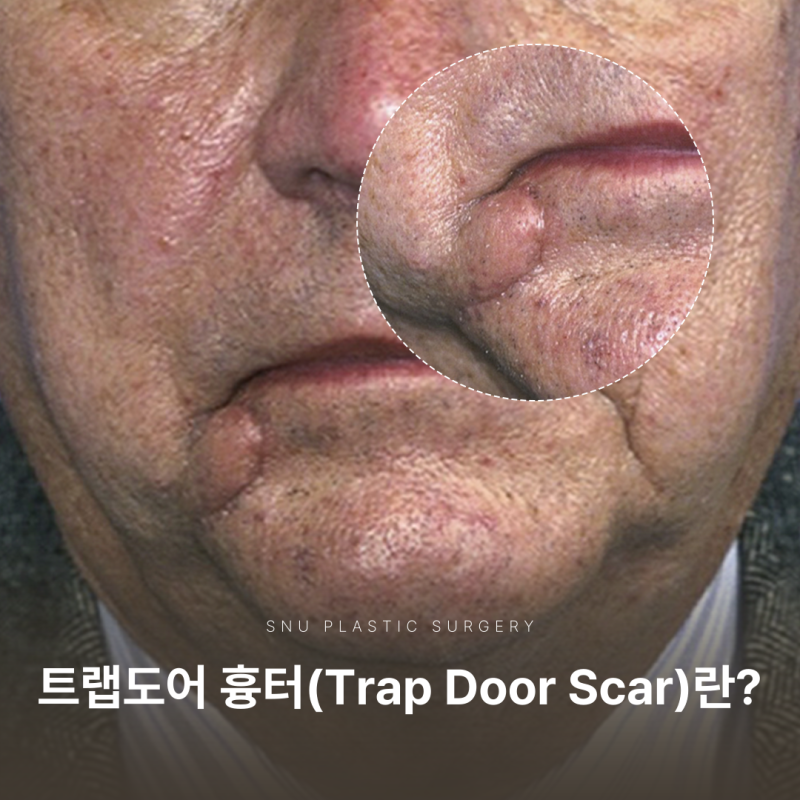
📍 Causes:
Lymphatic and blood circulation disorders at the flap wound edges,
inadequate primary closure, etc.
📍 Appearance:
The scar is prominent,
does not blend with skin creases,
and sometimes involves hyperpigmentation.
Nowadays, with proper initial closure after injury,
and concurrent compression therapy using silicone gel sheets or
laser treatment,
the incidence has significantly decreased.
However, for old scars that are 10, 20 years or older,
many people still have trapdoor scars
due to the limitations of treatment technology at the time.
# Why are Trapdoor Scars Challenging?
Simply excising and suturing the scar
has a high probability of recurrence.
This is due to the imbalance in tension and
contraction between the existing scar tissue and
the surrounding normal skin.
Therefore, for a fundamental solution,
a design that breaks this imbalance is necessary.
# Scar Revision using Z-plasty
An effective method to correct trapdoor scars
is to break down and redistribute the direction and
tension of the scar.
The suitable surgical technique for this is
Z-plasty.
What is Z-plasty?
Z-plasty is a method where the skin is incised in a Z-shape,
and then two triangular skin flaps are
interchanged and sutured.
This method disperses long scars and
realigns the scar parallel to the skin creases (Langer's lines)
to improve aesthetics.
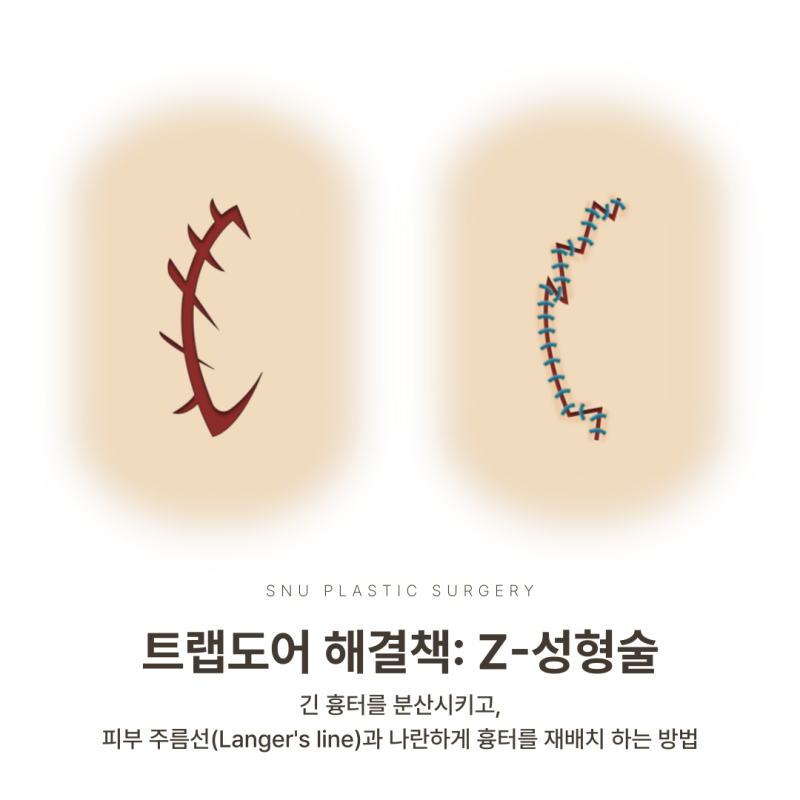
Especially for trapdoor scars, it is more effective to apply
multiple small Z-plasties consecutively (Multiple Z-plasty)
rather than one large Z.
This evenly disperses the contractile force of the scar,
preventing recurrence, and
makes the final scar appear like a natural crease line.
# Key Points of Z-plasty: ‘Experience’ and ‘Design’
Z-plasty may sound simple,
but the results vary depending on ‘where, how, and how many Z-shapes
to draw’.
✅ The absolutely crucial design of the Z-plasty
limb axis
The angle, length, and direction of each Z-plasty arm (axis)
must be accurately understood and designed
in relation to the natural skin creases and
the anatomical structure of the muscles.
Plastic surgeons have a deep understanding and rich experience
in such designs.
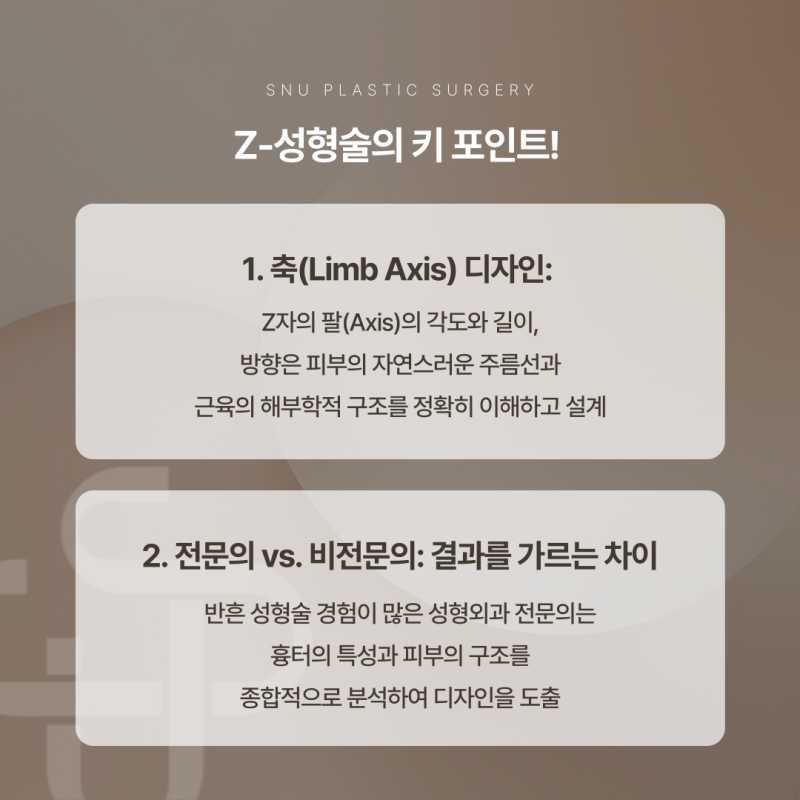
✅ Specialist vs. Non-specialist:
The difference that determines the outcome
A plastic surgeon with extensive experience in scar revision
can comprehensively analyze the characteristics of the scar and the skin structure
to derive a design and achieve highly satisfactory
results through precise suturing.
On the other hand, if performed by a doctor
unfamiliar with this field,
inappropriate axis design can easily lead to
the counterproductive effect of the scar becoming longer.
There is also a risk of worse results than simply excising and suturing the scar.
🪄 Get a professional consultation.
Even a trapdoor scar that had been a concern for 30 years
was improved to a fine line similar to a crease line
through Z-plasty.
The patient was finally able to be freed
from the external stress they had felt for so many years.

A trapdoor scar is not a simple scar but a problem
arising from ‘tissue imbalance’.
Therefore, resolving it requires professional knowledge and
skills to identify and correct the fundamental cause.
For those who are concerned about scars,
we sincerely recommend not giving up and exploring new possibilities
through an accurate diagnosis and treatment consultation with a plastic surgeon
experienced in scar treatment.

※ We hope today's article helps you understand the characteristics of trapdoor scars and
professional treatment methods.
Since the condition and location of scars vary for each individual,
an accurate diagnosis and treatment plan should be established through consultation
with professional medical staff.
Homepage
📌 KakaoTalk Channel (Click the image below to go)