2026-07-21
General Anesthesia vs. Sedation Anesthesia: A Comparison of Anesthesia Methods
This article compares general anesthesia and sedation anesthesia, highlighting their differences, safety aspects, and crucial considerations for patients.

Hello,
This is Cheongdam SNU Plastic Surgery Clinic.
When planning plastic surgery or various procedures,
there's a widespread perception that ‘sedation anesthesia is less burdensome than general anesthesia.’
But what is the reality?
Today, we will compare the differences between these two anesthesia methods and their safety.
What's the Difference Between Anesthesia Methods?
General anesthesia
is a method that blocks consciousness, sensation, movement, and reflex functions.
Patients cannot breathe spontaneously and require the assistance of a ventilator,
maintaining an unconscious state during surgery using potent anesthetics and muscle relaxants.
On the other hand,
sedation anesthesia (conscious sedation)
is a method that induces a deep sleep state in the patient through sedatives.
Patients can breathe spontaneously and may wake up with strong stimuli.
It encompasses various stages, from cases where consciousness is not completely blocked to deep sedation.
General Anesthesia vs. Sedation Anesthesia: Differences in Safety
Many people consider sedation anesthesia
to be safer, but
actual data reveals
different results.
According to one domestic study,
30 out of 39 sedation anesthesia accidents (76.9%)
resulted in death, showing a similar level of risk
to the mortality rate of general anesthesia accidents (82%).
General Anesthesia: Systematic Safety Management

General anesthesia is performed in operating rooms
staffed by anesthesiologists
and specialized nursing personnel.
During surgery, oxygen saturation, heart rate,
blood pressure, etc., are continuously monitored,
and after surgery, patients receive intensive observation
in the recovery room.
The Korean Patient Safety Center emphasizes,
‘After general anesthesia, patients' consciousness and
cardiopulmonary function may be unstable, requiring thorough monitoring.’
In fact, in about 97% of general anesthesia cases,
an anesthesiologist directly manages the patient,
and a system is in place to immediately respond to emergencies
such as airway obstruction or respiratory depression.
Furthermore, tertiary hospitals are equipped with
emergency equipment and monitoring devices such as
ventilators and cardiac defibrillators,
allowing for quick response to critical situations.
Sedation Anesthesia: A Vulnerable Blind Spot
While sedation anesthesia may seem relatively simple,
it carries several risks.
Repeated or excessive administration of sedatives
can lead to respiratory depression or hypotension,
and if not properly managed,
it can result in situations like cardiac arrest.
Most sedation anesthesia accidents occur when the surgeon
is simultaneously performing the surgery and monitoring the patient.
One study found that 36 out of 39 sedation anesthesia accidents (92.3%)
occurred when a non-anesthesiologist directly administered sedatives
without separate monitoring personnel.
When surgery and anesthesia management are performed simultaneously,
concentration is divided, making it easy to miss changes in the patient's condition,
and immediate response becomes difficult in an emergency.
Differences Between International Standards and Domestic Reality
In developed countries like the US, Canada, UK, Europe, and Japan,
safety management guidelines equivalent to general anesthesia
are applied even when performing sedation anesthesia.
Pre-anesthesia examination, intra-anesthesia monitoring,
and post-anesthesia recovery management are strictly controlled.
In the US, the FDA provides guidelines for propofol usage
based on weight and height, and
anesthesia nurses are also permitted to participate
in sedation procedures.
However, in Korea, related regulations
are relatively insufficient.
Under medical law, the obligation for patient explanation and consent before anesthesia
applies only to general anesthesia,
while for sedation anesthesia, it remains a recommendation.
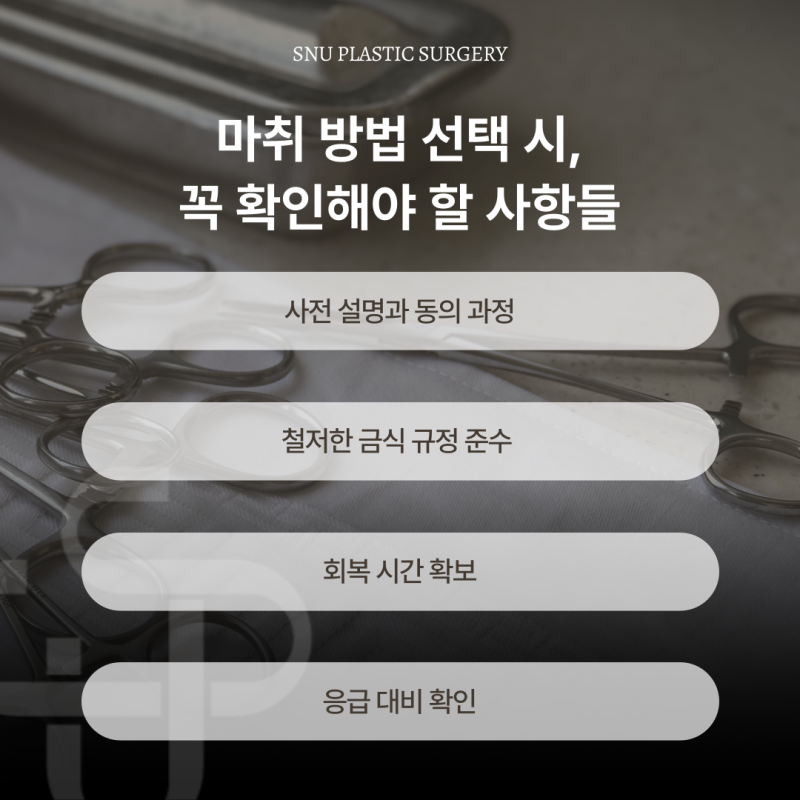
Things to Check When Choosing an Anesthesia Method
When choosing an anesthesia method,
please check the following:
🌟 Pre-explanation and Consent Process
You should receive sufficient explanation about the anesthetic drugs to be used,
expected side effects, and emergency response plans,
and complete a written consent form.
🌟 Adherence to Fasting Regulations
Even for sedation anesthesia, it can be converted to general anesthesia in an emergency,
so strict adherence to pre-surgical fasting regulations is crucial.
🌟 Recovery Management
Recovery time may vary depending on individual differences after anesthesia,
so ensure sufficient observation time and avoid driving on the day of the procedure.
🌟 Emergency Preparedness Facilities
Please check if emergency equipment such as oxygen supply devices and cardiac defibrillators
are available, and if medical staff experienced in anesthesia management
are present.
Anesthesia is a medical procedure that requires
professional management by medical staff.
Whether it's general anesthesia or sedation anesthesia,
understand their respective characteristics and risks,
and undergo the procedure in a facility with adequate safety equipment and experienced
medical staff.
Most importantly, it is crucial to choose the appropriate anesthesia method for you
through sufficient consultation with medical staff and to undergo the procedure in a safe environment.
Please keep in mind that your health and safety should be prioritized.
✔️ Homepage
✔️ KakaoTalk Channel (Click image below to navigate)

Frequently Asked Questions
How do general anesthesia and sedation anesthesia differ?
General anesthesia blocks consciousness, sensation, movement, and reflex functions, requiring the aid of a ventilator. In contrast, sedation anesthesia induces a deep sleep state through sedatives, but spontaneous breathing is possible, and patients may wake up with strong stimuli.
Is sedation anesthesia safer than general anesthesia?
No, not necessarily. According to a domestic study, the mortality rate of sedation anesthesia accidents (76.9%) was similar to that of general anesthesia accidents (82%), indicating a comparable level of risk. Sedation anesthesia also carries risks such as respiratory depression and hypotension.
How is general anesthesia safely managed?
General anesthesia is performed in operating rooms staffed by anesthesiologists and specialized nursing personnel. During surgery, oxygen saturation, heart rate, and blood pressure are continuously monitored, and patients receive intensive observation in the recovery room after surgery. A system is in place to immediately respond to emergencies.
What are the potential risks during sedation anesthesia?
During sedation anesthesia, repeated or excessive administration of sedatives can lead to respiratory depression or hypotension, and if not properly managed, there is a risk of cardiac arrest. The risk of accidents is particularly high when the surgeon simultaneously performs the surgery and monitors the patient.
What should I check when choosing an anesthesia method?
When choosing an anesthesia method, you should receive sufficient explanation about the anesthetic drugs to be used, side effects, and emergency response plans, and provide written consent. Additionally, you should adhere to pre-surgical fasting regulations, ensure adequate recovery management after anesthesia, and confirm that emergency preparedness facilities and experienced medical staff are available.
What are the domestic regulations for sedation anesthesia safety management?
In Korea, regulations related to sedation anesthesia are relatively insufficient compared to developed countries. Under medical law, the obligation for patient explanation and consent before anesthesia applies only to general anesthesia, while for sedation anesthesia, it remains a recommendation.