2026-07-21
The Truth and Illusion of Liquid Lifting: The Misconception of Lifting the Face with Fillers
Explore the reality of 'liquid lifting' with fillers, distinguishing between temporary volume restoration and true structural lifting. Understand its limitations, potential side effects, and effective alternatives for genuine facial rejuvenation.

Hello,
This is SNU Plastic Surgery Clinic in Cheongdam.
Advertisements claiming to ‘lift the face with fillers’ have recently been increasing, especially in China.
Today, we will explore the actual effects and limitations of filler procedures, often referred to as ‘liquid lifting’.
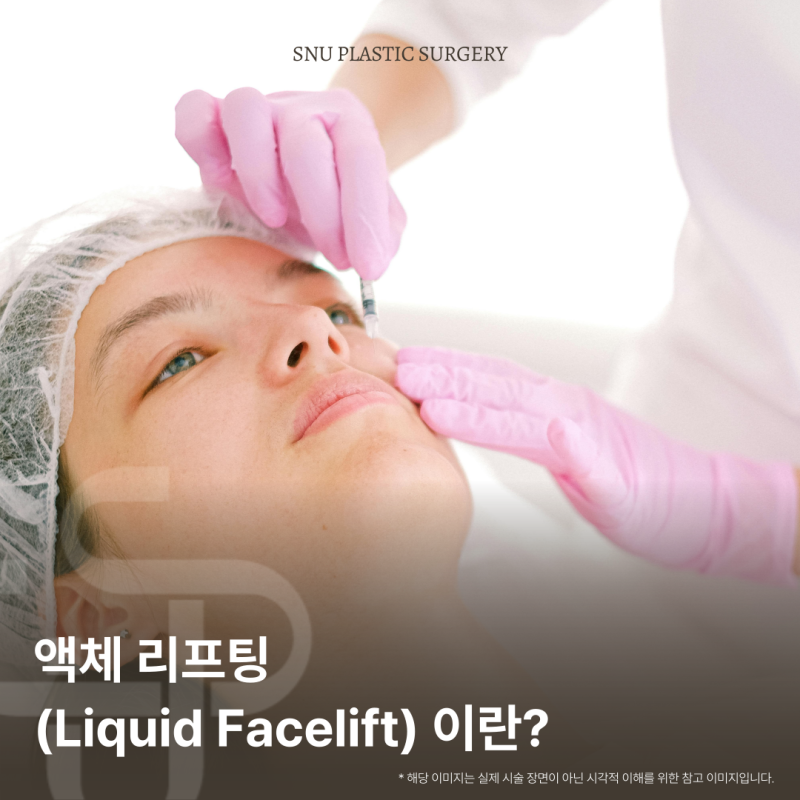
What is Liquid Facelift?
Liquid facelift is a non-surgical procedure that uses fillers to restore volume to the face. Its main principles are as follows:
Volume Restoration Effect
As we age, volume decreases in areas such as under the eyes, cheekbones, and temples. Injecting fillers into these areas can improve one's impression and make a tired-looking face appear more refreshed.
Visual Improvement Effect
When sunken areas are filled, the skin becomes tauter, wrinkles are reduced, and the facial contours appear more defined.
Fillers in the anterior cheekbones can improve mid-face sagging and reduce 'Indian band' wrinkles.
However, this is closer to an optical illusion than actual lifting.
Key Limitations of Filler-Based Procedures
1. Lack of Structural Support
Fillers only add volume to the subcutaneous tissue; they do not actually support sagging muscle layers or the skin itself.
In areas with frequent facial expressions, such as nasolabial folds or around the mouth, fillers can migrate or deform.
Furthermore, instead of lifting sagging skin, they merely create a balloon-like effect, which can make the face appear heavier.
2. Temporary Effects and Cumulative Side Effects
The effects of fillers typically last for about 6 months to 1.5 years, which is much shorter than surgical lifting (5-10 years).
Repeated filler injections can lead to facial asymmetry, excessive volume, and lymphedema.
In particular, over-treatment with under-eye fillers can worsen dark circles and cause a 'balloon effect'.

3. Problem of Excessive Volume Injection (The Misconception that ‘More is More Effective’)
For aegyo-sal (under-eye bags), less than 1cc for both sides combined is appropriate, but some clinics may recommend 2-3cc or more for commercial purposes.
Injecting too much filler into the cheeks can lead to an 'pouty' expression or deformities like a 'prognathic' jaw.
Fillers are ‘volume enhancers’, not ‘lifting tools’.
To lift sagging tissue, structural support through threads or ultrasound devices, or surgical treatment, is necessary.
Liquid Lifting vs. Actual Lifting Effect Comparison

The Realistic Role of Liquid Lifting: An Adjunctive Approach

This does not mean fillers are meaningless.
They can be helpful as an adjunctive role in the following cases:
Early Stages of Aging
For mild volume loss in early 30s, low-molecular-weight HA fillers can improve elasticity.
As Part of Combination Procedures
After fixing the fascia with thread lifting, supplementing cheekbone or perioral volume with fillers can create a synergistic effect.
Micro-lifting
When combined with skin boosters (e.g., Chanel Injection, Rejuran), it helps improve fine elasticity on the skin's surface.
⚠️ Precautions
Always undergo 3D skin analysis and a low-volume test before the procedure.
It is especially advisable to avoid places that recommend ‘a large volume at once’.
Alternatives for True Lifting

🌟 Thread Lifting
PDO or PCL threads are inserted into the deep layers of the skin to physically fix the fascial tissue.
The barbs of the threads adhere to the fascial layer, and the effect lasts for over a year.
🌟 Energy-Based Devices
Ultrasound devices like Ultherapy regenerate collagen in the deep layers of the skin, restoring elasticity within 2-6 months.
🌟 Combined Volume + Lifting
In cases of severe cheek hollowing,
threads and fillers are used together to address both volume replenishment and skin tightening simultaneously.

The claim that fillers alone can lift the face is medical over-promotion.
Liquid lifting is merely a temporary improvement through volume replenishment.
To address sagging subcutaneous tissue and fascial layers, structural realignment is necessary.
✨ Ideal Approach ✨
1st Step
Diagnose aging type (volume loss vs. sagging) with a physical examination
2nd Step
If sagging is the primary concern, prioritize thread lifting and HIFU (Ultherapy) procedures
3rd Step
Afterward, replenish only insufficient volume with a small amount of filler
Ultimately,
‘Liquid’ is an auxiliary material,
‘Lifting’ is a technique.
Do not confuse the two, and seek a method that suits you with a trustworthy medical professional.
✔️ Homepage
✔️ KakaoTalk Channel (Click image below to navigate)



Frequently Asked Questions
What is liquid lifting?
Liquid lifting is a non-surgical procedure that uses fillers to restore volume to the face. It aims to improve one's impression and define facial contours by restoring volume lost in areas such as under the eyes, cheekbones, and temples due to aging.
Can filler procedures lift the face?
While filler procedures can visually make the face appear lifted by adding volume, their effect on structurally supporting and lifting sagging muscle layers or the skin itself is minimal. This is explained as being closer to an optical illusion.
What are the main limitations of filler lifting?
The limitations of filler lifting include a lack of structural support, temporary effects (6 months to 1.5 years), and potential cumulative side effects from repeated procedures, such as facial asymmetry, excessive volume, and lymphedema.
What are the alternatives for true lifting effects besides fillers?
For true lifting, alternatives such as thread lifting or energy-based device procedures like Ultherapy can be considered. Thread lifting physically fixes fascial tissue, while energy devices restore elasticity by regenerating collagen.
What should be noted when undergoing filler procedures?
It is crucial to undergo 3D skin analysis and a low-volume test before the procedure. It is especially advisable to avoid places that recommend ‘a large volume at once’, and to understand that fillers are volume enhancers, not lifting tools.
Can fillers be combined with other lifting procedures?
Yes, it is possible. Combining thread lifting to fix the fascia with fillers to replenish cheekbone or perioral volume can create a synergistic effect. It can also help improve fine elasticity on the skin's surface when combined with skin boosters.