2026-07-21
When Ptosis Surgery Fails and Revision Surgery is Needed: Apgujeong Rodeo Plastic Surgery
As we age, various physical changes occur, especially on the face. Skin loses moisture and elasticity, leading to wrinkles. While many issues can be addressed with non-surgical methods, severe eyelid sagging (ptosis) often requires surgical intervention. This article discusses ptosis surgery and revision surgery options at SNU Plastic Surgery Clinic in Apgujeong Rodeo.

Hello. This is SNU Plastic Surgery Clinic, providing medical care at Apgujeong Rodeo Plastic Surgery.
As we age, various physical changes occur. These changes typically become noticeable from the age of 50, especially on the face.
As people get older, their faces become dehydrated and dry, leading to the formation of wrinkles. Most often, this process begins in localized areas and gradually spreads, slowly settling on the forehead, around the eyes, and in the nasolabial folds.
Simultaneously with the appearance of wrinkles, skin elasticity can also decrease. However, this usually doesn't happen all at once; rather, skin elasticity gradually declines after wrinkles begin to form.
Nevertheless, just as there is a term ‘rapid aging’, the speed of aging varies from person to person. Those who experience rapid aging may see wrinkles and loss of elasticity simultaneously. Decreased skin elasticity occurs as the skin lacks proteins like collagen and elastin with age.
Therefore, the period for actively seeking wrinkle improvement begins around the age of 50, and most improvements are made with Botox.
Skin elasticity can also be improved with Botox, as well as with thread lifts, laser lifts, or fillers.
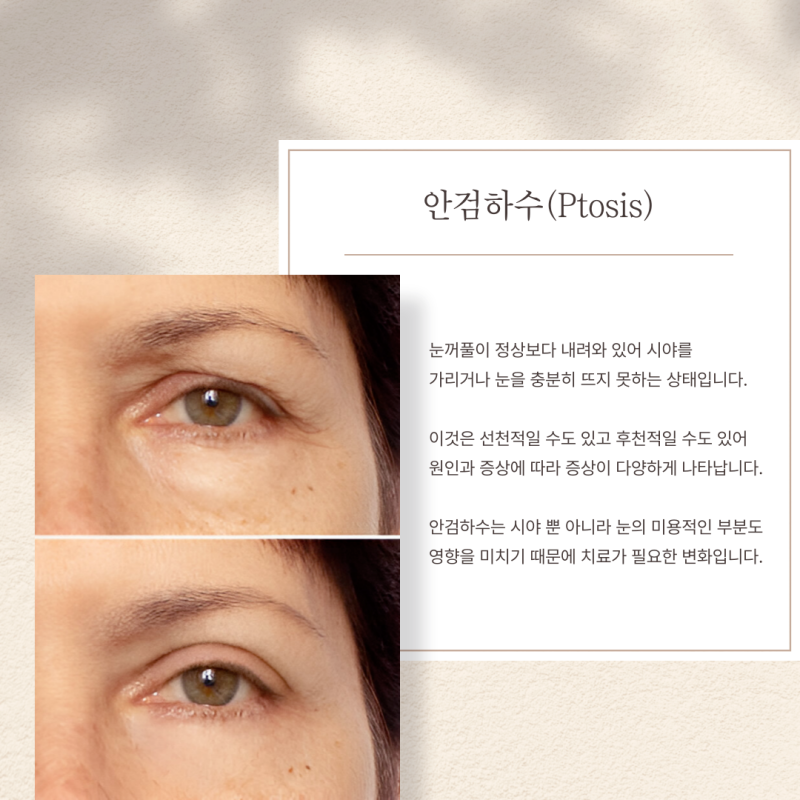
However, if there is a part of the skin where elasticity is difficult to improve even with such excellent modern medical technology, it is the ‘eyes’. Among the eyes, sagging of the eyelids is a symptom that almost all older individuals experience.
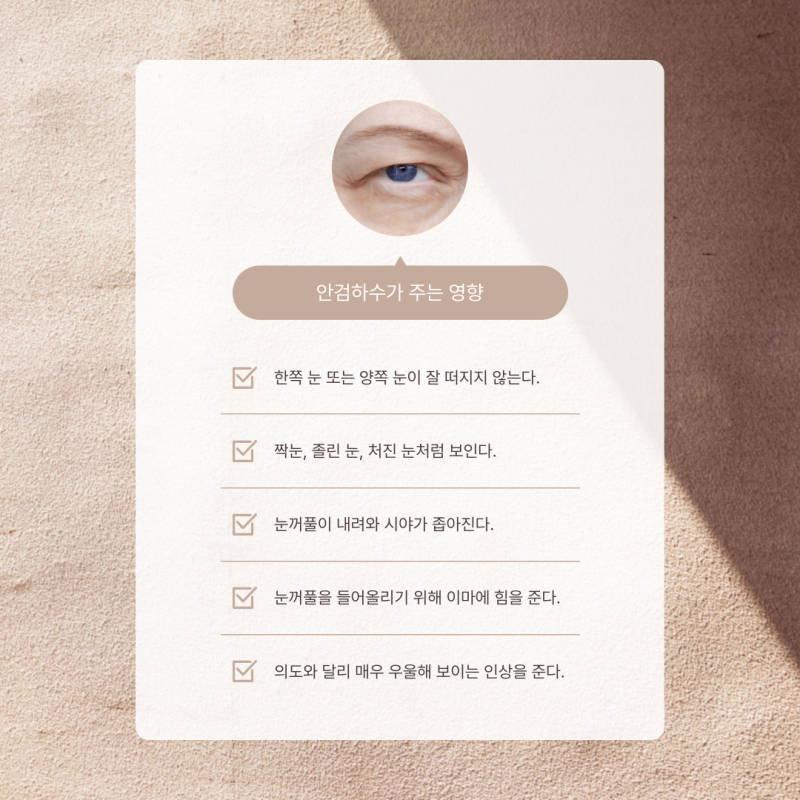
However, some individuals with particularly severe cases may find that their entire eyeball is not visible, appearing only halfway, due to significant drooping of the upper eyelid.
What happens then? The field of vision narrows and appears blurry.
This is difficult to treat with Botox, fillers, thread lifts, or laser lifts because the skin in this area is very thin, making injections or laser lifting procedures very delicate.

Ptosis Surgery
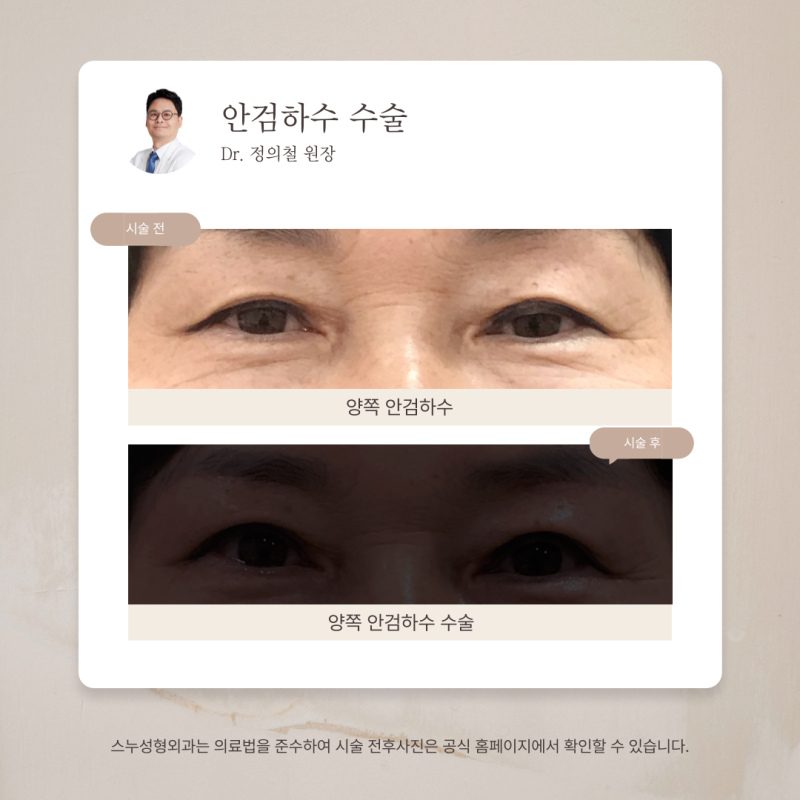
Therefore, the necessary method is a surgical procedure called ‘ptosis surgery’.
The drooping of the upper eyelid is called ptosis. While some places offer non-surgical methods, non-surgical methods are considered semi-permanent. Therefore, they return to their original state over time. Thus, when long-term improvement without problems is needed for several years, surgery is considered.
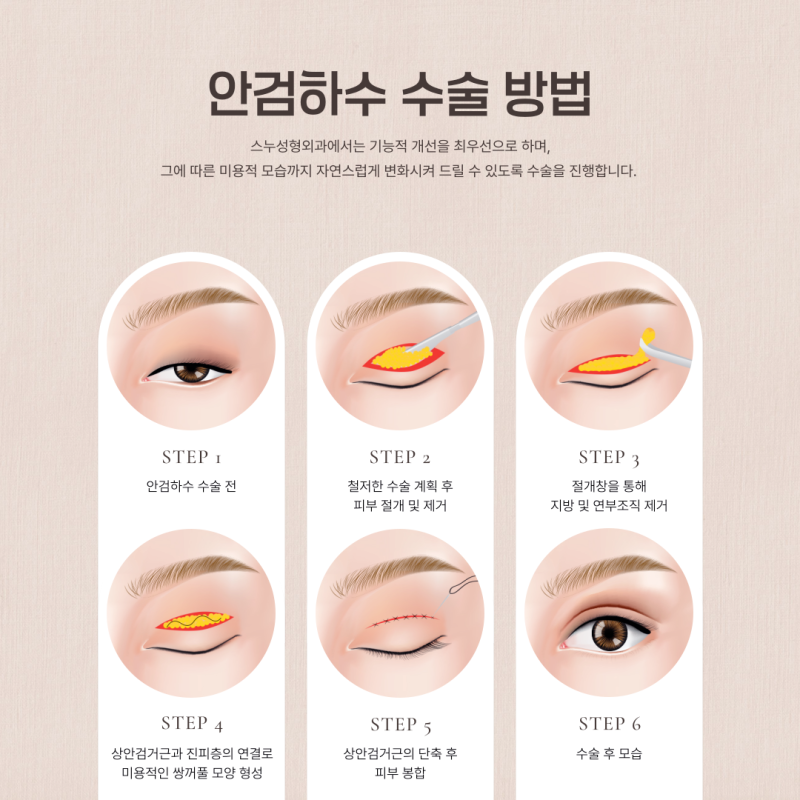
At SNU Plastic Surgery Clinic, which provides medical care at Apgujeong Rodeo Plastic Surgery, the ptosis surgery method involves establishing a design with the client, incising the skin of the problematic area, and then removing some unnecessary fat and soft tissue through the incision.

Afterward, the levator palpebrae superioris muscle is connected to the dermal layer to restore the eyelid to its original, non-sagging position, thereby reforming the double eyelid. Subsequently, the skin is sutured after shortening the levator palpebrae superioris muscle, completing the procedure. This entire process typically takes 1 hour to 1 hour and 30 minutes.
While it might seem like a long time, it signifies that the procedure is handled with great care.
Typical non-surgical procedures take about 15 to 30 minutes, but their short duration means they offer semi-permanent upper eyelid correction. For those seeking to improve structural problems long-term through a surgical method, Director Eui-Chul Jung of SNU Plastic Surgery Clinic is available.
Ptosis Revision Surgery
Furthermore, there are cases where individuals who have already undergone ptosis surgery require revision surgery.
Such cases include unsatisfactory or asymmetrical surgical results, recurrence of eyelid drooping, and in rare cases, when side effects or complications arise, or due to weakening of the levator palpebrae superioris muscle, leading to consideration of ptosis revision surgery.
Clients who require revision surgery after ptosis surgery elsewhere, matching the aforementioned conditions, can receive assistance at SNU Plastic Surgery Clinic, which provides medical care at Apgujeong Rodeo Plastic Surgery.

Director Eui-Chul Jung of our clinic operates a separate ‘Eye Plastic Surgery Clinic’ to provide better results for those seeking cosmetic eye surgery or functional eye surgery.
Additionally, our clinic helps reduce the financial burden for those who need functional eye surgery by applying medical insurance.
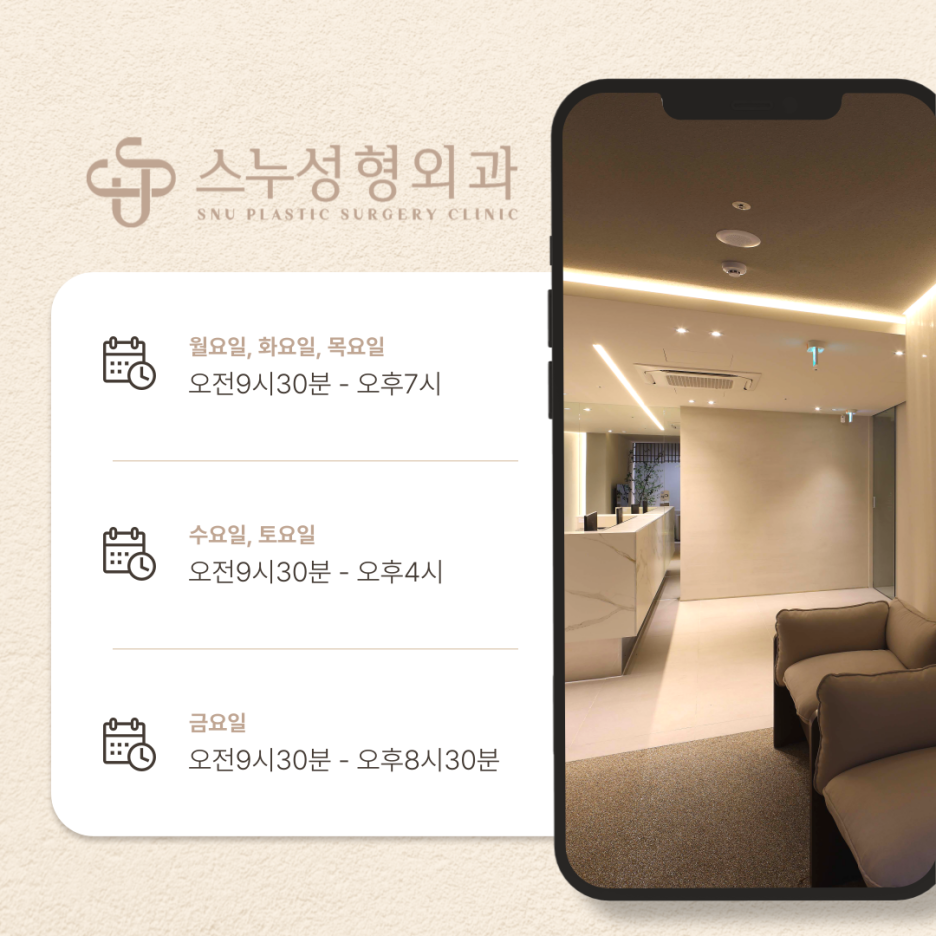
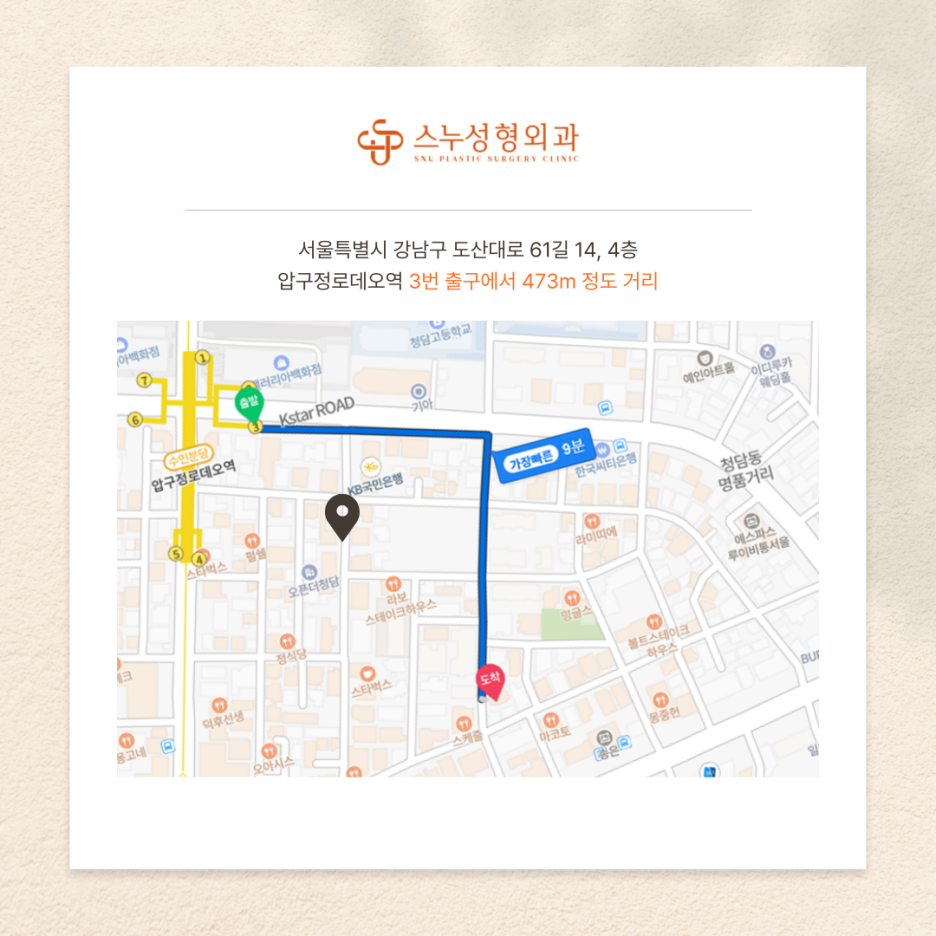
Detailed explanations regarding applicable parts can be found on our official website. For those who wish for faster consultation and a better understanding, you can receive immediate guidance by visiting or calling for a consultation.
















Frequently Asked Questions
In what cases is ptosis surgery necessary?
Yes, ptosis surgery is necessary when severe upper eyelid drooping narrows or blurs vision, or when improvement is difficult with non-surgical methods. It is an effective long-term solution, especially for those with thin eyelid skin where Botox or filler procedures must be approached with caution.
What is the process for ptosis surgery?
Ptosis surgery involves incising the skin of the drooping area, then removing some unnecessary fat and soft tissue. Afterward, the levator palpebrae superioris muscle is connected to the dermal layer to reform the double eyelid, and the skin is sutured after shortening the levator palpebrae superioris muscle.
How long does ptosis surgery take?
Ptosis surgery typically takes an average of 1 hour to 1 hour and 30 minutes. While this is longer than non-surgical methods, it signifies that the procedure is handled with great care to provide long-term structural improvement.
In what cases is ptosis revision surgery considered?
Ptosis revision surgery is considered when surgical results are unsatisfactory or asymmetrical, when eyelid drooping recurs, in rare cases of side effects or complications, or due to weakening of the levator palpebrae superioris muscle, among other reasons.
Is medical insurance applicable for ptosis surgery?
Yes, for cases requiring functional eye surgery, medical insurance can be applied to reduce the financial burden. It is advisable to inquire at the hospital or check the official website for detailed information on eligibility and coverage.