2026-07-21
Blepharospasm Symptoms, Causes, Treatment, and Eyelid Surgery Precautions
If eyelid twitching persists for weeks, it may be blepharospasm, not just fatigue. This condition involves involuntary muscle contractions around the eyes. Early diagnosis and treatment are crucial, especially before eyelid surgery, as surgery can worsen symptoms.


Hello.
This is Dr. J from Cheongdam SNU Plastic Surgery Clinic.
If eyelid twitching, which you might simply attribute to fatigue,
persists for several weeks or more,
it could be a condition called ‘blepharospasm’,
which goes beyond a simple cosmetic issue.
Especially for those planning eyelid surgery,
there is a concern that surgery might actually worsen the symptoms,
so it is advisable to receive an accurate diagnosis and preliminary treatment
before deciding on surgery.
# If it's not just simple eye twitching? Suspected symptoms of ‘blepharospasm’
Blepharospasm is a condition where the muscles around the eyes,
which are involved in opening and closing the eyelids,
continuously contract involuntarily.
Initially, it is easy to confuse it with eye twitching due to simple fatigue,
but if you observe the following characteristics,
caution is needed.
✅ Repeated blinking that cannot be controlled voluntarily,
twitching, or spasms that cause the eyes to squeeze shut.
In such cases, many people often say,
‘My eyelids feel droopy.’
‘I can't open my eyes properly, it feels like ptosis.’
They feel as if eyelid surgery is necessary.
✅ Symptoms worsen with bright light, stress, and fatigue.
✅ As the symptoms gradually progress,
the twitching, which initially occurred occasionally,
increases in frequency and intensity.
✅ It may start in one eye but can spread to both eyes.
✅ It can also be accompanied by dry eyes, foreign body sensation, or stiffness.
# Why does it occur? Main causes of blepharospasm
The exact cause of blepharospasm is not yet fully understood,
but it is presumed to be due to a functional abnormality
in a part of the brain called the basal ganglia.
Various factors, such as those listed below,
can interact to cause or worsen the symptoms.

📍 Fatigue and stress
Physical and mental fatigue are the most common triggers.
📍 Nutritional imbalance
Deficiencies in magnesium, calcium, vitamin B12, etc., affect muscle and nerve function.
📍 Dry eyes
Dryness of the eyes can be a signal that spasms are beginning.
📍 Medication side effects
Long-term use of sleeping pills or tranquilizers can have an impact.
📍 Underlying diseases
Although rare, cerebrovascular abnormalities or brain tumors can be the cause,
so persistent symptoms require a detailed examination.
+ Other causes include excessive caffeine intake and alcohol consumption.
# Realistic Treatment Methods
While a fundamental cure for blepharospasm is difficult,
there are treatment methods that can reduce symptoms
and improve quality of life.
1. Lifestyle Management
Rest, stress reduction, cutting down on caffeine,
and nutritional supplements (magnesium, calcium, etc.)
can alleviate some symptoms.
However, this method alone is often insufficient
to control advanced blepharospasm.

2. Botox Injections (Botulinum Toxin)
Currently, Botox injections are recognized as the primary treatment for blepharospasm.
The principle of Botox injections is to inject a small amount of Botox
into the excessively contracting eyelid muscles,
temporarily blocking the release of neurotransmitters
and thereby suppressing the spasms.
✅ Effects of Botox Injections
The effects begin to appear within 2-3 days after injection,
with significant improvement seen after 1-2 weeks.
A single injection typically reduces symptoms significantly for about 3-4 months.
✅ Advantages of Botox Injections
It is less invasive than surgery and has a more pronounced effect than medication,
making it a standard treatment worldwide.
✅ Side Effects of Botox Injections
Temporary eyelid drooping, double vision, dryness, or bruising may occur,
but these are usually temporary, and the risk can be reduced when performed by an experienced doctor.

3. Surgery (Orbicularis Myectomy)
This is a fundamental surgical procedure performed when Botox cannot control the condition,
or when daily life is severely disrupted to the point of being unable to open the eyes.
It involves preserving only a small portion of the medial orbicularis oculi muscle,
which is where blepharospasm symptoms manifest, and actually removing a large part of it.
While the cosmetic results may not be ideal, functional improvement can be achieved.
⚠️ Pay special attention! Eyelid Plastic Surgery and Blepharospasm
Undergoing cosmetic eyelid surgery (such as upper blepharoplasty)
while experiencing blepharospasm symptoms can be risky.
🚨 Surgery does not address the root cause.
Blepharospasm is a problem stemming from a functional abnormality of the cranial nerves.
Plastic surgery that removes eyelid skin and fat not only fails to treat the root cause,
but the surgery itself often acts as a new stress factor,
worsening the symptoms.
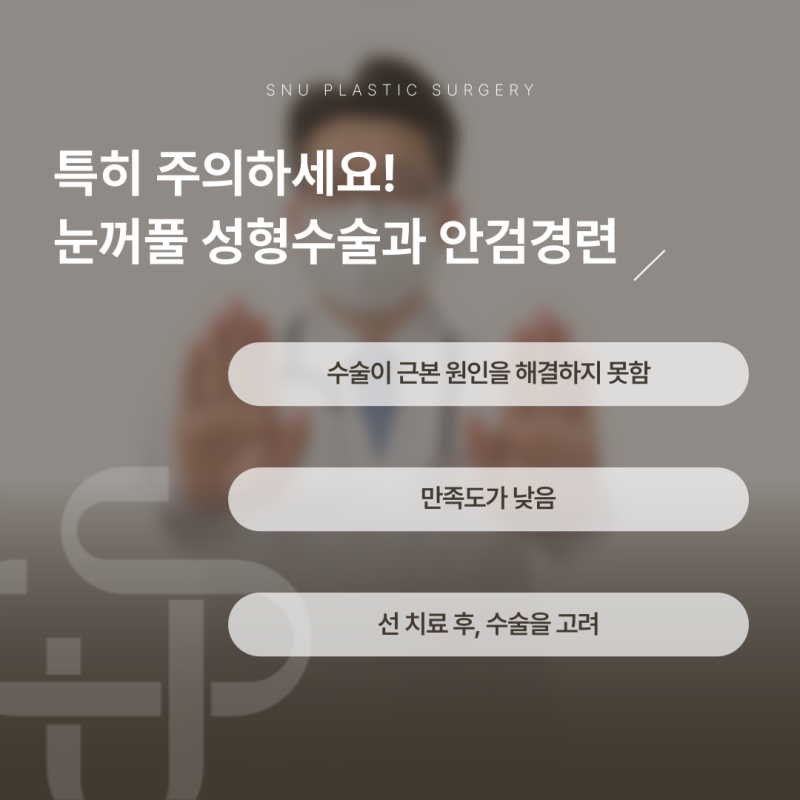
🚨 Satisfaction is extremely low.
Due to persistent eye twitching and spasms after surgery,
satisfaction with the surgical results tends to be low.
On the contrary, there are many reviews stating,
‘My eye twitching got worse after the surgery.’
🚨 Prior treatment followed by surgery is the principle.
It is advisable to avoid eyelid plastic surgery as much as possible
during periods when blepharospasm symptoms are active.
If surgery is necessary,
it should only be considered after blepharospasm has been sufficiently controlled
with Botox injections or similar treatments.
If it's just simple eyelid twitching,
you can rest and observe.
However, if it persists for several weeks or more
and causes discomfort in daily life, it should be taken as a warning sign from your body.
Especially if you are planning eyelid surgery,
these are symptoms that must be checked without further delay.

The eyes are precious sensory organs
and the center of the face, appearing first in communication with others.
Surgery performed while ignoring blepharospasm symptoms
can lead to unpredictable results.
Be sure to receive an accurate diagnosis from a specialist
to establish a treatment plan suitable for you.
* This blog post is based on medical knowledge,
but individual patient conditions may vary,
so consultation with a specialist is strongly recommended
for accurate diagnosis and treatment.
Homepage
📌 KakaoTalk Channel (Click image below to move)