2026-07-21
Advantages and Disadvantages of Donated Rib Cartilage Rhinoplasty
Explore the pros and cons of donated rib cartilage rhinoplasty, focusing on long-term safety, surgical efficiency, and potential risks like absorption and structural limitations.

Advantages and Disadvantages of Donated Rib Cartilage Rhinoplasty

Hello,
This is Dr. J from Cheongdam SNU Plastic Surgery Clinic.
Recently, the use of donated rib cartilage in rhinoplasty,
especially in revision surgery,
has been increasing, but controversy still exists.
Today, we will objectively analyze the advantages and disadvantages of donated rib cartilage,
focusing on long-term safety.
# Advantages and Disadvantages of Donated Rib Cartilage
📍 Advantages
1. Excellent Surgical Efficiency
No need for autologous rib harvesting,
which shortens surgery time
and leaves no scars.
Additionally, there is no chest pain or
movement restriction,
allowing for a quicker return to daily life.
2. Abundant Cartilage Supply
Provides sufficient material for revision surgery patients
who have insufficient autologous cartilage (septum, ear).
3. Controllable Infection Rate
Most immunogenicity is removed through radiation,
and when properly processed,
the infection rate is low.
📍 Disadvantages
1. High Absorption Rate
According to some studies (JAMA, 2017),
the absorption rate of donated rib cartilage is about 30%.
(10 times higher than autologous rib cartilage at 3% ↑)
There is a risk of this occurring, especially in the nasal tip with thin skin.
2. Limited Structural Support
There is a risk of deformation or collapse
in pressure-bearing areas
(columellar support, septal extension graft).
Since it is not living tissue,
vascularization is not possible, and in case of infection,
there is a possibility of complete graft loss.
3. Lack of Long-Term Data
Most studies have a follow-up period of ≤5 years,
so the reliability of long-term results over 10 years or more
is low.
# Neutral Perspective: Donated Rib Cartilage vs. Autologous Rib Cartilage Comparison
📍 Donated Rib Cartilage vs. Autologous Rib Cartilage Comparison (Table)

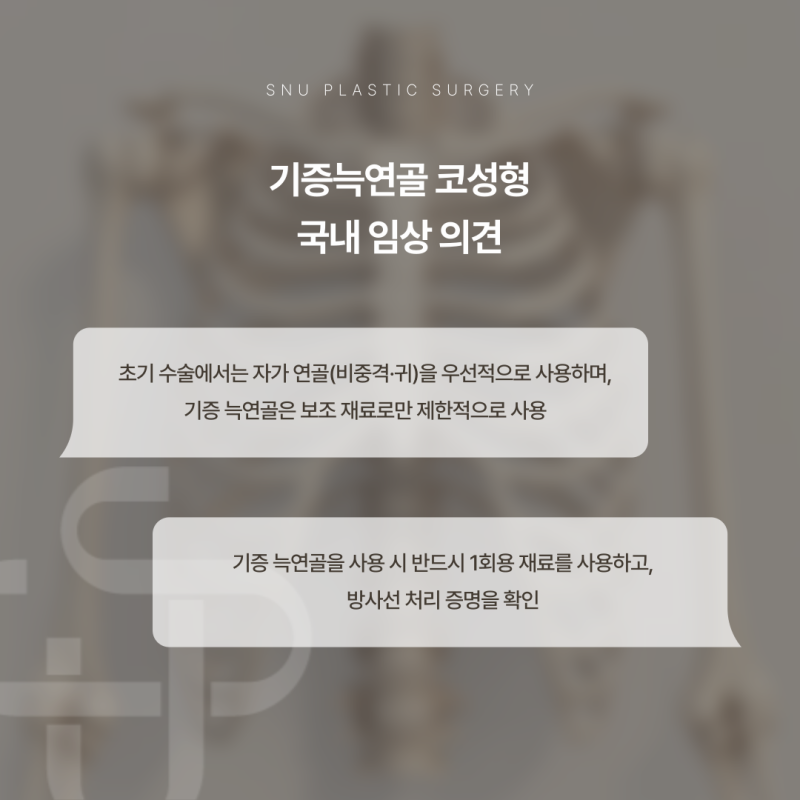
According to domestic clinical opinions,
for initial surgery,
autologous cartilage (septum, ear) is prioritized,
and donated rib cartilage is limited to an auxiliary material.
When using donated rib cartilage,
it is recommended to confirm that it is a single-use material and has been radiation-treated.
# Neutral Selection Guide: When to Consider Donated Rib Cartilage?

✅ Cases where donated rib cartilage is recommended
- When reinforcing the nasal bridge with thick skin:
Less affected by absorption.
- When autologous rib harvesting is not possible:
(Progressive autoimmune disease, history of chest surgery).
- For third or more revision surgeries:
(Temporary alternative when autologous cartilage is depleted).
🚫 Contraindications
- Nasal tip support or septal reinforcement:
High risk of structural failure.
- Thin skin + need for high-strength support:
High possibility of deformation due to absorption.
# Checklist for Successful Surgery

1. Verify Hospital Credibility
If single-use materials are reused after general sterilization,
the risk of infection increases, so
request a radiation treatment certificate for donated rib cartilage (single-use material).
2. Caution with Mixed Surgeries
When mixing autologous tissue + donated rib cartilage,
the infection rate may increase slightly, so
using a single material is recommended if possible.
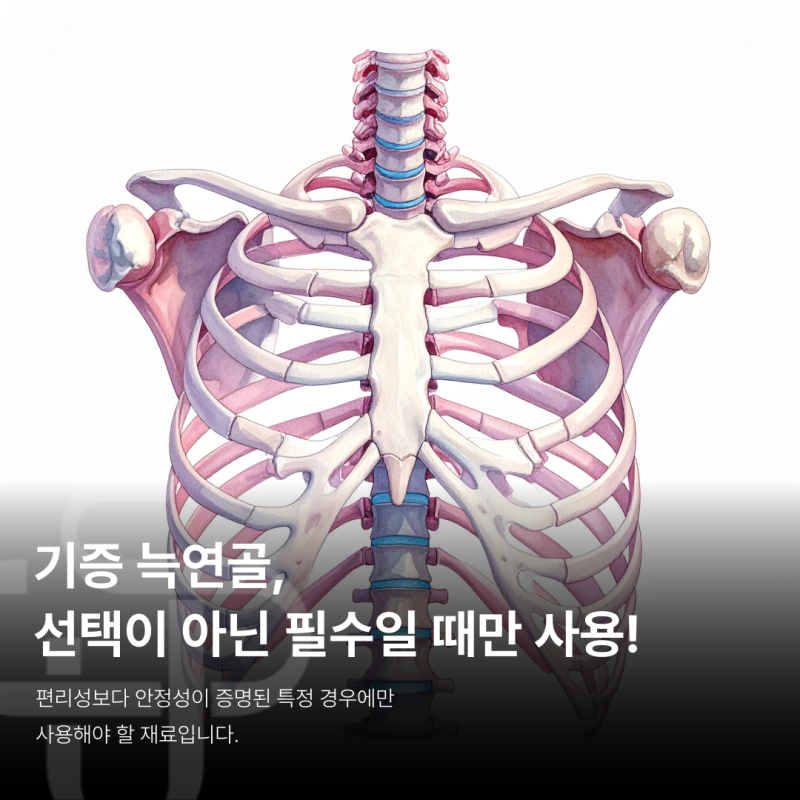
Donated rib cartilage, use only when it is a necessity, not a choice!
The advantages (surgical efficiency, cartilage supply) and
disadvantages (absorption rate, structural limitations) should be
compared with scientific data.
Considering skin condition, nasal structure,
and surgical history, it is recommended to consult
an experienced doctor.
Donated rib cartilage is a strategic material that should be used
only in specific cases where safety is proven, rather than for convenience.
Homepage
📌 KakaoTalk Channel (Click image below to move)



Frequently Asked Questions
What is the biggest advantage of donor rib cartilage rhinoplasty?
The biggest advantage of donor rib cartilage rhinoplasty is its excellent surgical efficiency. It eliminates the need for autologous rib harvesting, which shortens surgery time, avoids scars, and allows for a quicker return to daily life due to no chest pain or movement restrictions. Additionally, it provides an abundant supply of cartilage for revision surgery patients who have insufficient autologous cartilage.
What are the disadvantages of donor rib cartilage rhinoplasty?
The main disadvantages of donor rib cartilage rhinoplasty are its high absorption rate and limited structural support. Some studies show an absorption rate of up to 30%, and there is a risk of deformation or collapse in pressure-bearing areas such as the columella support. The lack of long-term data is also considered a disadvantage.
In what cases is donor rib cartilage recommended?
Donor rib cartilage may be recommended as a temporary alternative in cases where the absorption effect is minimal when reinforcing the nasal bridge of thick skin, when autologous rib harvesting is impossible due to progressive autoimmune disease or a history of chest surgery, or in third or more revision surgeries where autologous cartilage is depleted.
What precautions should be taken when using donor rib cartilage?
When using donor rib cartilage, it is important to verify the hospital's credibility. You should request a radiation treatment certificate for single-use materials, and it is recommended to use a single material if possible, as mixing with autologous tissue can increase infection rates. It is contraindicated for nasal tip support or septal reinforcement due to a high risk of structural failure.
Is donor rib cartilage at a higher risk of infection than autologous rib cartilage?
No, properly processed donor rib cartilage has a low infection rate. This is because radiation irradiation largely removes immunogenicity. However, since it is not living tissue, vascularization is impossible, so there is a possibility of complete graft loss in case of infection.
Is the return to daily life quick after donor rib cartilage rhinoplasty?
Yes, donor rib cartilage rhinoplasty allows for a quicker return to daily life because it eliminates the need for autologous rib harvesting, thus avoiding chest pain and movement restrictions. This reduces the discomfort that can occur with autologous rib cartilage harvesting.